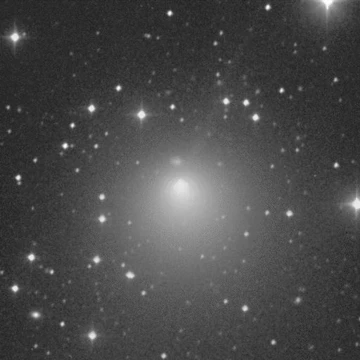
163P/NEAT
Jupiter-family comet discovered in 2004 with precovery images back to 1990.

163P/NEAT is a Jupiter-family comet that orbits the Sun once every 7.3 years. Its nucleus was initially estimated at about 3 kilometers across, but infrared data from the Spitzer Space Telescope, collected between 2006 and 2007, later indicated a radius of roughly 1.39 kilometers. The comet was discovered on 5 November 2004 by the Near-Earth Asteroid Tracking (NEAT) program using the 1.2-meter Samuel Oschin telescope at Palomar Observatory.
The comet's next perihelion will occur on 24 November 2026, when it will be 2.1 astronomical units (AU) from the Sun. At that time, it is expected to reach only magnitude 18, which is too faint for most amateur telescopes. Precovery images were identified by Maik Meyer in December 2004, including two from 1997, two from 1991, and three from 1990. The comet received its permanent numerical designation, 163P, on 18 January 2005.
During its 2005 perihelion passage, the comet brightened to about magnitude 16. Before its 2012 return, it was observed three times on 3 November 2011 by the Palomar Transient Factory (PTF) survey, when it was a 20th-magnitude object about 1.5 AU (220 million kilometers) from the Sun. Around 17 November 2114, the comet will pass roughly 0.117 AU (17.5 million kilometers) from Jupiter.
Quick Facts
- Discovery Ref
- IAUC_8429
- Discoverer
- Near-Earth Asteroid Tracking (644)
- Discovery Site
- Palomar Observatory
- Discovery Date
- 5 November 2004
- Designations
- P/2004 V4
- Orbit Ref
- jpldata · MPC
- Epoch
- 21 November 2025 (JD 2461000.5)
- Observation Arc
- 29.39 years
- Earliest Precovery Date
- 24 October 1990Meyer_2004
- Obs
- 384
- Perihelion
- 2.055 AU
- Aphelion
- 5.465 AU
Facts from the source article.
Lore & Background
Precovery images of 163P/NEAT were found by Maik Meyer in December 2004, consisting of two images from 1997, two from 1991, and three from 1990. The comet received its permanent numerical designation 163P on 18 January 2005. During its 2005 perihelion passage it brightened to an apparent magnitude of about 16. Ahead of its 2012 apparition, the comet was observed three times on 3 November 2011 by the Palomar Transient Factory (PTF) survey while it was a 20th-magnitude object at a distance of 1.5 AU from the Sun.
Reader's Guide
163P/NEAT is notable as a Jupiter-family comet with a well-documented observational history spanning precovery images from 1990 onward. Its nucleus size was precisely measured by the Spitzer Space Telescope between 2006 and 2007, revealing a radius of 1.39 km. The comet will next reach perihelion on 24 November 2026 at 2.1 AU from the Sun, but at an expected magnitude of 18 it will remain beyond the reach of most amateur astronomers. A close approach to Jupiter is predicted around 17 November 2114, when it will pass about 0.117 AU from the planet. The comet's discovery by the NEAT survey and subsequent precovery work by Maik Meyer highlight the value of archival astronomical data.
Did You Know?
- Precovery images of the comet were found by Maik Meyer in December 2004, including images from 1990, 1991, and 1997.
- Infrared observations by the Spitzer Space Telescope between 2006 and 2007 gave a nucleus radius of 1.39 km.
More in Periodic Comets, Part 2 1-24
Spotted an error? Know more?
Reader corrections go straight into our review queue. Suggest an edit · How this site is sourced