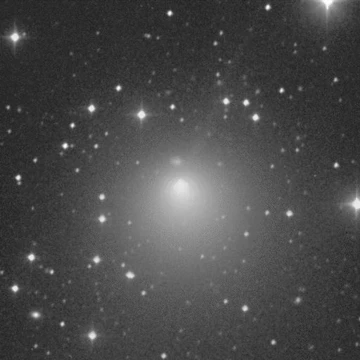
156P/Russell–LINEAR
Jupiter-family comet discovered in 1986 by Kenneth S. Russell.

156P/Russell–LINEAR is a Jupiter-family comet that takes about 6.4 years to orbit the Sun. It was first spotted by Australian astronomer Kenneth S. Russell in September 1986, on a photographic plate taken on 3 September using the U.K. Schmidt Telescope at Siding Spring Observatory. At the time, it had an apparent magnitude of 17. Attempts to find it again on 25 September that year were unsuccessful. The comet was rediscovered on 19 November 1993 by Carolyn S. Shoemaker, using the 0.46-meter Schmidt telescope at Palomar Observatory. It appeared asteroidal and received the provisional designation 1993 WU. During its next perihelion in 2000, the Lincoln Near-Earth Asteroid Research program noted it as an asteroidal object on 31 August and 5 November, giving it the designation 2000 QD181. Further observations from November 2000 to January 2001 led to another designation, 2000 XV43. Timothy B. Spahr later recognized that these objects were the same comet seen in 1986, and it was numbered 156P. The comet passed 0.70 AU from Jupiter in November 1970, which reduced its perihelion distance from 1.73 AU to 1.56 AU. Another close approach to Jupiter occurred in March 2018, at a distance of 0.36 AU, further decreasing the perihelion distance to 1.33 AU and shortening the orbital period from 6.85 years to 6.44 years. At its 2020 perihelion, the comet came within 0.48 AU of Earth on 24 October 2020, brightening to an apparent magnitude of 9.7 by mid-November. On 14 October 2020, when the comet was 1.40 AU from the Sun, its production rates for cyanide and diatomic carbon were measured at (2.85±0.51)×10²⁴ mol/s and (3.44±0.62)×10²⁴ mol/s, respectively—comparable to other Jupiter-family comets. Two strong jets were observed around perihelion and persisted into December, indicating heightened activity after the closest approach. The comet’s nucleus is estimated to be less than 2.0 in radius.
Quick Facts
- Discovery Ref
- IAUC_8118
- Discoverer
- Kenneth S. Russell
- Discovery Site
- Siding Spring Observatory
- Discovery Date
- 3 September 1986
- Mpc Name
- P/1986 R1, P/1993 WU, P/2000 QD · 181, P/2000 XV · 43
- Orbit Ref
- jpldata · MPC
- Epoch
- 20 March 2020 (JD 2458928.5)
- Observation Arc
- 35.57 years
- Obs
- 2,317
- Perihelion
- 1.333 AU
- Aphelion
- 5.591 AU
- Semimajor
- 3.462 AU
Facts from the source article.
Lore & Background
The comet was first detected by Kenneth S. Russell on 3 September 1986 using the U.K. Schmidt Telescope at Siding Spring Observatory, Australia, with an apparent magnitude of 17. Follow-up observations on 25 September 1986 failed to recover it. The comet was rediscovered on 19 November 1993 by Carolyn S. Shoemaker on a plate from the 0.46-m Schmidt telescope at Palomar Observatory, appearing asteroidal and receiving the provisional designation 1993 WU. During the 2000 perihelion, it was observed by Lincoln Near-Earth Asteroid Research on 31 August and 5 November, given the designation 2000 QD181, and later observed as 2000 XV43. Timothy B. Spahr identified these objects as the same comet from 1986, leading to its permanent number 156P. The comet passed 0.70 AU from Jupiter in November 1970, decreasing its perihelion distance from 1.73 AU to 1.56 AU. Another approach to Jupiter in March 2018 at 0.36 AU further reduced its perihelion distance to 1.33 AU and shortened its orbital period from 6.85 years to 6.44 years. During the 2020 perihelion, the comet approached Earth to 0.48 AU on 24 October 2020 and brightened to an apparent magnitude of 9.7 in mid November 2020. Physical characteristics: On 14 October 2020, when the comet was at a heliocentric distance of 1.40 AU, the cyanide production rate was estimated at (2.85±0.51)×10^24 mol/s and diatomic carbon at (3.44±0.62)×10^24 mol/s, comparable to other Jupiter-family comets. Two strong jets were observed during perihelion and persisted until December, indicating increased activity after perihelion. The nucleus radius is estimated to be less than 2.0 ± 0.2 km.
Reader's Guide
156P/Russell–LINEAR is significant as a Jupiter-family comet whose orbital evolution has been directly influenced by close approaches to Jupiter. The article documents two such encounters: one in November 1970 at 0.70 AU, which reduced its perihelion distance from 1.73 AU to 1.56 AU, and another in March 2018 at 0.36 AU, which further decreased its perihelion distance to 1.33 AU and shortened its orbital period from 6.85 years to 6.44 years. These changes illustrate the dynamic nature of short-period comets under gravitational perturbations. The comet's discovery history is also notable: it was initially observed in 1986, then independently rediscovered in 1993 and again in 2000 under different provisional designations before being unified by Timothy B. Spahr. Its physical characterization during the 2020 perihelion, including cyanide and diatomic carbon production rates and the observation of two strong jets, provides data comparable to other Jupiter-family comets. The nucleus size estimate of less than 2.0 ± 0.2 km in radius adds to the inventory of known cometary nuclei.
Did You Know?
- The comet was discovered by Kenneth S. Russell on a plate exposed on 3 September 1986 using the U.K. Schmidt Telescope at Siding Spring Observatory.
- It was independently observed in 1993 as 1993 WU by Carolyn S. Shoemaker and in 2000 as 2000 QD181 and 2000 XV43 before being identified as the same comet by Timothy B. Spahr.
- During the 2020 perihelion, the comet brightened to an apparent magnitude of 9.7 and exhibited two strong jets that persisted until December.
More in Periodic Comets, Part 2 1-24
Spotted an error? Know more?
Reader corrections go straight into our review queue. Suggest an edit · How this site is sourced