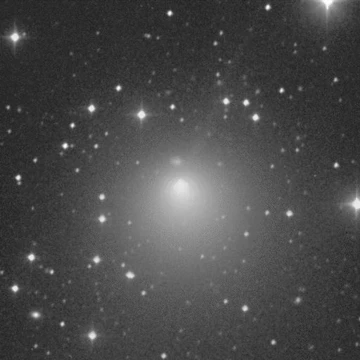
141P/Machholz
A fragmented Jupiter-family comet with multiple observed components.

141P/Machholz (also called 141P/Machholz 2) is a Jupiter-family comet that takes about 5.3 years to orbit the Sun. It was first spotted by Donald Machholz on 13 August 1994 using a 0.25-meter reflector telescope, when it had an apparent magnitude of around 10.
Just days after discovery, observers noticed several condensations near the main body, suggesting the comet had broken apart sometime between 1987 and 1989, during its previous close approach to the Sun. On 18 August 1994, Michael Jäger reported a fragment 48 arcminutes northeast of the main comet. Eventually, fragments were labeled A through E, with A as the primary component. By 5 October 1994, component D had split into two pieces, separated by 7 arcseconds. The fragments formed two groups: A and B in the south, and C, D, and E in the north, all linked by a dust trail. Fragment B faded quickly in November 1994, while fragment D was still seen during the 1999 return.
Zdenek Sekanina calculated that the first breakup occurred in late 1987, about 600 days before the 1989 perihelion, creating fragment B. A second breakup around the 1989 perihelion produced fragments C and D. Fragment D then split again about 600 days after that perihelion, forming fragment E, and split further during the 1994 perihelion.
Fragment A was recovered on 3 August 1999 by Robert H. McNaught at Siding Spring Observatory, appearing as a stellar object; no other fragments were visible then. During the 2015 apparition, a new fragment, H, was found—initially thought to be a new comet but later linked to 141P/Machholz. Another fragment, I, appeared during the 2020–21 apparition. On 3 March 2021, the comet experienced an outburst, brightening by 2.8 magnitudes.
The comet’s orbit is currently stable, in a 9:4 resonance with Jupiter. Meteor streams from 141P/Machholz crossed Earth’s orbit in the 18th and 19th centuries, but no associated showers are predicted now. On 13 December 2036, the comet will pass 0.127 AU (about 19 million km) from Earth. A closer approach is calculated to have occurred on 25 December 1978, when it came within roughly 0.11 AU (16 million km). The comet was last observed by the Vera C. Rubin Observatory in July 2025.
Quick Facts
- Discovery Ref
- IAUC_6053
- Discoverer
- Donald E. Machholz
- Discovery Date
- 13 August 1994
- Mpc Name
- P/1994 P1, P/1999 P1
- Designations
- Machholz 2 · 1994 XXVI, 1994o
- Orbit Ref
- jpldata · MPC
- Epoch
- 30 April 2026 (JD 2461160.5)
- Observation Arc
- 26.61 years
- Obs
- 1,815
- Perihelion
- 0.807 AU
- Aphelion
- 5.305 AU
- Semimajor
- 3.056 AU
Facts from the source article.
Lore & Background
The comet was discovered visually on 13 August 1994 by Donald E. Machholz using a 0.25m reflector telescope, at an estimated apparent magnitude of 10. A few days later, on 18 August 1994, Michael Jäger reported a fragment 48 arcminutes northeast of the comet, and three more fragments were subsequently found. The fragments were labeled A through E, with A being the main component. Component D split further on 5 October 1994, with the two parts 7 arcseconds apart. The fragments formed two groups: A and B in the southern group, and C, D, and E in the north group, all connected by a dust trail. Fragment B faded rapidly in November 1994, while fragment D was still observed during the 1999 apparition.
Zdenek Sekanina estimated that the first breakup occurred in late 1987, about 600 days before the 1989 perihelion, creating fragment B. The next breakup happened around the 1989 perihelion, producing fragments C and D. Fragment D split again 600 days after perihelion, creating fragment E, and split further during the 1994 perihelion. Fragment A was recovered by Robert H. McNaught at Siding Spring Observatory on 3 August 1999 as a stellar object, with no other fragment visible at that time. During the 2015 apparition, fragment H was found, initially thought to be a new comet but later linked to 141P/Machholz. During the 2020-21 apparition, fragment I was discovered. The comet experienced an outburst on 3 March 2021, brightening by 2.8 magnitudes.
Reader's Guide
The significance of 141P/Machholz lies in its well-documented fragmentation history, which provides insight into the processes that break up cometary nuclei. The multiple breakup events, estimated by Zdenek Sekanina to have occurred between 1987 and 1994, produced a series of fragments that were tracked over several apparitions. The comet's orbit is currently stable, lying in a 9:4 orbital resonance with Jupiter. Meteor streams from the comet intersected Earth's orbit during the 18th and 19th centuries, but no associated meteor showers are currently predicted. The comet's legacy includes its recovery in 1999 by Robert H. McNaught, the later discovery of additional fragments in 2015 and 2020-21, and its last observation by the Vera C. Rubin Observatory in July 2025. Future close approaches to Earth include a pass of 0.127 AU on 13 December 2036, and a historically closer approach of about 0.11 AU on 25 December 1978.
Did You Know?
- The comet fragmented multiple times between 1987 and 1994, producing at least five components labeled A through E.
- Fragment D split into two parts on 5 October 1994, with the components 7 arcseconds apart.
- The comet passed about 0.11 AU from Earth on 25 December 1978, closer than its predicted approach of 0.127 AU on 13 December 2036.
More in Periodic Comets, Part 2 1-24
Spotted an error? Know more?
Reader corrections go straight into our review queue. Suggest an edit · How this site is sourced