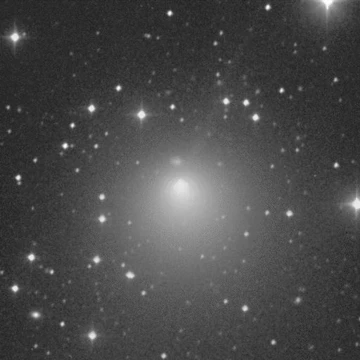
120P/Mueller
Jupiter-family comet discovered by Jean Mueller in 1987.

120P/Mueller (Mueller 1) is a Jupiter-family comet that orbits the Sun once every 8.4 years. It is among 15 comets found by American astronomer Jean Mueller.
Mueller first detected the comet on photographic plates taken at Palomar Observatory on the night of 18 October 1987. She described it as a diffuse object of 17th magnitude in Pisces, with a condensation and a tail stretching about 20–30 arcseconds toward the south-southwest. Follow-up observations through 27 October 1987 allowed Daniel W. E. Green to calculate that the comet was periodic, with an orbital period of roughly 8.21 years at that time. James V. Scotti recovered the comet on 30 July 1995 from Kitt Peak Observatory as P/1995 O1, when it was magnitude 22. It has been observed at every subsequent return. Its most recent perihelion was in May 2021, and it experienced a 1.4-magnitude outburst in August 2021.
The comet’s nucleus was initially estimated in 2004 to be about 3.0 km (1.9 mi) in diameter. Optical photometry in 2007 revised that figure downward to roughly 1.54 km (0.96 mi).
Quick Facts
- Discovery Ref
- IAUC_4472
- Discoverer
- Jean E. Mueller
- Discovery Site
- Palomar Observatory
- Discovery Date
- 18 October 1987
- Mpc Name
- P/1987 U2 / P/1995 O2
- Designations
- Mueller 1 / 1987 XXXI, 1987a1
- Orbit Ref
- jpldata · MPC
- Epoch
- 6 September 2007 (JD 2454349.5)
- Observation Arc
- 34.14 years
- Obs
- 147
- Perihelion
- 2.744 AU
- Aphelion
- 5.527 AU
Facts from the source article.
Lore & Background
Jean Mueller first spotted the comet on photographic plates exposed from the Palomar Observatory on the night of 18 October 1987. She described the new comet as a diffuse 17th-magnitude object within the constellation Pisces. A condensation and an apparent tail about 20–30 arcseconds in length towards the south-southwest was also noted. Orbital calculations using follow-up observations until 27 October 1987 helped Daniel W. E. Green to determine Mueller's comet as periodic, at the time having an orbital period of roughly 8.21 years.
James V. Scotti recovered the comet from the Kitt Peak Observatory on 30 July 1995 as P/1995 O1. It was a 22nd-magnitude object at the time of its recovery. The comet was observed from every subsequent apparition since. It most recently came to perihelion in May 2021 and underwent a 1.4 magnitude outburst in August 2021.
Initial estimates of the size of its nucleus in 2004 was approximately 3.0 km (1.9 mi) in diameter. Optical photometry obtained in 2007 revised this to half of the previous estimate, currently about 1.54 km (0.96 mi) in diameter.
Reader's Guide
120P/Mueller is notable as one of 15 comets discovered by American astronomer Jean Mueller, and as a Jupiter-family comet with an 8.4-year orbit. Its discovery on photographic plates at Palomar Observatory in 1987, and subsequent recovery by James V. Scotti in 1995, demonstrate the observational continuity of periodic comets. The comet has been observed at every apparition since its recovery, allowing for consistent tracking. A significant event occurred in August 2021 when it underwent a 1.4 magnitude outburst shortly after its May 2021 perihelion. The size of its nucleus has been revised downward from an initial 2004 estimate of 3.0 km to about 1.54 km based on 2007 optical photometry, illustrating the refinement of physical measurements over time. Its orbital period was initially calculated as roughly 8.21 years, later updated to 8.4 years.
Did You Know?
- 120P/Mueller was discovered by American astronomer Jean Mueller on 18 October 1987 at Palomar Observatory.
- Its nucleus diameter was revised from 3.0 km in 2004 to about 1.54 km in 2007.
- James V. Scotti recovered the comet in 1995 as a 22nd-magnitude object.
More in Periodic Comets, Part 2 1-24
Spotted an error? Know more?
Reader corrections go straight into our review queue. Suggest an edit · How this site is sourced