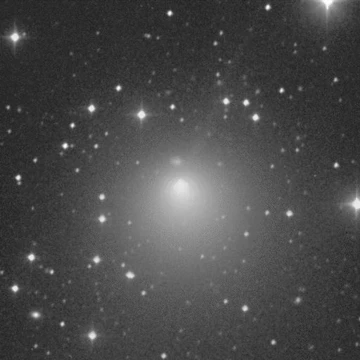
119P/Parker–Hartley
Jupiter-family comet co-discovered in 1989 with a 7.44-year orbit.

119P/Parker–Hartley is a Jupiter-family comet that orbits the Sun once every 7.44 years. It was co-discovered by Quentin A. Parker and Malcolm Hartley, who spotted it on a photographic plate taken with the 1.2-m UK Schmidt Telescope at Siding Spring Observatory on 2 March 1989. At the time, it appeared as a diffuse object of 16th magnitude in the constellation Aries. A precovery image from 11 February 1989 showed a diffuse trail, helping astronomers determine that the comet had already passed perihelion nearly two years earlier.
The comet had actually been detected earlier, in 1986, when it was classified as an asteroid and designated 1986 TF. It was first observed by Poul B. Jensen and Antonin Mrkos between August and October 1986. Jensen noted that on his plates from Brorfelde Observatory, the object appeared slightly diffuse compared to typical minor planets, though it lacked central condensation. Mrkos’s observations from Klet' Observatory initially showed no activity, but a reanalysis of those plates in 2000 revealed weak cometary activity at the time.
Since its discovery, the comet has been recovered at every subsequent apparition—in 1996, 2005, 2014, and 2022—and is expected to return in 2030.
The nucleus of Parker–Hartley, as measured by the Hubble Space Telescope in 2005, is about 3.66 km (2.27 mi) in diameter.
As of 2025, the comet follows a heliocentric orbit with a period of about 7.437 years, a perihelion distance of roughly 2.33 AU (349 million km; 217 million mi), and an inclination of about 7.4 degrees to the ecliptic. Its orbit led Shuichi Nakano to classify it as a quasi-Hilda object. The comet makes several close approaches to Jupiter between 1984 and 2161. Before its discovery, it passed within 0.15 AU (22 million km; 14 million mi) of Jupiter in May 1984. On 16 March 2161, it is predicted to pass about 0.019 AU (2.8 million km; 1.8 million mi) from the planet.
Quick Facts
- Discovery Ref
- IAUC_4749
- Discoverer
- Quentin A. Parker / Malcolm Hartley
- Discovery Site
- Siding Spring Observatory
- Discovery Date
- 2 March 1989
- Designations
- 1987 XXXVI, 1989i
- Orbit Ref
- jpldata · MPC
- Epoch
- 21 November 2025 (JD 2461000.5)
- Observation Arc
- 37.60 years
- Earliest Precovery Date
- 29 September 1986
- Obs
- 3,334
- Perihelion
- 2.332 AU
- Aphelion
- 5.288 AU
Facts from the source article.
Lore & Background
Robert H. McNaught reported the discovery of a comet on a photographic plate taken by Quentin A. Parker and Malcolm Hartley using the Siding Spring Observatory's 1.2-m UK Schmidt Telescope on 2 March 1989. At discovery, the comet was a diffuse 16th-magnitude object in the constellation Aries. Additional observations, including a precovery image from 11 February 1989 showing a diffuse trail, allowed astronomers to determine that Parker–Hartley is a periodic comet that had reached perihelion nearly two years prior. Further investigation revealed the comet was actually discovered as early as 1986, when it was initially identified as an asteroid called 1986 TF, first spotted by Poul B. Jensen and Antonin Mrkos from August to October 1986. Jensen reported that on reanalysis of his 1986 plates from Brorfelde Observatory, it was a slightly diffuse object relative to other minor planets, albeit without central condensation. While initially contradicted by observations made by Antonin Mrkos at the Klet' Observatory where there was no reported activity, reanalysis of that observatory's 1986 photographic plates in 2000 later revealed that the comet did show some weak activity at the time. Observations from the Hubble Space Telescope in 2005 revealed the nucleus is about 3.66 km in diameter. The comet has been recovered on every subsequent apparition since: 1996, 2005, 2014, and 2022.
Reader's Guide
119P/Parker–Hartley holds significance as a Jupiter-family comet with a well-documented observational history spanning from its initial misidentification as an asteroid in 1986 to its confirmed cometary nature. The comet's discovery story illustrates the challenges of distinguishing comets from asteroids, as early plates showed only slight diffuseness and no central condensation, leading to initial disagreement between observers. The eventual reanalysis of archival plates in 2000 confirmed weak cometary activity in 1986, resolving the ambiguity. Its orbit, with a perihelion of 2.33 AU and inclination of 7.4 degrees, led Shuichi Nakano to classify it as a quasi-Hilda object. The comet makes several close approaches to Jupiter between 1984 and 2161, including a past flyby at 0.15 AU in May 1984 and a future close approach of about 0.019 AU on 16 March 2161. Hubble Space Telescope observations in 2005 provided a precise measurement of its nucleus diameter at 3.66 km. The comet's regular returns—recovered in 1996, 2005, 2014, and 2022—and predicted return in 2030 make it a reliably observable object for continued study.
Did You Know?
- The comet was co-discovered by Quentin A. Parker and Malcolm Hartley on a photographic plate taken on 2 March 1989.
- It was initially identified as an asteroid called 1986 TF before its cometary nature was confirmed.
- The nucleus diameter is about 3.66 km, measured by the Hubble Space Telescope in 2005.
- The comet will pass about 0.019 AU from Jupiter on 16 March 2161.
More in Periodic Comets, Part 2 1-24
Spotted an error? Know more?
Reader corrections go straight into our review queue. Suggest an edit · How this site is sourced