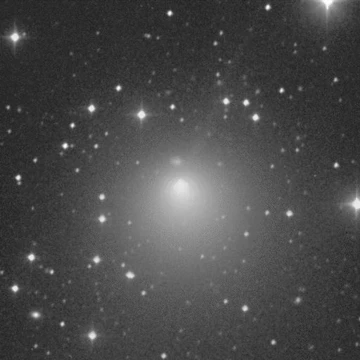
115P/Maury
Jupiter-family comet discovered by Alain J. Maury in 1985.

115P/Maury, called Comet Maury, is a Jupiter-family comet that orbits the Sun once every 8.83 years. It was the first of nine comets found by French astronomer Alain J. Maury.
Maury spotted the comet on photographic plates taken by James M. Schombert on the night of 16 August 1985. At that time, it appeared as a faint, diffuse 16th-magnitude object with a short tail in the constellation Aquarius. Colleagues at Palomar Observatory confirmed its existence through follow-up observations between 20 and 23 August. Further observations through October 1985 showed that the object, designated P/1985 Q1, followed a short-period orbit of about 8.84 years.
On 3 May 1994, James V. Scotti recovered the comet at Kitt Peak Observatory, designating it P/1994 J1. In December 1997, while the comet was inactive at aphelion, the Keck Observatory made direct measurements of its nucleus. The comet was also observed during its 2002 and 2011 apparitions. During its 2020 apparition, the Zwicky Transient Facility detected a small outburst, with the comet brightening by 0.3 magnitudes between 19 and 23 June.
The comet’s orbit is inclined about 11.68 degrees from the ecliptic. Orbital calculations indicate it is currently in a stable 4/3 resonance with Jupiter, where it has remained for the past few thousand years. Before entering this resonance, it was likely a centaur with an orbit beyond Saturn, brought to its present path by multiple encounters with Jupiter.
Based on Keck Observatory observations and assuming a geometric albedo of 0.04, the nucleus has a radius of about 1.11 km (0.69 mi). In July 2011, when the comet was 2.146 AU (321.0 million km) from the Sun, it was found to eject about 6.9×10⁷ kg of material per year, a mass loss rate of 2.1 kg/s (4.6 lb/s). This level of activity is similar to that seen from comets 157P/Tritton and 373P/Rinner, which also produce fairly weak activity each apparition.
Quick Facts
- Discovery Ref
- IAUC_4102
- Discoverer
- Alain J. Maury
- Discovery Site
- Palomar Observatory
- Discovery Date
- 16 August 1985
- Mpc Name
- P/1985 Q1, P/1994 J1
- Orbit Ref
- jpldata · MPC
- Epoch
- 25 February 2023 (JD 2460000.5)
- Observation Arc
- 35.39 years
- Obs
- 1,435
- Perihelion
- 2.059 AU
- Aphelion
- 6.484 AU
- Semimajor
- 4.272 AU
Facts from the source article.
Lore & Background
Alain J. Maury discovered the comet while examining photographic plates taken by James M. Schombert on the night of 16 August 1985. At the time, the comet was a diffuse 16th-magnitude object with a short tail located in the constellation Aquarius. Multiple follow-up observations from colleagues at the Palomar Observatory between 20 and 23 August confirmed its existence. Additional observations up to October 1985 helped astronomers conclude that the orbit of P/1985 Q1 indicated it is a short-period comet with an orbital period of roughly 8.84 years.
On 3 May 1994, James V. Scotti successfully recovered the comet from the Kitt Peak Observatory as P/1994 J1. The comet was later observed at the Keck Observatory while it was inactive at aphelion in December 1997, allowing direct measurements of its nucleus. The comet was also observed during its 2002 and 2011 apparitions. A small apparent outburst was detected from the Zwicky Transient Facility (ZTF) during its 2020 apparition, where the comet temporarily brightened by 0.3 magnitudes between 19 and 23 June.
The nucleus of the comet has a radius of about 1.11 km based on observations by the Keck Observatory, assuming a geometric albedo of 0.04. In July 2011, while it was 2.146 AU from the Sun, it was determined that 115P/Maury ejects a total mass of 6.9×10^7 kg of material per year, indicating a mass loss rate of 2.1 kg/s. This is similar to what was observed from 157P/Tritton and 373P/Rinner, where these comets produce fairly weak activity on each apparition.
Reader's Guide
115P/Maury holds significance as the first comet discovered by Alain J. Maury, who would go on to discover nine comets. Its orbit is currently in a stable 4/3 resonance with Jupiter, where it has remained for the past few thousand years. Before entering this resonance, it is likely that the comet was a centaur with an orbit beyond Saturn, brought down to its present-day orbit by multiple encounters with Jupiter. The comet's nucleus was directly measured at aphelion in December 1997 using the Keck Observatory, yielding a radius of about 1.11 km. Its mass loss rate of 2.1 kg/s, measured in July 2011, is comparable to that of 157P/Tritton and 373P/Rinner, indicating weak activity during each apparition. The 2020 apparition featured a small outburst detected by the Zwicky Transient Facility, where the comet brightened by 0.3 magnitudes over four days.
Did You Know?
- 115P/Maury was discovered on photographic plates taken by James M. Schombert on 16 August 1985.
- The comet's nucleus has a radius of about 1.11 km, measured by the Keck Observatory in December 1997.
- It ejects material at a rate of 2.1 kg/s, similar to comets 157P/Tritton and 373P/Rinner.
- The comet is in a stable 4/3 orbital resonance with Jupiter.
More in Periodic Comets, Part 2 1-24
Spotted an error? Know more?
Reader corrections go straight into our review queue. Suggest an edit · How this site is sourced