Particle And Nuclear Physics
39 entries in the Particle And Nuclear Physics compendium.
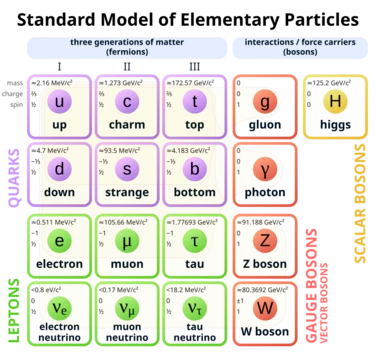
FermionSubatomic particles with half-integer spin obeying Pauli exclusion.Gauge bosonForce-carrying bosons that mediate fundamental interactions.GluonMassless vector boson mediating the strong interaction.HadronComposite subatomic particles made of quarks held by strong force.Higgs bosonElementary particle confirming the Higgs field and mass mechanism.LeptonElementary fermions that do not undergo strong interactions.MesonUnstable hadrons composed of a quark and an antiquark.MuonA heavy electron that reshaped particle physics.NeutrinoAn elusive elementary particle that rarely interacts with matter.NeutronThe neutron is a subatomic particle, symbol n or n⁰, that carries no electric charge and hProtonProton: stable subatomic particle, building block of atomic nuclei.QuarkElementary particles that form protons, neutrons, and all hadrons.Tau (particle)Third charged lepton, heavier analogue of the electron.Subatomic particleParticles smaller than atoms, studied in particle physics.ParticleA particle is a separate part of a larger system.Particle physicsStudy of fundamental particles and forces that constitute matter and radiation.Particle detectorDevice that detects, tracks, and identifies ionizing particles.Nuclear fissionNuclear fission splits atomic nuclei, releasing vast energy.Nuclear fusionNuclear fusion combines nuclei, releasing energy that powers stars and weapons.Nuclear physicsStudy of atomic nuclei and their interactions.NucleosynthesisProcess creating atomic nuclei from pre-existing nucleons and nuclei.Radioactive decayUnstable atomic nuclei lose energy by emitting radiation.IsotopeAtoms of same element differing in neutron number.IonizationProcess by which atoms or molecules gain or lose electrons to become ions.PositronFirst antimatter particle, predicted by Dirac, discovered by Anderson.Large Hadron ColliderWorld's largest and highest-energy particle accelerator.TevatronHighest-energy particle collider until the Large Hadron Collider.Standard ModelTheory of three fundamental forces and elementary particles.Quantum chromodynamicsQuantum field theory of the strong force binding quarks.Quantum electrodynamicsRelativistic quantum field theory of light and matter interaction.Quantum field theoryFramework combining field theory, relativity, and quantum mechanics.Pauli exclusion principleNo two fermions can share identical quantum states.Spin (physics)Intrinsic quantized angular momentum of elementary particles.SuperconductivityPhenomenon of zero resistance and magnetic field expulsion in materials.String theoryTheoretical framework replacing point particles with vibrating strings.SupersymmetryA theoretical symmetry between bosons and fermions, unconfirmed by experiment.Physics beyond the Standard ModelTheoretical developments addressing the Standard Model's deficiencies.ScatteringPhysical processes where radiation or particles deflect from straight paths.Rutherford scattering experimentsExperiments revealing the atomic nucleus via alpha particle scattering.
Browse Particle And Nuclear Physics in the interactive codex →