Neutrino
An elusive elementary particle that rarely interacts with matter.

A neutrino (denoted by the Greek letter ν) is an elementary particle that interacts only via the weak interaction and gravity. It is electrically neutral, and its rest mass is so tiny—far smaller than that of any other known massive elementary particle—that it was long assumed to be zero. The weak force has an extremely short range, and the gravitational force is negligible due to the neutrino’s minuscule mass; neutrinos do not participate in either the electromagnetic or strong interactions. Consequently, they typically pass through ordinary matter without any detectable effect, making them exceptionally challenging to study.
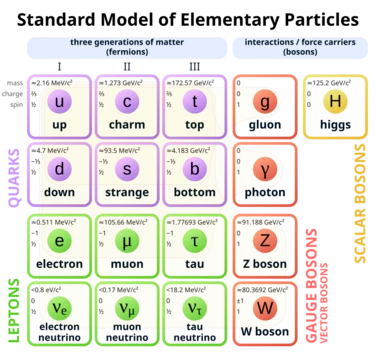
Neutrinos are fermions with a spin of ½. They come in three leptonic flavors—electron neutrino, muon neutrino, and tau neutrino—each associated with its corresponding charged lepton. Although once believed massless, it is now known that there are three distinct, very small neutrino masses (the smallest of which could be zero). These mass states do not correspond uniquely to the flavor states: a neutrino created with a specific flavor is a quantum superposition of all three mass states. As a result, neutrinos oscillate between flavors as they travel; for instance, an electron neutrino produced in beta decay may later interact as a muon or tau neutrino. As of 2026, the absolute mass values remain unknown, but experiments have determined the differences of their squares, an upper limit on their sum, and an upper limit on the electron neutrino mass.
Each neutrino has a corresponding antiparticle, the antineutrino, which also has spin ½ and no electric charge. Antineutrinos are distinguished by opposite lepton number and weak isospin, and by right-handed chirality instead of left-handed. To conserve total lepton number, electron neutrinos appear only with positrons or electron-antineutrinos, while electron antineutrinos appear only with electrons or electron neutrinos.
Neutrinos are produced in various radioactive decays, including beta decay of atomic nuclei or hadrons, natural nuclear reactions in stars, and artificial processes in nuclear reactors, bombs, and particle accelerators. They are also generated in supernovae, during neutron star spin-down, and when cosmic rays or accelerated particle beams strike atoms. The majority of neutrinos detected on Earth come from nuclear reactions in the Sun, yielding a flux of about 65 billion so
- type
- Elementary particle
- interaction
- Weak interaction and gravity
- spin
- 1/2 ħ
- flavors
- Electron neutrino, muon neutrino, tau neutrino
- antiparticle
- Antineutrino
Lore & Background
Neutrinos are elementary particles that interact only through the weak force and gravity. They are electrically neutral and possess an extremely small rest mass, far smaller than any other massive elementary particle, which long led scientists to believe they were massless. Because the weak force has a very short range and gravity is extremely weak at such small masses, neutrinos do not participate in electromagnetic or strong interactions. As a result, they pass through ordinary matter almost entirely unimpeded. Neutrinos come in three leptonic flavors—electron, muon, and tau—each associated with a corresponding charged lepton. Although they were once thought massless, it is now known that three distinct neutrino masses exist, all tiny, but these masses do not correspond uniquely to the flavors; a neutrino created with a specific flavor is a quantum superposition of all three mass states. Consequently, neutrinos oscillate between flavors as they travel. For instance, an electron neutrino produced in beta decay may later interact as a muon or tau neutrino. Neutrinos are fermions with spin ½, and each has an antiparticle called an antineutrino, which differs by having opposite lepton number and weak isospin, and right-handed chirality instead of left-handed. Neutrinos are produced in various radioactive decays, including beta decay of atomic nuclei and hadrons, natural nuclear reactions in stars, and artificial processes in nuclear reactors, bombs, or particle accelerators. They are also generated in supernovae, during neutron star spin-down, and when cosmic rays or accelerated particles strike atoms. The majority of neutrinos detected on Earth come from nuclear reactions in the Sun, with a flux of about 65 billion per square centimeter per second at the surface. Neutrinos can be used for tomography of Earth’s interior.
Reader's Guide
Neutrinos are fundamental to understanding particle physics and the universe. Their extremely weak interactions allow them to pass through vast amounts of matter, making them unique probes of processes otherwise hidden, such as nuclear reactions in the Sun's core and the interior of the Earth. The discovery that neutrinos oscillate between flavors—meaning they have mass—was a major breakthrough, contradicting earlier assumptions and opening new questions about the nature of mass and the Standard Model. Neutrinos are produced in various radioactive decays, including beta decay, nuclear reactions in stars, supernovas, and particle accelerators. The majority of neutrinos detected on Earth come from the Sun, with a flux of about 65 billion per second per square centimeter. Their study continues to challenge and refine our understanding of fundamental physics, with ongoing experiments seeking to determine the exact values of their masses and to explore their role in cosmology.
Did You Know?
- Neutrinos are fermions with spin 1/2 ħ and have no electric charge.
- The name 'neutrino' was jokingly coined by Edoardo Amaldi during a conversation with Enrico Fermi.
- The first detection of a neutrino in nature was in 1965 in a gold mine near Boksburg, South Africa.
- Neutrinos oscillate between different flavors in flight, so an electron neutrino may later interact as a muon or tau neutrino.
Frequently Asked Questions
What is a neutrino?
A neutrino is a fundamental, electrically neutral particle that only feels the weak nuclear force and gravity. It is one of the lightest known elementary particles and carries a spin of 1/2 ħ.
Why are neutrinos so notoriously hard to detect?
Because they interact with ordinary matter almost exclusively through the weak force, they can stream through light-years of lead without a single collision. This near-total transparency means detectors must be enormous and buried deep underground to catch even a handful of events.
What flavors of neutrino exist?
There are three known flavors: the electron neutrino, the muon neutrino, and the tau neutrino, each associated with a corresponding charged lepton. They can oscillate between flavors as they travel, a phenomenon that was key evidence they carry mass.
What is an antineutrino and how does it differ from a neutrino?
An antineutrino is the antiparticle counterpart of a neutrino, commonly produced in nuclear beta decay and in the cores of stars. It shares the same mass and spin as its neutrino partner but carries the opposite lepton number, making it distinguishable in weak-interaction reactions.
More in Particle And Nuclear Physics 1-24
Spotted an error? Know more?
This is a living reference — every entry is fact-audited, and reader corrections feed straight into our audit queue. Suggest an edit · See this site's audit record