String theory
Theoretical framework replacing point particles with vibrating strings.
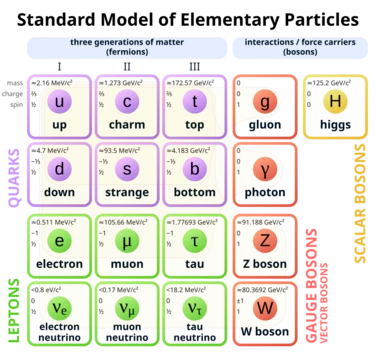
String theory is a theoretical framework in physics that replaces the point-like particles of particle physics with one-dimensional objects called strings. It describes how these strings move through space and interact by vibrations, and on distance scales larger than the string scale, a string acts like a particle with properties determined by its vibrational state. String theory is a candidate for a theory of everything, potentially providing a unified description of gravity and particle physics, though it is not known to what extent it describes the real world.
The theory originated in the late 1960s as an attempt to describe the strong nuclear force, but was later abandoned in favor of quantum chromodynamics. However, physicists realized that the very features that made it unsuitable for nuclear physics made it a promising candidate for a quantum theory of gravity. In string theory, one vibrational state of the string corresponds to the graviton, the hypothetical quantum particle that carries the gravitational force, thus offering a framework for quantum gravity. The earliest version, bosonic string theory, only described particles called bosons. This later evolved into superstring theory, which introduced a connection called supersymmetry between bosons and fermions. Five consistent superstring theories were developed, and in the mid-1990s it was conjectured that these were all different limiting cases of a single eleven-dimensional theory called M-theory. In 1997, a key relationship called the anti-de Sitter/conformal field theory (AdS/CFT) correspondence was discovered, linking string theory to quantum field theory. String theory has contributed to advances in black hole physics, early universe cosmology, nuclear physics, and condensed matter physics, and has stimulated developments in pure mathematics. However, the full theory lacks a satisfactory definition in all circumstances, and it describes an enormous landscape of possible universes, complicating efforts to connect it to real-world particle physics. These issues have led some to question the value of continued research on string theory unification.
- field
- Theoretical physics
- known_for
- Proposing strings as fundamental objects, quantum gravity, candidate for theory of everything
- first studied
- Late 1960s
- related theory
- M-theory
Lore & Background
String theory was first studied in the late 1960s as a theory of the strong nuclear force, before being abandoned in favor of quantum chromodynamics. It was then realized that the properties making it unsuitable for nuclear physics made it a promising candidate for a quantum theory of gravity. The earliest version, bosonic string theory, incorporated only bosons, later developing into superstring theory, which posits supersymmetry between bosons and fermions. Five consistent versions of superstring theory were developed before it was conjectured in the mid-1990s that they were all limiting cases of a single theory in eleven dimensions known as M-theory.
Reader's Guide
String theory originated in the late 1960s as a model for the strong nuclear force before being set aside in favor of quantum chromodynamics. However, the very features that made it unsuitable for nuclear physics suggested it could serve as a quantum theory of gravity, with one vibrational state of the string corresponding to the graviton, the hypothetical quantum carrier of gravitational force. The earliest formulation, bosonic string theory, only described particles called bosons. It later evolved into superstring theory, which introduced a connection called supersymmetry between bosons and fermions. Five consistent superstring theories were developed, and in the mid-1990s it was conjectured that these were all different limits of a single eleven-dimensional theory called M-theory. A major breakthrough came in late 1997 with the discovery of the anti-de Sitter/conformal field theory (AdS/CFT) correspondence, linking string theory to quantum field theory. String theory has advanced mathematical physics, with applications to black hole physics, early universe cosmology, nuclear physics, and condensed matter physics, and has spurred developments in pure mathematics. It remains a candidate for a theory of everything, potentially unifying gravity with particle physics, though it is not yet known how fully it describes the real world or how much freedom the theory allows in its details.
Did You Know?
- String theory was first studied in the late 1960s as a theory of the strong nuclear force.
- One vibrational state of the string corresponds to the graviton, a quantum particle carrying gravitational force.
- Five consistent versions of superstring theory were developed before the conjecture of M-theory in the mid-1990s.
Frequently Asked Questions
Who is String theory?
String theory is a theoretical framework in physics that swaps the standard point-like particles for tiny one-dimensional strings whose different vibrational patterns give rise to the various particles we observe. It emerged in the late 1960s and has since become one of the most ambitious attempts to unify all fundamental forces.
What are String theory's powers/role?
Its core idea is that every particle we know is really just a string buzzing at a particular frequency, and at distances much larger than the string's own size it behaves exactly like the point particle we'd expect. This naturally weaves quantum mechanics and gravity into a single mathematical picture.
How does String theory's story end?
As of now the story is still being written—string theory remains a candidate for a theory of everything, but no experiment has yet confirmed that it describes our actual universe. Whether it uniquely predicts the physics we see is still an open question.
What's String theory's biggest plot twist?
The AdS/CFT correspondence, worked out in the late 1990s, revealed a surprising equivalence between a gravitational theory in one space and a quantum field theory without gravity in a lower-dimensional space. This result became a cornerstone for studying quantum gravity and black-hole physics.
Why is String theory important?
It offers a mathematically consistent way to include gravity alongside the other forces, something no other framework has achieved with equal elegance. Even if it ultimately doesn't describe nature, the tools it has generated continue to reshape how physicists think about space, time, and quantum fields.
More in Particle And Nuclear Physics 1-24
Spotted an error? Know more?
This is a living reference — every entry is fact-audited, and reader corrections feed straight into our audit queue. Suggest an edit · See this site's audit record