Higgs boson
Elementary particle confirming the Higgs field and mass mechanism.

The Higgs boson is an elementary particle within the Standard Model of particle physics, arising from the quantum excitation of the Higgs field. It is a massive scalar boson, possessing zero spin, even parity, and no electric or color charge. The particle is highly unstable, decaying into other particles almost immediately after its creation. The Higgs field itself is a scalar field with two neutral and two electrically charged components, forming a complex doublet of the weak isospin symmetry. Its unique "sombrero potential" causes the field to take a nonzero value everywhere in space, even in a vacuum. This nonzero value breaks the weak isospin symmetry of the electroweak interaction, and through the Higgs mechanism, it provides rest mass to all massive elementary particles in the Standard Model, including the Higgs boson itself. For decades, confirming the existence of the Higgs field was considered the central unresolved problem in particle physics. The particle and field are named after physicist Peter Higgs, who in 1964, alongside five other scientists in three teams, proposed the Higgs mechanism to explain how certain particles acquire mass. At very high energies, all fundamental particles known at the time should be massless, but explaining how some gain mass at lower energies had proven extremely difficult. If this mechanism were correct, a scalar boson with specific properties should exist, which could be used to test the theory. After a 40-year search, a subatomic particle matching these expected properties was discovered in 2012 by the ATLAS and CMS experiments at the Large Hadron Collider at CERN. This discovery was subsequently confirmed, and the theoretical predictions were awarded the Nobel Prize in Physics in 2013. The Higgs boson has been popularly called the "God particle" after a 1993 book, though this name has been criticized by physicists, including Peter Higgs.
- type
- Elementary particle
- field
- Particle physics
- discovered
- 2012
- discovery facility
- Large Hadron Collider (LHC) at CERN
- discovery experiments
- ATLAS and CMS
- named after
- Physicist Peter Higgs
- key property
- Gives mass to massive elementary particles via the Higgs mechanism
Quick Facts
- Composition
- Elementary particle
- Statistics
- Bose–Einstein statistics
- Family
- Scalar boson
- Interaction
- Gravity, electroweak
- Antiparticle
- Self
- Theorised
- R. Brout, F. Englert, P. Higgs, G. S. Guralnik, C. R. Hagen, and T. W. B. Kibble (1964)
- Discovered
- Large Hadron Collider (2011–2013)
- Symbol
- Higgs boson
- Mass
- 125.11 · 0.11 ul=GeV/c2
- Mean Lifetime
- 1.56 · e=-22 · u=s / (predicted)1.2 ~ 4.6 · e=-22 · u=s (tentatively measured at 3.2 sigma (1 in 1000) significance)
- Electric Charge
- 0 e
- Spin
- 0 ħ
Facts from the source article.
Lore & Background
The Higgs boson is an elementary particle within the Standard Model, arising from the quantum excitation of the Higgs field. It is a massive scalar boson with zero spin, even parity, no electric charge, and no color charge. The particle is highly unstable, decaying into other particles almost immediately after generation. Its existence was predicted in 1964 by Peter Higgs and five other scientists across three teams, who proposed the Higgs mechanism to explain how particles acquire mass. The Higgs field itself is a scalar field with two neutral and two charged components, forming a complex doublet of weak isospin symmetry. Its "sombrero potential" causes it to take a nonzero value everywhere, breaking the weak isospin symmetry and giving rest mass to all massive elementary particles, including the Higgs boson itself. After a 40-year search, a subatomic particle matching the expected properties was discovered in 2012 by the ATLAS and CMS experiments at the Large Hadron Collider at CERN. The particle was later confirmed as a Higgs boson, leading to the 2013 Nobel Prize in Physics for Higgs and François Englert. The Higgs boson is sometimes called the "God particle," a term criticized by physicists including Peter Higgs.
Reader's Guide
The Higgs boson is significant because its discovery completed the Standard Model of particle physics, confirming the Higgs mechanism that explains how massive elementary particles acquire rest mass. The Higgs field, which permeates all space, breaks electroweak symmetry and gives mass to the W and Z gauge bosons, solving a long-standing problem in gauge-invariant theories. The 2012 discovery at the Large Hadron Collider ended a 40-year search and validated theoretical work from the 1964 PRL symmetry breaking papers. The Higgs boson's properties—zero spin, even parity, no electric or color charge—match predictions, and its existence underpins our understanding of mass generation in the universe.
Did You Know?
- The Higgs boson is very unstable, decaying into other particles almost immediately upon generation.
- The Higgs field has a nonzero value everywhere, including otherwise empty space, due to its 'sombrero potential'.
- The Higgs boson was discovered in 2012 by the ATLAS and CMS experiments at the Large Hadron Collider at CERN.
The Higgs Boson Within the Standard Model's Architecture
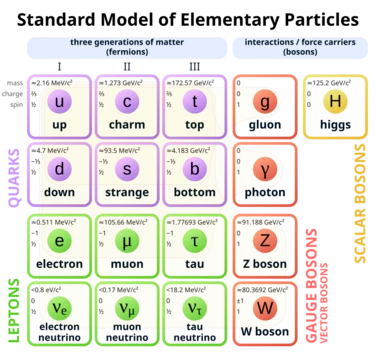
The Standard Model, which achieved broad acceptance in the mid-1970s following experimental verification of quarks, organizes all known elementary particles into a coherent framework of 61 species. It accounts for the three non-gravitational fundamental interactions—strong, weak, and electromagnetic—by assigning each a set of mediating gauge bosons: eight gluons for the strong force, the W-minus, W-plus, and Z bosons for the weak force, and the photon for electromagnetism. Beyond these force carriers, the model includes 24 fundamental fermions, comprising twelve matter particles and their corresponding antiparticles, which together constitute all known matter. The Higgs boson occupies a distinct niche within this architecture: it is a boson whose existence the Standard Model predicted, yet it does not mediate any of the three recognized fundamental interactions. While the model has passed nearly every experimental test to date, most particle physicists regard it as an incomplete picture of nature. Neutrino mass measurements have already revealed the first experimental departures from its predictions, and the reconciliation of gravity with the quantum framework remains an open problem addressed by proposals such as string theory, supersymmetry, and loop quantum gravity.
The Defining Moment: CERN's 2012 Announcement
On 4 July 2012, a team of physicists working with the Large Hadron Collider at CERN made an announcement that would echo through the entire field of particle physics: they had detected a new particle whose behavior closely matched the properties expected of the long-sought Higgs boson. This moment represented the culmination of a process in which a purely theoretical prediction was finally validated through experimental observation. The LHC, one of the most powerful particle accelerators ever constructed, provided the high-energy collision environment necessary to produce and identify such an elusive particle. The discovery confirmed that the Standard Model's roster of 61 elementary particles was, in this crucial respect, complete. Yet the announcement also carried an implicit caveat. The particle behaves similarly to what is expected of the Higgs boson, a phrasing that left room for further investigation. Moreover, the broader scientific community already recognized that the Standard Model, for all its success in passing experimental tests, is likely an incomplete description of nature. The Higgs discovery thus stood simultaneously as a triumph of the existing framework and a reminder that deeper questions—about gravity, about neutrino mass, about the ultimate unification of forces—remained stubbornly unresolved.
Theory First, Experiment Later: The Higgs as a Paradigm
The Higgs boson exemplifies a pattern central to how modern physics advances: a particle is first postulated within a theoretical framework and only later confirmed through experimental observation. Theoretical particle physics, which examines the behavior of fundamental particles in the broader context of cosmology and quantum theory, generated the prediction of the Higgs boson as part of the Standard Model's architecture. Experimental particle physics, by contrast, is concerned with detecting and measuring these particles through radioactive processes and in the controlled environments of accelerators such as the Large Hadron Collider. These two branches are described as closely interrelated, and the Higgs boson's journey from mathematical expectation to laboratory detection illustrates that interdependence vividly. The particle was not stumbled upon in a collision; it was sought because the theory demanded it. This stands in contrast to earlier eras of discovery, when the 1950s and 1960s saw a bewildering variety of new particles appear in high-energy collisions, a period informally dubbed the particle zoo. The Higgs, by contrast, was a specific, predicted member of a small set of fundamental particles, and its eventual detection confirmed that the theoretical structure was on the right track.
From the Particle Zoo to a Unified Framework
For much of the twentieth century, particle physics was dominated by an ever-growing catalog of newly discovered species. Throughout the 1950s and 1960s, collisions of particles accelerated to increasingly high energies revealed a bewildering variety of new entities, a proliferation that physicists informally called the particle zoo. Landmark findings such as the CP violation identified by James Cronin and Val Fitch raised fresh questions about the imbalance between matter and antimatter, adding further complexity to the picture. The formulation of the Standard Model during the 1970s brought order to this chaos. It demonstrated that the large number of observed particles could be explained as combinations of a relatively small set of more fundamental constituents, all framed within the mathematics of quantum field theory. This reclassification is widely regarded as the beginning of modern particle physics. Within this unified picture, the Higgs boson found its designated place as a predicted boson alongside the gauge bosons that mediate the three known fundamental interactions. The model's 61 elementary particles can combine to form the hundreds of composite species discovered since the 1960s, giving the Higgs a role in a framework that tamed the zoo without erasing its richness.
Frequently Asked Questions
What is the Higgs boson?
It is a fundamental particle that appears as a quantum ripple in the Higgs field, serving as the observable evidence that the field is real. In the Standard Model it sits as the last confirmed piece of the elementary-particle roster.
What does the Higgs boson actually do?
By itself it is extremely short-lived, breaking apart into lighter particles almost the instant it is produced. Its true role is to confirm the Higgs field, the mechanism that endows elementary particles such as electrons and quarks with their rest mass.
How and where was the Higgs boson discovered?
In 2012, the ATLAS and CMS detector collaborations at CERN's Large Hadron Collider independently reported its existence. That announcement closed out roughly four decades of experimental searching.
What are the Higgs boson's key physical properties?
It carries no electric charge and no color charge, and it has zero spin, classifying it as a scalar boson. It is also massive and highly unstable, so it never travels far before decaying.
Why does the Higgs boson matter to physics as a whole?
Its detection validated the Higgs field and the mass-giving mechanism that underpin the Standard Model, removing the theory's last major unverified prediction. The particle is named after physicist Peter Higgs, one of the theorists who first proposed the field in the 1960s.
More in Particle And Nuclear Physics 1-24
Spotted an error? Know more?
This is a living reference — every entry is fact-audited, and reader corrections feed straight into our audit queue. Suggest an edit · See this site's audit record