Particle physics
Study of fundamental particles and forces that constitute matter and radiation.

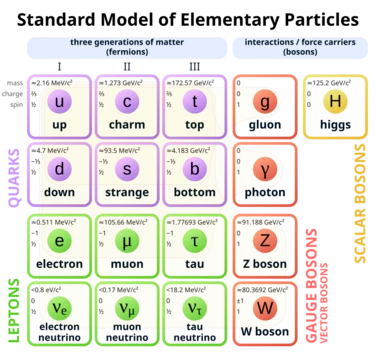
Particle physics, also called high-energy physics, investigates the fundamental particles and forces that make up matter and radiation. It studies elementary particles and their combinations up to the scale of protons and neutrons; the subsequent study of how protons and neutrons combine is the domain of nuclear physics. The foundational theory for this field is the Standard Model, which classifies all known elementary particles into two categories: fermions, which are the particles of matter, and bosons, which carry forces. Fermions are organized into three generations, though ordinary matter consists only of the first generation, comprising up and down quarks (which form protons and neutrons), electrons, and electron neutrinos. The three fundamental interactions mediated by bosons are electromagnetism, the weak interaction, and the strong interaction. Quarks combine to form hadrons but cannot exist independently; hadrons with an odd number of quarks are baryons, while those with an even number are mesons. The proton and neutron are baryons that constitute most ordinary matter's mass, while mesons are unstable, lasting at most a few hundredths of a microsecond, and appear after collisions of quark-based particles, such as in cosmic rays or particle accelerators. Every particle has a corresponding antiparticle with the same mass but opposite electric charge; for instance, the electron's antiparticle is the positively charged positron. Some particles, like the photon, are their own antiparticle. These elementary particles are excitations of quantum fields that also govern their interactions. The reconciliation of gravity with particle physics remains unsolved, with theories like loop quantum gravity, string theory, and supersymmetry proposed. Experimental particle physics studies these particles in radioactive processes and accelerators like the Large Hadron Collider, while theoretical particle physics examines them in cosmology and quantum theory; the Higgs boson, for example, was predicted theoretically before experimental confirmation. The idea of fundamental particles dates to the 6th century BC, and John Dalton later concluded each element had a unique particle. The early 20th century revealed atoms as composite, with electrons and nuclear fission and fusion discoveries leading to nuclear weapons. Hans Bethe's 1947 calculation of the Lamb shift is credit
- field
- Particle physics / High-energy physics
- key_theory
- Standard Model
- fundamental_particles
- Fermions (matter) and bosons (force carriers)
- known_for
- Explaining fundamental particles and three interactions (electromagnetism, weak, strong)
- unresolved_issue
- Reconciliation of gravity with particle physics
Lore & Background
The idea that all matter is composed of elementary particles dates from at least the 6th century BC. In the 19th century, John Dalton concluded each element was composed of a unique type of particle, called the atom. Later, physicists discovered atoms are conglomerates of smaller particles, such as the electron. Early 20th-century nuclear and quantum physics led to proofs of nuclear fission in 1939 by Lise Meitner and nuclear fusion by Hans Bethe that same year, also leading to nuclear weapons. Bethe's 1947 calculation of the Lamb shift is credited with opening the way to the modern era of particle physics. Throughout the 1950s and 1960s, a bewildering variety of particles was found in high-energy collisions, referred to informally as the particle zoo. Important discoveries such as CP violation by James Cronin and Val Fitch brought new questions to matter-antimatter imbalance. After the formulation of the Standard Model during the 1970s, physicists clarified the origin of the particle zoo, explaining the large number of particles as combinations of a relatively small number of more fundamental particles, framed in quantum field theories.
Reader's Guide
Particle physics is significant because it provides the foundational understanding of all known matter and forces, except gravity. The Standard Model, which gained widespread acceptance in the mid-1970s after experimental confirmation of quarks, describes the strong, weak, and electromagnetic interactions via gauge bosons and contains 24 fundamental fermions (12 particles and their antiparticles). It also predicted the Higgs boson, which was confirmed experimentally on 4 July 2012 at the Large Hadron Collider. The Standard Model currently has 61 elementary particles and agrees with almost all experimental tests, though most particle physicists believe it is incomplete. Measurements of neutrino mass have provided the first experimental deviations from the Standard Model, as neutrinos do not have mass in it. The field continues to explore unresolved questions, such as the reconciliation of gravity with particle physics, through theories like loop quantum gravity, string theory, and supersymmetry. Experimental particle physics studies particles in radioactive processes and accelerators like the Large Hadron Collider, while theoretical particle physics studies them in the context of cosmology and quantum theory.
Did You Know?
- Ordinary matter is made only from the first fermion generation: up and down quarks, electrons, and electron neutrinos.
- Hadrons containing an odd number of quarks are called baryons; those with an even number are called mesons.
- The antiparticle of the electron is the positron, which has the same mass but opposite electric charge.
- The Higgs boson gives mass to the W and Z bosons via the Higgs mechanism; the gluon and photon are massless.
More in Particle And Nuclear Physics 1-24
Spotted an error? Know more?
This is a living reference — every entry is fact-audited, and reader corrections feed straight into our audit queue. Suggest an edit · See this site's audit record