Hadron
Composite subatomic particles made of quarks held by strong force.

Hadrons are composite subatomic particles consisting of two or more quarks bound together by the strong nuclear force. The term comes from the Ancient Greek ἁδρός (hadrós), meaning "stout" or "thick." These particles are similar to molecules, which are held together by the electromagnetic force. The proton and neutron, two types of hadrons, account for most of the mass of ordinary matter; in turn, most of their mass arises from the binding energy of their constituent quarks, a consequence of the strong force.
Hadrons fall into two main categories: baryons, which contain an odd number of quarks (typically three), and mesons, which contain an even number (usually two: one quark and one antiquark). Protons and neutrons—the particles that make up the bulk of an atom's mass—are examples of baryons; pions are an example of a meson. An exotic meson called the Z(4430)−, a tetraquark state, was discovered by the Belle Collaboration in 2007 and confirmed as a resonance by the LHCb collaboration in 2014. Two exotic baryons, the pentaquark states P+c(4380) and P+c(4450), were found by the LHCb collaboration in 2015. Other exotic hadron candidates and color-singlet quark combinations may also exist.
Nearly all free hadrons and antihadrons—those not bound inside an atomic nucleus—are unstable and eventually decay into other particles. The only known possible exception is the free proton, which appears stable or decays over an immense timescale (on the order of 10³⁴ years or more). In contrast, free neutrons are the longest-lived unstable particles, decaying with a half-life of about 611 seconds and a mean lifetime of 879 seconds.
Hadron physics is studied by colliding hadrons—such as protons—with each other or with the nuclei of dense, heavy elements like lead or gold, then detecting the debris in the resulting particle showers. A similar process occurs naturally in the upper atmosphere, where cosmic rays collide with rarefied gas particles, producing muons and mesons like pions.
The term "hadron" was introduced by L. B. Okun in a plenary talk at the 1962 International Conference on High Energy Physics at CERN. He proposed it as a concise alternative to "strongly interacting particles," noting that the latter was clumsy and did not easily form an adjective. Okun derived the word from the Greek ἁδρός, meaning "large" or "massive," in contrast to λεπτός ("small," "light").
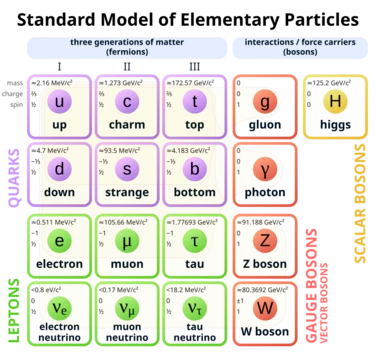
According to the quark model, a hadron's properties are mainly determined by its valence quarks. For instance, a proton consists of two up quarks (each with electric charge +2/3 e) and one down quark (with charge −1/3 e), summing to a total charge of +1 e. Quarks also carry color charge, but hadrons must have zero total color charge due to color confinement; they must be "colorless" or "white." This is achieved either by pairing a quark of one color with an antiquark of the corresponding anticolor (forming a meson) or by combining three quarks of different colors (forming a baryon).
Inside hadrons, massless virtual gluons are the most numerous particles and contribute the majority of the hadron's mass, except for heavy charm and bottom quarks (the top quark decays before it can bind into a hadron). The strong-force gluons binding the quarks have enough energy to create resonances containing massive quarks. As a result, short-lived pairs of virtual quarks and antiquarks constantly form and vanish within a hadron. Since these virtual quarks are not stable wave packets but irregular, transient phenomena, it is meaningless to ask which quark is real and which is virtual; only a small excess of quarks over antiquarks is apparent from outside. Thus, when a hadron is said to consist of two or three quarks, this refers to that constant excess.
Like all subatomic particles, hadrons are assigned quantum numbers based on representations of the Poincaré group: JPC (m), where J is spin, P is intrinsic parity, C is charge conjugation, and m is mass. A hadron's mass has little to do with its valence quarks' masses; instead, due to mass–energy equivalence, most of the mass comes from the energy of the strong interaction. Hadrons can also carry flavor quantum numbers like isospin (G-parity) and strangeness. All quarks have an additive, conserved quantum number called baryon number (B), which is +1/3 for quarks and −1/3 for antiquarks. Consequently, baryons (made of three, five, or another odd number of quarks) have B = 1, while mesons have B = 0.
- field
- Particle physics
- known_for
- Composite particles made of quarks, including protons and neutrons
- classification
- Baryons (odd number of quarks) and mesons (even number of quarks)
- etymology
- From Ancient Greek ἁδρός (hadrós) 'stout, thick'; term introduced by L. B. Okun in 1962
Lore & Background
The term 'hadron' was introduced by L. B. Okun in a plenary talk at the 1962 International Conference on High Energy Physics at CERN. He proposed the name to replace the clumsy phrase 'strongly interacting particles', deriving it from the Greek ἁδρός meaning 'large' or 'massive', in contrast to λεπτός meaning 'small' or 'light'. Hadrons are categorized into two broad families: baryons, made of an odd number of quarks (usually three), and mesons, made of an even number of quarks (usually two: one quark and one antiquark). Protons and neutrons are examples of baryons; pions are an example of a meson. Almost all free hadrons and antihadrons are believed to be unstable and eventually decay, with the only known possible exception being free protons, which appear stable or take immense amounts of time to decay. Hadron physics is studied by colliding hadrons and detecting the debris in particle showers, a process that also occurs naturally in the upper atmosphere from cosmic ray collisions.
Reader's Guide
Hadrons are fundamental to understanding the structure of ordinary matter, as protons and neutrons—the building blocks of atomic nuclei—are hadrons. Their study reveals the nature of the strong nuclear force, which binds quarks together via massless virtual gluons. The mass of hadrons comes primarily from the energy of the strong interaction rather than the mass of their constituent quarks, illustrating mass–energy equivalence. The discovery of exotic hadrons like tetraquarks and pentaquarks has expanded the quark model and continues to test quantum chromodynamics. Hadrons also exhibit properties such as color confinement, requiring them to be colorless, and asymptotic freedom, where the strong interaction weakens at high energies. Their decays and resonances provide insights into particle physics, and the stability of the proton remains a key question in physics.
Did You Know?
- The term 'hadron' was introduced by L. B. Okun in 1962 at CERN.
- Most of the mass of ordinary matter comes from two hadrons: the proton and the neutron.
A Name Forged at CERN
In 1962, at the International Conference on High Energy Physics held at CERN, physicist L. B. Okun stood before the assembled community and introduced a word that would become one of the most fundamental labels in particle physics. He was delivering a plenary talk on weak interactions, yet kept needing to refer to particles governed by the strong nuclear force. The existing phrase "strongly interacting particles" was, in his own assessment, clumsy and resisted the formation of a usable adjective. The workaround "non-leptonic" was imprecise, since it could equally describe photonic processes. Okun proposed "hadron," drawing on the Ancient Greek ἁδρός, meaning "stout," "thick," or "massive," deliberately set against λεπτός, which connotes "small" and "light." He declared that decays involving these particles would be termed "hadronic," and he expressed the hope that the terminology would prove convenient. The name stuck, and it became the standard umbrella term for every composite subatomic particle bound by the strong force.
Two Families and Their Exotic Cousins
Hadrons divide into two principal families based on their quark count. Baryons contain an odd number of quarks—most commonly three—and include the proton and neutron, which together supply the bulk of an atom's mass. Mesons, by contrast, carry an even number, typically a quark-antiquark pair, with the pion serving as the classic example. The requirement that every hadron be color-neutral, a consequence of color confinement, dictates the allowed arrangements: a meson pairs one color with its corresponding anticolor, while a baryon assembles three quarks of three distinct colors. Yet the quark model has proven more flexible than its simplest picture. In 2007 the Belle Collaboration identified a tetraquark state, the Z(4430)−, an exotic meson, which the LHCb collaboration later confirmed as a genuine resonance in 2014. Two years later, LHCb reported two pentaquark states, P+c(4380) and P+c(4450), exotic baryons built from five quarks. Several additional exotic candidates and other color-singlet combinations continue to be explored, hinting that the hadron zoo is far from fully catalogued.
Where the Mass Truly Lives
A common misconception is that a hadron's mass simply adds up from the masses of its constituent quarks. In reality, the valence quarks contribute only a small fraction of the total. The overwhelming majority of particles inside a hadron are massless virtual gluons, and it is the energy of the strong-force field binding the quarks that accounts for most of the particle's mass, in accordance with mass–energy equivalence. This is why the proton and neutron, which together supply most of the mass of ordinary matter, are so much heavier than the sum of their quark masses would suggest. Inside the hadron, short-lived virtual quark-antiquark pairs are constantly popping into existence and annihilating again. Because these virtual quarks are transient rather than stable wave packets, it is not physically meaningful to label one quark "real" and another "virtual." When physicists say a proton has two up quarks and one down quark, they are referring to the small net excess of quarks over antiquarks that remains visible from the outside.
Fragile Lives and Fleeting Resonances
With the notable exception of the free proton, hadrons are transient. Nearly every free hadron and antihadron eventually decays into lighter particles. The free neutron, the longest-lived unstable particle known, holds on for a half-life of roughly 611 seconds, with a mean lifetime near 879 seconds, before breaking apart. The proton, by contrast, appears either truly stable or so long-lived that its decay timescale exceeds 10^34 years. Hadrons also possess excited states called resonances; several hundred distinct resonances have been observed experimentally. These excited configurations are extraordinarily short-lived, collapsing via the strong nuclear force in roughly 10^-24 seconds. In the laboratory, physicists probe hadron structure by smashing protons into one another or into the nuclei of heavy elements such as lead or gold, then sifting through the resulting particle showers. Nature runs a similar experiment in the extreme upper atmosphere, where cosmic-ray collisions with sparse gas molecules spawn muons and mesons like pions in a brief, high-energy cascade.
Frequently Asked Questions
What is a Hadron?
A hadron is a composite subatomic particle built from two or more quarks bound together by the strong nuclear force. Think of it as the particle-physics equivalent of a molecule, except the binding agent is the strong force rather than electromagnetism.
What are the two families of Hadrons?
Hadrons split into baryons, which contain an odd number of quarks (such as the three-quark proton and neutron), and mesons, which contain an even number (typically a quark-antiquark pair).
Why are Hadrons important to everyday matter?
The proton and neutron—the two hadrons that make up atomic nuclei—account for nearly all the mass of ordinary matter. In fact, most of even their own mass doesn't come from the quarks themselves but from the binding energy of the strong force holding those quarks together.
Where does the word "Hadron" come from?
The name traces back to the Ancient Greek word ἁδρός (hadrós), meaning "stout" or "thick," a fitting nod to these chunky composite particles.
Who introduced the term "Hadron" and when?
The physicist L. B. Okun coined the term in 1962 to give a single umbrella label to the growing zoo of quark-based particles being discovered at the time.
More in Particle And Nuclear Physics 1-24
Spotted an error? Know more?
This is a living reference — every entry is fact-audited, and reader corrections feed straight into our audit queue. Suggest an edit · See this site's audit record