Subatomic particle
Particles smaller than atoms, studied in particle physics.

In physics, a subatomic particle is any particle that is smaller than an atom. The Standard Model of particle physics divides these particles into two types: composite particles, like protons and neutrons, which are made of smaller constituents, and elementary particles, like electrons, which are not made of anything else. The fields of particle physics and nuclear physics focus on studying these particles and the ways they interact.
Most particles that carry forces—such as photons and gluons—are classified as bosons. These bosons have quanta of energy but lack rest mass and discrete diameters, existing instead as pure energy wavelengths. In contrast, particles that have rest mass and cannot overlap or combine are called fermions. However, the W and Z bosons are exceptions: they are bosons but have relatively large rest masses, around 80 GeV/c² and 90 GeV/c² respectively.
Experiments have shown that light can behave both as a stream of particles (photons) and as a wave, leading to the concept of wave–particle duality. This means quantum-scale particles sometimes act like particles and sometimes like waves, and are occasionally referred to as "wavicles." Another key idea is the uncertainty principle, which states that certain pairs of properties—like a particle’s exact position and momentum—cannot be measured simultaneously with perfect precision.
Within quantum field theory, particle interactions are understood as the creation and annihilation of quanta of fundamental forces, blending particle physics with field theory. Even among particle physicists, there is no single agreed-upon definition of a particle. Professional definitions include: a particle is a collapsed wave function; a particle is an excitation of a quantum field; a particle is an irreducible representation of the Poincaré group; or a particle is simply an observed thing.
**Classification**
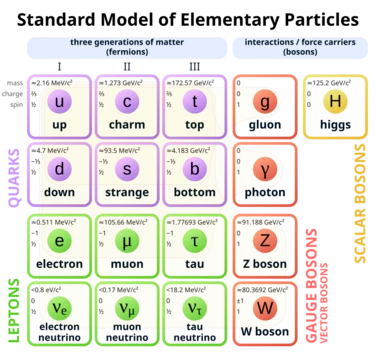
**By composition:** Subatomic particles are either elementary (not made of other particles) or composite (made of multiple elementary particles bound together). The elementary particles of the Standard Model include six flavors of quarks (up, down, charm, strange, top, bottom), six types of leptons (electron, electron neutrino, muon, muon neutrino, tau, tau neutrino), twelve gauge bosons (the photon, three W and Z bosons, and eight gluons), and the Higgs boson. All of these have been experimentally discovered, with the top quark (1995), tau neutrino (2000), and Higgs boson (2012) being the most recent. Various extensions of the Standard Model predict an elementary graviton and other particles, but none have been found as of 2026.
**Hadrons:** The term "hadron" comes from Greek and was introduced in 1962 by Lev Okun. Nearly all composite particles contain multiple quarks (or antiquarks) bound by gluons, though a few exceptions (like positronium and muonium) have no quarks. Particles containing few (up to five) quarks (including antiquarks) are called hadrons. Due to color confinement, quarks never appear alone but always within hadrons. Hadrons are divided by quark count: baryons contain an odd number of quarks (almost always three), with protons and neutrons (the nucleons) being the best known; mesons contain an even number (almost always two—one quark and one antiquark), with pions and kaons as the best known. Except for protons and neutrons, all hadrons are unstable and decay within microseconds or less. A proton consists of two up quarks and one down quark; a neutron consists of two down quarks and one up quark. These commonly bind into atomic nuclei—for example, a helium-4 nucleus has two protons and two neutrons. Most hadrons do not survive long enough to form nucleus-like composites; those that do (other than protons and neutrons) create exotic nuclei.
**By statistics:** Any subatomic particle obeying quantum mechanics in three-dimensional space can be either a boson (integer spin) or a fermion (odd half-integer spin). In the Standard Model, all elementary fermions have spin 1/2 and are divided into quarks (which carry color charge and feel the strong force) and leptons (which do not). Elementary bosons include the gauge bosons (photon, W and Z, gluons) with spin 1, while the Higgs boson has spin 0. The hypothetical graviton would have spin 2 but is not part of the Standard Model. Some extensions, like supersymmetry, predict additional elementary particles with spin 3/2, but none have been discovered as of 2023. Due to spin rules for composite particles, baryons (three quarks) have spin 1/2 or 3/2 and are fermions; mesons (two quarks) have integer spin 0 or 1 and are bosons.
**By mass:** In special relativity, a particle’s rest energy equals its mass times the speed of light squared (E = mc²), so mass can be expressed in terms of energy and vice versa. If a particle has a rest frame, it has positive rest mass and is called massive. All composite particles are massive. Baryons (meaning "heavy") tend to have greater mass than mesons (meaning "intermediate"), which in turn tend to be heavier than leptons (meaning "lightweight"), though the heaviest lepton (the tau) is heavier than the two lightest baryons (nucleons). Any particle with an electric charge is necessarily massive. The terms baryons, mesons, and leptons were originally defined in the 1950s.
- field
- Particle physics, nuclear physics
- known_for
- Being smaller than atoms; classified as composite or elementary; subject to wave–particle duality and the uncertainty principle
Lore & Background
Subatomic particles are categorized as either composite, such as protons and neutrons, which are built from smaller constituents, or elementary, such as electrons, which are not composed of other particles. According to the Standard Model, the known elementary particles include six flavors of quarks (up, down, charm, strange, top, bottom), six types of leptons (electron, electron neutrino, muon, muon neutrino, tau, tau neutrino), twelve gauge bosons (the photon, three W and Z bosons, and eight gluons), and the Higgs boson. Most force-carrying particles like photons and gluons are bosons, lacking rest mass and discrete diameters, while particles with rest mass that cannot overlap are fermions; the W and Z bosons are exceptions with substantial rest masses. Composite particles containing quarks bound by gluons are called hadrons, which include baryons (odd number of quarks, typically three, such as the proton and neutron) and mesons (even number, typically two). The proton consists of two up quarks and one down quark, while the neutron has two down quarks and one up quark. All hadrons except the proton and neutron are unstable, decaying within microseconds. Particles also obey wave–particle duality, behaving as both waves and particles, and the uncertainty principle prevents the simultaneous exact measurement of certain paired properties like position and momentum. In quantum field theory, particle interactions involve the creation and annihilation of quanta of fundamental forces.
Reader's Guide
Subatomic particles are fundamental to understanding the structure of matter and the forces that govern interactions at the smallest scales. The concept of wave–particle duality reflects that quantum-scale particles behave both like particles and like waves. The uncertainty principle states that some properties, such as simultaneous position and momentum, cannot be measured exactly. Interactions are understood in quantum field theory as creation and annihilation of quanta of fundamental interactions. Even among particle physicists, the exact definition of a particle varies, including definitions such as a collapsed wave function, an excitation of a quantum field, an irreducible representation of the Poincaré group, or an observed thing. The study of subatomic particles has led to the Standard Model, which successfully describes known particles and forces, though extensions predict undiscovered particles like the graviton.
Did You Know?
- Composite particles such as protons and neutrons are composed of other particles, while elementary particles like electrons are not.
- Most force-carrying particles like photons and gluons are bosons and do not have rest mass, but the W and Z bosons have relatively large rest masses.
- All observable subatomic particles have electric charge that is an integer multiple of the elementary charge, though quarks have non-integer charges that cannot be isolated due to color confinement.
- The Higgs boson, discovered in 2012, is the only elementary particle with spin zero.
Frequently Asked Questions
Who is Subatomic particle?
A subatomic particle is any particle whose size is smaller than that of an atom, ranging from composite types like protons and neutrons to elementary types like electrons. It sits at the heart of both particle physics and nuclear physics as the primary object of study.
What are Subatomic particle's powers/role?
Subatomic particles are governed by wave–particle duality and the uncertainty principle, so they can exhibit both wave-like and particle-like behavior while resisting perfectly simultaneous measurement of position and momentum. They interact through the fundamental forces laid out in the Standard Model.
How does Subatomic particle's story end?
There is no narrative ending, because subatomic particles are the building blocks of all ordinary matter and the universe as we observe it. Research in particle and nuclear physics is ongoing, continually refining our picture of how these particles behave and interact.
Why is Subatomic particle important?
Every atom, every nucleus, and every piece of everyday matter is constructed from subatomic particles, so understanding them is essential to explaining the physical world. They are the central subject of the two closely linked disciplines of particle physics and nuclear physics.
What is Subatomic particle's classification?
The Standard Model sorts subatomic particles into two broad categories: composite particles, which are made of quarks (such as protons and neutrons), and elementary particles, which have no known smaller constituents (such as electrons). This composite-versus-elementary split is one of the field's core organizing principles.
More in Particle And Nuclear Physics 1-24
Spotted an error? Know more?
This is a living reference — every entry is fact-audited, and reader corrections feed straight into our audit queue. Suggest an edit · See this site's audit record