Particle
A particle is a separate part of a larger system.

In the physical sciences, a particle—sometimes called a corpuscle in older writings—is a distinct piece of a larger whole. Their size and number depend on the system in question: they can be as tiny as a subatomic electron, as small as an atom or molecule, or as large as a grain of powder or other granular material. Scientists also use particles to model big objects inside enormous systems, for instance, people in a crowd, planets in orbit, or galaxies moving apart as the universe expands. The term is intentionally broad, and its meaning is refined by different scientific fields. Anything composed of particles is called particulate, though this noun most often refers to airborne pollutants—a suspension of separate particles rather than a connected mass.
In physics, particles serve as simplifying assumptions. A thrown baseball, for example, can be idealized as a rigid, smooth sphere, ignoring rotation, buoyancy, and friction to reduce the problem to basic ballistics. Particles are grouped into three size classes. Macroscopic particles—like dust, sand, or debris—are much larger than atoms and are often treated as point-like despite having volume and shape. Microscopic particles range from atoms to molecules, including carbon dioxide, nanoparticles, and colloids, studied in chemistry and atomic physics. Subatomic particles, the smallest, include protons, neutrons, and electrons, as well as particles produced only in accelerators or cosmic rays, studied in particle physics. Because of their tiny size, microscopic and subatomic particles fall under quantum mechanics, exhibiting wave–particle duality and the question of whether they are distinct or identical.
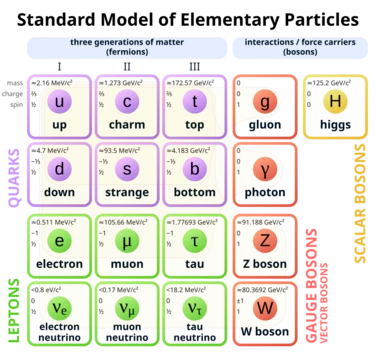
In particle physics, particles may be massive or massless. Massive particles have non-zero rest mass and must move slower than light; massless particles, like photons and gluons, always travel at light speed. Rest mass is not conserved in interactions: a massive neutral pion can decay into two massless photons, and massless particles can combine to form massive ones. Particles are either elementary (like leptons, quarks, and gluons) or composite (like protons, made of quarks). Elementary particles show no internal structure, while composite ones, though often point-like, have internal parts. Many particles decay from high-energy to lower-energy states by emitting radiation; those that do not are called stab
- field
- Physical sciences
- known_for
- Fundamental concept used across physics, chemistry, atmospheric science, soil science, and astrophysics
Lore & Background
The term particle is rather general in meaning and is refined as needed by various scientific fields. Anything composed of particles may be referred to as being particulate, though the noun particulate is most frequently used to refer to pollutants in Earth's atmosphere. In physics, particles can be used to make simplifying assumptions when modeling nature, such as idealizing a baseball as a rigid smooth sphere to calculate its trajectory. Particles are usually applied to three classes of sizes: macroscopic particles (much larger than atoms, often abstracted as point-like), microscopic particles (ranging from atoms to molecules), and subatomic particles (smaller than atoms, including protons, neutrons, and electrons).
Reader's Guide
The concept of a particle is foundational across many scientific disciplines. In particle physics, particles may be elementary (not made of other particles, such as leptons, quarks, and gluons) or composite (composed of other particles, such as protons made of quarks). Massive particles have non-zero rest mass and must move slower than light, while massless particles (like the photon and gluon) must move at the speed of light. Rest mass is not conserved in particle interactions, and particles can decay from high-energy to lower-energy states. In statistical mechanics, vast numbers of interacting particles are analyzed using statistical approaches to predict average quantities, providing a theoretical basis for thermodynamics and the ideal gas laws. In astrophysics, particles are used to model galaxy formation, and in computational physics, N-body simulations model dynamical systems of particles under conditions like gravity. The term also applies in atmospheric science to pollutants and in soil science to discrete solid particles that transmit force through points of contact.
Did You Know?
- A massive particle can decay into massless particles, and massless particles can combine to produce massive particles.
- Colloidal particles have a diameter between approximately 5 and 200 nanometers.
- In computational physics, N-body simulations are common in cosmology and computational fluid dynamics.
More in Particle And Nuclear Physics 1-24
Spotted an error? Know more?
This is a living reference — every entry is fact-audited, and reader corrections feed straight into our audit queue. Suggest an edit · See this site's audit record