Nuclear physics
Study of atomic nuclei and their interactions.

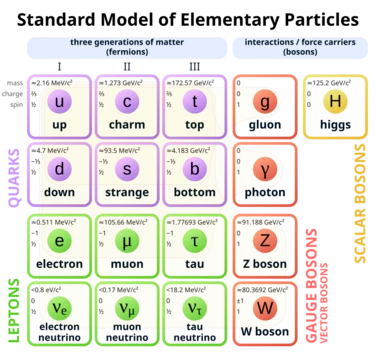
Nuclear physics is the branch of physics concerned with atomic nuclei—their internal parts, how those parts interact, and other forms of nuclear matter. This field is distinct from atomic physics, which looks at the whole atom, including its electrons. Findings in nuclear physics have produced practical uses across many areas: nuclear power, nuclear weapons, nuclear medicine, magnetic resonance imaging, industrial and agricultural isotopes, ion implantation in materials engineering, and radiocarbon dating in geology and archaeology. These applications are studied within nuclear engineering. Particle physics grew out of nuclear physics, and the two are usually taught together. Nuclear astrophysics applies nuclear physics to astronomy, helping explain how stars work and where chemical elements come from.
The history of nuclear physics as its own field began with Henri Becquerel’s 1896 discovery of radioactivity, which he found while studying phosphorescence in uranium salts. A year later, J. J. Thomson discovered the electron, showing that atoms have internal structure. At that time, the accepted model was Thomson’s “plum pudding” model, where the atom was a positively charged ball with negatively charged electrons embedded inside. Radioactivity was then studied extensively by Marie Curie, Pierre Curie, Ernest Rutherford, and others. By the early 1900s, physicists had identified three types of radiation from atoms: alpha, beta, and gamma. Experiments by Otto Hahn in 1911 and James Chadwick in 1914 revealed that beta decay produced a continuous spectrum of electron energies, unlike the discrete energies seen in gamma and alpha decays. This puzzled physicists because it seemed to violate energy conservation. The 1903 Nobel Prize in Physics went to Becquerel, Marie Curie, and Pierre Curie for their work on radioactivity. Rutherford received the 1908 Nobel Prize in Chemistry for his studies on element disintegration and radioactive substances. In 1905, Albert Einstein introduced mass–energy equivalence, but explaining radioactivity’s energy source had to wait until the nucleus was found to be made of smaller particles called nucleons.
Rutherford discovered the nucleus through experiments. In 1906, he published work on alpha particles passing through matter. Hans Geiger and Ernest Marsden, under Rutherford’s supervision, fired alpha particles at a thin gold foil. The plum pudding model predicted the particles would barely bend, but Rutherford told them to look for something surprising: a few particles scattered at large angles, some even bouncing straight back. He compared it to firing a bullet at tissue paper and having it rebound. This 1909 experiment, analyzed by Rutherford in 1911, led to the Rutherford model of the atom: a very small, dense nucleus containing most of the atom’s mass, made of heavy positively charged particles with electrons embedded to balance the charge (since the neutron was unknown). In this model, nitrogen-14 had a nucleus with 14 protons and 7 electrons (21 particles total), surrounded by 7 orbiting electrons.
Around 1920, Arthur Eddington predicted nuclear fusion in stars in his paper *The Internal Constitution of the Stars*. At the time, stellar energy was a mystery; Eddington correctly guessed it came from fusing hydrogen into helium, releasing enormous energy via Einstein’s equation E = mc². This was remarkable because fusion, thermonuclear energy, and even the fact that stars are mostly hydrogen had not yet been discovered.
Studies of nuclear spin challenged the Rutherford model. In 1929, Franco Rasetti at the California Institute of Technology investigated nuclear spin. By 1925, it was known that protons and electrons each had a spin of ±½. In the Rutherford model of nitrogen-14, 20 of the 21 nuclear particles should have paired up to cancel spin, leaving a net spin of ½. Rasetti’s work showed this was not the case.
- field
- Physics
- known_for
- Study of atomic nuclei, radioactivity, nuclear structure, and nuclear reactions
Lore & Background
Nuclear physics examines the atomic nucleus, its constituent particles, and their interactions, along with other forms of nuclear matter. It is distinct from atomic physics, which considers the entire atom including its electrons. The field’s defining characteristic is the study of the nucleus itself—a tiny, dense core containing most of an atom’s mass, composed of positively charged particles (protons) and, as later understood, neutral neutrons. A key early discovery was radioactivity, identified by Henri Becquerel in 1896 while studying uranium salts. This led to the identification of three radiation types: alpha, beta, and gamma. Beta decay posed an early puzzle because its emitted electrons showed a continuous range of energies, unlike the discrete energies of alpha and gamma decays, challenging the principle of energy conservation. The nucleus’s existence was experimentally demonstrated in 1909 by Geiger and Marsden under Rutherford’s supervision, who fired alpha particles at gold foil. Contrary to the prevailing plum pudding model—which predicted only slight deflections—some particles scattered at large angles or even backward, revealing a concentrated positive nucleus. This work also connected to stellar processes: Arthur Eddington later speculated that stars fuse hydrogen into helium, releasing energy via mass–energy equivalence, though fusion mechanisms were then unknown. Nuclear physics underpins applications in power, medicine, weapons, and dating techniques, and is closely linked to particle physics and nuclear astrophysics.
Reader's Guide
Nuclear physics is significant because it revealed the structure of matter at its most fundamental level, the atomic nucleus, and provided the basis for numerous technologies. The discovery of radioactivity by Becquerel and the subsequent work of the Curies and Rutherford opened the door to understanding nuclear transformations. Rutherford's discovery of the nucleus overturned the plum pudding model and established the modern picture of the atom. The discovery of the neutron by Chadwick solved the problem of nuclear spin and allowed scientists to calculate nuclear binding energies, confirming Einstein's mass-energy equivalence. Yukawa's theory of the strong force explained nuclear stability and led to the prediction of mesons. These developments enabled applications ranging from nuclear power and weapons to medical imaging and radiocarbon dating. Nuclear physics also gave rise to particle physics and nuclear astrophysics, which explains the inner workings of stars and the origin of the chemical elements.
Did You Know?
- Ernest Rutherford likened the discovery of the atomic nucleus to firing a bullet at tissue paper and having it bounce off.
More in Particle And Nuclear Physics 1-24
Spotted an error? Know more?
This is a living reference — every entry is fact-audited, and reader corrections feed straight into our audit queue. Suggest an edit · See this site's audit record