Lepton
Elementary fermions that do not undergo strong interactions.

Leptons are a family of elementary particles, each with a half-integer spin, that are not affected by the strong nuclear force. They come in two main types: charged leptons (like the electron, muon, and tau) and neutral leptons (called neutrinos). Charged leptons can join with other particles to form composite things such as atoms or positronium, while neutrinos interact so rarely that they are very hard to detect. The electron is the most familiar lepton.
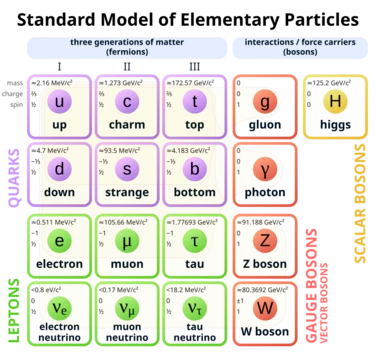
There are six leptons in total, known as flavors, arranged into three generations. The first generation includes the electron and the electron neutrino; the second has the muon and muon neutrino; the third has the tau and tau neutrino. Among charged leptons, the electron has the smallest mass. Heavier muons and taus quickly decay into electrons and neutrinos, moving from a higher mass state to a lower one. This makes electrons stable and the most common charged lepton in the universe, while muons and taus only appear in high-energy events like cosmic rays or particle accelerator collisions.
Leptons have intrinsic properties such as electric charge, spin, and mass. Unlike quarks, they do not experience the strong interaction, but they do feel gravity, the weak force, and electromagnetism (the last of which depends on electric charge, so neutrinos, being neutral, are unaffected by it).
For each lepton flavor, there is a corresponding antilepton, which has the same properties but with opposite signs for certain values. Some theories suggest neutrinos might be their own antiparticles, but this is not yet confirmed.
The electron was first theorized in the mid-1800s and discovered by J. J. Thomson in 1897. The muon was found by Carl D. Anderson in 1936, initially mistaken for a meson, but later recognized as behaving like a heavier electron. The concept of leptons as a family was proposed in 1947. The electron neutrino was hypothesized by Wolfgang Pauli in 1930 to explain beta decay, and first observed in 1956 by Clyde Cowan and Frederick Reines. The muon neutrino was discovered in 1962 by Leon Lederman, Melvin Schwartz, and Jack Steinberger. The tau was found between 1974 and 1977 by Martin Perl and colleagues. The tau neutrino was finally detected in July 2000 by the DONUT collaboration at Fermilab.
Leptons are key to the Standard Model. Electrons are part of atoms, alongside protons and neutrons. Exotic atoms can be made with muons or taus instead of electrons, and lepton-antilepton pairs like positronium can also be created.
The name "lepton" comes from the Greek *leptós*, meaning "fine, small, thin." It was first used by physicist Léon Rosenfeld in 1948, following a suggestion by C. Møller, as a counterpart to "nucleon" for particles of small mass. Rosenfeld applied it to electrons and the then-hypothetical neutrinos. The muon, originally classed as a meson, was reclassified as a lepton in the 1950s. The masses of electrons and muons are tiny compared to nucleons like the proton, and neutrinos have nearly zero mass. However, the tau, discovered in the mid-1970s, has nearly twice the mass of a proton.
- type
- Elementary particle
- spin
- 1/2
- flavors
- 6 (electron, muon, tau, and their neutrinos)
- generations
- 3
- antiparticle
- Antilepton (neutrinos may be their own antiparticle)
Lore & Background
The first lepton identified was the electron, discovered by J.J. Thomson in 1897. In 1930, Wolfgang Pauli proposed the electron neutrino to explain missing energy in beta decay. The muon, discovered by Carl D. Anderson in 1936, was initially classified as a meson but later reclassified as a lepton because it does not undergo strong interactions. The concept of "leptons" as a family was proposed in 1947. Leptons are elementary particles with half-integer spin that are not subject to the strong interaction, but they do experience gravity, the weak force, and electromagnetism (except neutrinos, which are electrically neutral). There are six flavours in three generations: the electron and electron neutrino; the muon and muon neutrino; and the tau and tau neutrino. Charged leptons can combine into composite particles like atoms and positronium, while neutrinos rarely interact. Electrons are stable and the most common charged lepton; muons and taus decay into electrons and neutrinos. The muon neutrino was discovered in 1962 by Lederman, Schwartz, and Steinberger. The tau was discovered between 1974 and 1977 by Martin Perl and colleagues. The tau neutrino was announced in 2000 by the DONUT collaboration at Fermilab. For every lepton flavour, there is a corresponding antilepton. The name "lepton" comes from the Greek *leptós*, meaning small or thin, and was first used by physicist Léon Rosenfeld in 1948.
Reader's Guide
Leptons are essential to the Standard Model, with electrons forming atoms alongside protons and neutrons. Charged leptons (electron, muon, tau) can combine into composite particles like positronium, while neutrinos rarely interact. Leptons are subject to gravitation, the weak interaction, and electromagnetism (except neutrinos, which are electrically neutral). The discovery of multiple neutrino flavors confirmed the three-generation structure. Leptons are fermions obeying the Pauli exclusion principle, and the weak interaction treats left-handed and right-handed leptons differently, violating parity.
Did You Know?
- The tau neutrino was the second-to-latest Standard Model particle directly observed, with its detection announced in 2000 by the DONUT collaboration.
- Electrons are stable and the most common charged lepton in the universe, while muons and taus can only be produced in high-energy collisions.
The Six Flavours and Three Generations
Leptons come in six distinct varieties, organized into three sequential generations. The first generation pairs the electron with its companion, the electron neutrino. The second generation introduces the muon alongside the muon neutrino, while the third generation features the tau and the tau neutrino. Within each generation, one member carries electric charge and the other is electrically neutral. The charged members—electron, muon, and tau—can bind with other particles to build composite structures like atoms and positronium. Neutrinos, by contrast, almost never interact with surrounding matter, making them extraordinarily difficult to detect. Mass hierarchy plays a crucial role in stability: the electron is the lightest charged lepton and therefore the most stable, persisting indefinitely. The heavier muon and tau cannot survive for long; they rapidly decay into electrons and neutrinos, shedding excess mass. Because of this, muons and taus only appear in extreme environments such as cosmic-ray impacts or particle accelerators, whereas electrons are the most abundant charged leptons in the cosmos.
A Century of Discovery
The identification of leptons unfolded over more than a century. J. J. Thomson and his British collaborators isolated the electron in 1897, establishing the first member of the family. In 1930, Wolfgang Pauli proposed an unseen particle to account for energy, momentum, and angular momentum deficits in beta decay; this hypothetical electron neutrino was not directly observed until Clyde Cowan and Frederick Reines confirmed it in their 1956 experiment. Carl D. Anderson detected the muon in 1936, though it was initially misfiled as a meson before its electron-like behaviour prompted reclassification. The very term "lepton" as a unifying family name was not proposed until 1947. Leon M. Lederman, Melvin Schwartz, and Jack Steinberger demonstrated in 1962 that a second neutrino flavour existed, a finding that earned them the 1988 Nobel Prize. Martin Lewis Perl and colleagues at SLAC and Lawrence Berkeley National Laboratory identified the tau between 1974 and 1977. The final piece, the tau neutrino, eluded detection until the DONUT collaboration at Fermilab announced its discovery in July 2000.
Interactions, Spin, and Antiparticles
Every lepton possesses intrinsic characteristics—electric charge, spin, and mass—and all carry a half-integer spin of one-half. A defining feature that separates leptons from quarks is their complete exemption from the strong nuclear force. They do, however, respond to the remaining three fundamental interactions: gravitation, the weak force, and electromagnetism. Electromagnetic coupling is proportional to electric charge, so neutrinos, being uncharged, feel no electromagnetic pull at all. For each lepton flavour there exists a corresponding antilepton, an antiparticle whose properties match in magnitude but flip in sign. A tantalizing open question surrounds neutrinos: certain theoretical frameworks suggest they might be their own antiparticles, yet no experiment has definitively confirmed or ruled out this possibility. Charged leptons can pair with their antiparticles to form composite states such as positronium, while neutrinos remain so weakly coupled to matter that they pass through ordinary substances almost undetected.
Naming, Mass, and Place in the Standard Model
The word "lepton" traces back to the Greek λεπτός, meaning fine, small, or thin, a form attested as far back as Mycenaean Linear B script. Physicist Léon Rosenfeld adopted the term in 1948, following a suggestion from C. Møller, as a counterpart to "nucleon" to describe particles of small mass. At the time, this encompassed the electron, the hypothesized neutrino, and—after its reclassification in the 1950s—the muon. Their masses are indeed tiny relative to the proton's 938.3 MeV/c²: the electron sits at 0.511 MeV/c² and the muon at 105.7 MeV/c². The tau, discovered later, breaks this pattern with a mass of 1777 MeV/c², nearly twice the proton's. Within the Standard Model, leptons occupy a foundational role. Electrons form part of every atom alongside protons and neutrons, and exotic variants substituting muons or taus for electrons can be synthesized in the laboratory. Lepton–antilepton pairs such as positronium further illustrate the family's versatility in composite matter.
Frequently Asked Questions
Who is Lepton?
Lepton is an elementary fermion with spin 1/2 that never participates in strong nuclear interactions. It sits as a fundamental building block inside the Standard Model of particle physics.
What flavors and generations does Lepton have?
There are six lepton flavors organized into three generations: the electron, muon, and tau, each paired with its own neutrino. The electron is the most familiar, serving as a core component of every atom.
What is Lepton's antiparticle?
Each lepton has a corresponding antilepton, though neutrinos remain a special case since they may actually be their own antiparticles.
Why is Lepton important to the bigger picture?
Because leptons are elementary fermions that bypass the strong force entirely, they occupy a unique slot in the Standard Model alongside quarks. Without the electron lepton, atoms—and therefore all ordinary matter—would not exist.
More in Particle And Nuclear Physics 1-24
Spotted an error? Know more?
This is a living reference — every entry is fact-audited, and reader corrections feed straight into our audit queue. Suggest an edit · See this site's audit record