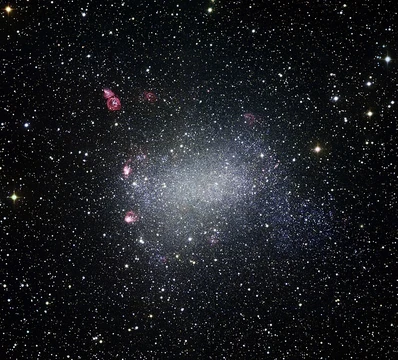
NGC 985
A ring galaxy formed by a merger, with a second nucleus.

NGC 985 is a ring galaxy in the constellation of Cetus, located approximately 550 million light years from Earth. It is notable as a type 1 Seyfert galaxy and a luminous infrared galaxy, with a total infrared luminosity that classifies it as such. Discovered in 1886 by Francis Leavenworth, the galaxy spans about 160,000 light years across.
Quick Facts
- Epoch
- J2000
- Ra
- 02 · 34 · 37.8
- Dec
- -08 · 47 · 15
- Dist Ly
- 567 Mly (174 Mpc)
- Z
- 0.043143 ± 0.000073
- H Radial V
- 12,934 ± 22 km/s
- Appmag V
- 13.5
- Constellation Name
- Cetus
- Notes
- Seyfert galaxy
- Names
- VV 285, Mrk 1048, MCG -02-07-035, PGC 9817
Facts from the source article.
Lore & Background
NGC 985 is characterized by its ring shape, believed to have formed as a result of a galaxy merger. Evidence for this includes the observation of a second nucleus, found 3.8 arcseconds northwest of the active nucleus when observed in infrared light. This secondary nucleus is much redder than the rest of the galaxy, indicating the presence of old stars. It has been suggested that the collision between a disk galaxy and another galaxy caused the formation of the ring and displaced the nucleus, creating an empty ring. Based on kinematics, the secondary nucleus belonged to the intruder galaxy, while the active nucleus is associated with the main stellar component.
As is common with merger remnants, NGC 985 has an increased star formation rate and shines bright in the infrared. Very large molecular clouds exist near the nuclei; they may be clouds gathering around the nucleus in the process of forming a disk around the two nuclei, or molecular clouds disrupted by an outflow from the nucleus. The total molecular gas mass of the galaxy is estimated, though the specific value is not given.
NGC 985 is a powerful X-ray source, detected by ROSAT. Its X-ray spectrum is complex, not accounted for by a simple power law at 0.6 keV, suggesting the presence of a warm absorber. The hard X-ray emission is characterized by a simple power law. The X-ray flux, especially soft X-rays, diminished in 2013. Variability of X-ray and ultraviolet emission from the nucleus was observed using XMM-Newton and the Hubble Space Telescope, revealing outflowing wind from an accretion disk around a supermassive black hole that obstructed the nucleus in soft X-rays and UV. The nucleus is otherwise seen unobstructed.
Reader's Guide
NGC 985 holds significance as a clear example of a ring galaxy formed through a galaxy merger, with direct observational evidence of a second nucleus supporting this origin. Its status as a type 1 Seyfert galaxy and a luminous infrared galaxy highlights its active galactic nucleus and intense star formation, common in merger remnants. The detection of a secondary nucleus in infrared light, much redder and associated with old stars, provides a rare glimpse into the dynamics of galactic collisions. The complex X-ray emission, including a warm absorber and variability observed by XMM-Newton and Hubble, reveals an outflowing wind from an accretion disk around a supermassive black hole, offering insights into feedback processes. The galaxy's powerful X-ray emission, detected by ROSAT, and its infrared luminosity underscore its role in studying the interplay between mergers, star formation, and active nuclei. The legacy of NGC 985 lies in its contribution to understanding how galaxy interactions reshape structure and trigger nuclear activity, with its ring and dual nuclei serving as a laboratory for such processes.
Did You Know?
- NGC 985 is a ring galaxy in Cetus, discovered by Francis Leavenworth in 1886.
- It has a second nucleus 3.8 arcseconds northwest of the active nucleus, visible in infrared light.
- The galaxy's soft X-ray flux diminished in 2013, observed by XMM-Newton and Hubble.
- NGC 985 is also known as Markarian 1048.
More in NGC Objects, Part 2 1-24
Spotted an error? Know more?
Reader corrections go straight into our review queue. Suggest an edit · How this site is sourced