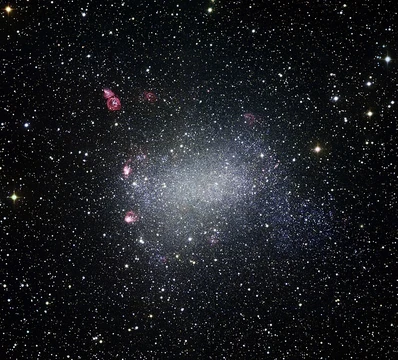
NGC 896
The western knot of the Heart Nebula, first discovered.

NGC 896 is the brightest part of the Heart Nebula, a knot at the nebula's western edge. It was the first portion of the larger nebula to be discovered and is separately classified due to this historical distinction.
Quick Facts
- Epoch
- J2000.0
- Ra
- 02 · 33 · 22
- Dec
- +61 · 26 · 36
- Dist Ly
- 7000
- Dist Pc
- 2100
- Appmag V
- 6.5
- Constellation
- Cassiopeia
- Radius Ly
- 165
- Absmag V
- −5.1
- Names
- NGC 896, IC1805, Sh 2-190, Westerhout 4 (W4)
Facts from the source article.
Lore & Background
NGC 896 was discovered by William Herschel on 3 November 1787. It represents the brightest knot at the western edge of the Heart Nebula (Sharpless 2-190), and because it was the first part of that nebula to be identified, it received its own NGC designation. The Heart Nebula itself is an emission nebula located 7500 light-years away in the Perseus Arm of the Galaxy, within the constellation Cassiopeia. The nebula displays glowing ionized hydrogen gas and darker dust lanes, and its intense red output and morphology are driven by radiation from a small group of hot stars near the center, an open cluster known as Collinder 26, Melotte 15, or IC 1805. That cluster contains a few bright stars nearly 50 times the mass of the Sun and many dimmer stars of only a fraction of the Solar mass. The Heart Nebula also contains ionized oxygen and sulfur gasses, producing blue and orange colors in narrowband images, and spans almost 2 degrees in the sky—four times the diameter of the full moon. It belongs to the larger W3/W4/W5 complex and is the brightest part of a superbubble called the W4 superbubble, or W4 chimney, through which hot gas is believed to transfer from the galactic disk to the halo.
Reader's Guide
NGC 896 holds significance as the first identified portion of the Heart Nebula, marking the initial discovery of a much larger and structurally complex emission region. Its separate classification underscores how astronomical cataloging can preserve the history of observation, even when later surveys reveal a broader context. The object is part of the W3/W4/W5 complex and lies within the W4 superbubble, a structure that may play a role in transporting hot gas from the galactic disk to the halo. The nebula's appearance—dominated by ionized hydrogen, oxygen, and sulfur—illustrates the interplay between massive stars and their surrounding interstellar medium. The open cluster at its center, containing stars up to 50 solar masses, provides the energy that shapes the nebula's intense red output and filamentary morphology. NGC 896's legacy is tied to both its historical role in Herschel's discoveries and its place within a dynamic galactic environment that continues to inform studies of star formation and feedback processes.
Did You Know?
- The Heart Nebula was identified as a radio source in 1958 and is also known as Westerhout 4 (W4).
- The nebula spans almost 2 degrees in the sky, covering an area four times the diameter of the full moon.
Frequently Asked Questions
What exactly is NGC 896?
NGC 896 is a bright knot of glowing gas sitting at the western edge of the larger Heart Nebula. It is an emission nebula located roughly 7,500 light-years away in the constellation Cassiopeia.
Who discovered NGC 896 and when?
William Herschel identified this western knot on 3 November 1787, making it the first recognized piece of what is now known as the Heart Nebula.
Why does NGC 896 have its own catalog number if it's part of the Heart Nebula?
Because Herschel found this knot before the rest of the nebula was charted, it was given a separate NGC entry as a matter of historical record. Its independent classification is purely a legacy of discovery order.
What type of object is NGC 896?
It is classified as an emission nebula, meaning the gas in that region is ionized and producing its own light rather than simply reflecting starlight.
Where in the sky can I find NGC 896?
Look toward the constellation Cassiopeia, where the object sits about 7,500 light-years from Earth as the brightest knot along the Heart Nebula's western border.
More in NGC Objects, Part 2 1-24
Spotted an error? Know more?
Reader corrections go straight into our review queue. Suggest an edit · How this site is sourced