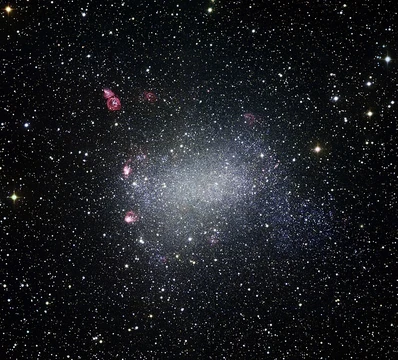
NGC 864
An isolated spiral galaxy with asymmetric HI spectrum.

NGC 864 is an intermediate spiral galaxy located in the constellation Cetus. It is notable for its classification as an isolated galaxy in the AMIGA catalogue (CIG 96) and for its asymmetric HI spectrum, which is unusual for an isolated system. The galaxy was discovered by William Herschel and was later selected for kinematic studies using the GHαFaS system on the William Herschel Telescope.
Quick Facts
- Epoch
- J2000
- Ra
- 02 · 15 · 27,64
- Dec
- +06 · 00 · 09.4
- Constellation Name
- Cetus
- Appmag V
- 10.9
- Appmag B
- 11.4
- Z
- +0.005210 · 0.000004
- H Radial V
- 1562 ± 1 km/s
- Names
- NGC 864 • UGC 1736 • PGC 8631 • CGCG 413-066 • MCG +01-06-061 • IRAS 02128+0546 • / KUG 0211+276 • 2MASX J02152764+0600094 • CN 510
- Dist Ly
- 22.0 ± 1.5 / (72 ± 5)6 ly)
Facts from the source article.
Lore & Background
NGC 864 was discovered by William Herschel and first described in his Catalogue of Nebulae and Clusters of Stars, published in 1786. It is classified as an isolated galaxy on the AMIGA catalogue as CIG 96. In 2012, a group of astronomers at the Roque de los Muchachos Observatory selected NGC 864 for a kinematics study due to its diameter, declination, and inclination. The project aimed to understand the galaxy's morphology and to develop a flux-calibration method for the new GHαFaS system on the William Herschel Telescope.
Using ACAM and GHαFaS to produce high spectral resolution Hα images, along with integral-field spectrograph data, astronomers determined that the galaxy's bar presents bright regions of massive star formation at its ends, where two asymmetric arms arise. The outer spiral shows a flocculent pattern, leading some astronomers to classify it as a grand design galaxy.
A 2005 study produced an integral HI spectrum of NGC 864, analyzing its HI density distribution and velocity field. The data showed the interstellar medium to be symmetric in velocity but asymmetric in intensity, suggesting the asymmetry is unlikely to result from an internal dynamical instability. Researchers speculate the asymmetry may have been caused by a minor galaxy companion crossing the equatorial plane just outside the optical disc but within the extended HI disc, creating the observed warp.
Reader's Guide
NGC 864 holds significance as an isolated galaxy whose HI spectrum asymmetry challenges typical explanations tied to galaxy interactions. Its selection for kinematic study in 2012 contributed to the development of the GHαFaS flux-calibration method, aiding future observations. The galaxy's morphology, with a bar hosting bright star-forming regions and asymmetric arms, provides insight into internal evolution processes. The 2005 HI study highlights that isolated galaxies can exhibit asymmetries possibly from minor companions rather than internal instabilities, offering a broader understanding of galaxy dynamics. NGC 864's legacy lies in its role as a test case for understanding asymmetry in isolation and in advancing observational techniques for spiral galaxies.
Did You Know?
- Its discovery was made by William Herschel on October 25, 1785.
- The galaxy was selected in 2012 for a kinematics study to develop a flux-calibration method for the GHαFaS system.
- A 2005 study found its HI spectrum symmetric in velocity but asymmetric in intensity.
Frequently Asked Questions
What kind of object is NGC 864?
NGC 864 is a spiral galaxy of intermediate type sitting in the southern constellation Cetus. It also carries the catalogue label CIG 96, identifying it as one of the isolated galaxies catalogued in the AMIGA survey.
Who first spotted NGC 864 and when?
The British astronomer William Herschel recorded the galaxy on October 25, 1785, during his systematic sweeps of the southern sky. That discovery date has remained attached to the object ever since.
What makes NGC 864 unusual among isolated galaxies?
Its hydrogen-alpha emission shows an asymmetric spectral profile, which is atypical for a system with no nearby companions to disturb its gas. That oddity is precisely what drew researchers to study it more closely.
Where in the sky can I find NGC 864?
Look toward the constellation Cetus, the sea monster, in the southern celestial hemisphere. The galaxy is not a bright naked-eye target, so binoculars or a small telescope will be needed to pick it out.
What modern instruments have been used to study NGC 864?
The GHαFaS integral-field spectrograph mounted on the William Herschel Telescope has been employed to map the galaxy's internal kinematics. Those observations help astronomers understand how an isolated spiral like NGC 864 rotates and evolves without external gravitational influence.
More in NGC Objects, Part 2 1-24
Spotted an error? Know more?
Reader corrections go straight into our review queue. Suggest an edit · How this site is sourced