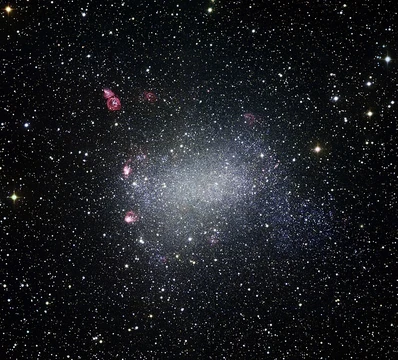
NGC 765
A massive low surface brightness spiral with a giant hydrogen disk.

NGC 765 is an intermediate spiral galaxy located in the constellation Aries, approximately 220 million light years from Earth. It is notable for its extensive, low-surface-brightness hydrogen disk, which is among the largest observed in the nearby universe, spanning about 240 kpc (780,000 light years). The galaxy hosts an active galactic nucleus and is classified as a massive low surface brightness galaxy.
Quick Facts
- Epoch
- J2000
- Ra
- 01 · 58 · 48.0
- Dec
- +24 · 53 · 33
- Dist Ly
- 222 Mly (68.1 Mpc)
- Z
- 0.017078 ± 0.000010
- H Radial V
- 5,120 ± 3 km/s
- Appmag V
- 13.0
- Constellation Name
- Aries
- Notes
- Extensive hydrogen disk
- Names
- UGC 1455, CGCG 482-033, MCG +04-05-025, PGC 7475
Facts from the source article.
Lore & Background
NGC 765 was discovered by Albert Marth on October 8, 1864. Its morphological classification in the De Vaucouleurs system is SAB(rs)bc, indicating a weak-barred spiral with spiral arms intermediately wound and a structure between ring and non-ring. The galaxy has at least three spiral arms traceable to a radius of 50 kpc, and it is identified as a low surface brightness galaxy with a prominent bulge.
Emission from low ionization elements—strong [N II], [S II], and [O I] lines—has been detected at the nucleus, along with X-ray emission observed by the Chandra X-ray Observatory, indicating an active galactic nucleus. The X-ray flux in the 0.2–10 KeV range is comparable to low-luminosity active galactic nuclei such as LINERs. Diffuse X-ray emission from the bulge is attributed to the presence of gas.
The galaxy holds a large amount of hydrogen gas, with an HI mass about an order of magnitude greater than that of other low surface brightness galaxies and three times the mean mass in spiral galaxies. The HI mass-to-luminosity ratio is M_HI/L_B ~ 1.6. The HI is distributed in a large, asymmetric disk measuring 240 kpc across, the largest observed disk in the nearby universe, similar in size to that of Malin 1. Inside the disk are compact regions of higher brightness, less than 10 kpc across, with masses similar to dwarf irregular galaxies, holding about 10% of the galactic HI; these may be remnants of accreted galaxies.
Reader's Guide
NGC 765 is significant as a massive low surface brightness galaxy with an exceptionally large and massive hydrogen disk, the largest observed in the nearby universe. Its HI mass exceeds that of typical low surface brightness galaxies by an order of magnitude and is three times the mean for spiral galaxies, placing it in a rare category. The galaxy's active nucleus, detected through optical emission lines and X-rays, adds to its interest as a low-luminosity active galactic nucleus. The asymmetric HI disk and embedded compact clumps—possibly accreted dwarf galaxies—provide clues to its formation and evolution. As a member of the LGG 41 galaxy group within the Perseus–Pisces Supercluster, NGC 765 offers a nearby laboratory for studying giant low surface brightness systems and their interaction history. Its disk size rivals that of Malin 1, the prototype giant low surface brightness galaxy, and it is often compared to NGC 262, another galaxy with a similar giant hydrogen disk.
Frequently Asked Questions
What is NGC 765?
NGC 765 is a massive intermediate spiral galaxy residing in the constellation Aries, roughly 220 million light years from Earth. It harbours an active galactic nucleus at its centre and is broadly classified as a low surface brightness system.
How large is NGC 765's hydrogen disk?
Its neutral hydrogen envelope extends to roughly 240 kiloparsecs, about 780,000 light years across, ranking it among the most extended gas disks known in the nearby universe. The visible spiral body itself spans approximately 195,000 light years.
Who discovered NGC 765 and when?
German astronomer Albert Marth first recorded the galaxy on 8 October 1864 as part of his deep-sky surveys. It has retained the NGC 765 catalogue number in astronomical references ever since.
What is NGC 765's morphological classification?
It is typed as SAB(rs)bc, indicating a weak central bar, a ring feature, and intermediate spiral arms that blend early- and late-type characteristics. This places it squarely in the intermediate spiral category rather than a pure grand-design or flocculent form.
Why do astronomers find NGC 765 noteworthy?
The pairing of a very diffuse, low surface brightness profile with one of the largest nearby hydrogen disks makes it a key laboratory for probing how gas behaves in tenuous galactic environments. Its active nucleus adds a second line of inquiry into how central engines interact with extended outer structure.
More in NGC Objects, Part 2 1-24
Spotted an error? Know more?
Reader corrections go straight into our review queue. Suggest an edit · How this site is sourced