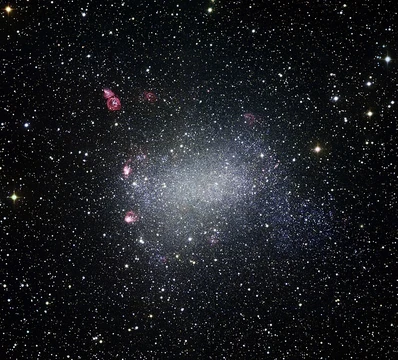
NGC 877
A grand-design spiral interacting with NGC 876, rich in star formation.

NGC 877 is an intermediate spiral galaxy located in the constellation Aries, approximately 160 million light years from Earth. It is notable for its grand design spiral pattern, interaction with the edge-on galaxy NGC 876, and classification as a luminous infrared galaxy with high star formation activity.
Quick Facts
- Epoch
- J2000
- Ra
- 02 · 17 · 59.6
- Dec
- +14 · 32 · 38
- Dist Ly
- 154 ± 25 Mly (47.1 ± 7.5 Mpc)
- Z
- 0.013052 ± 0.000010
- H Radial V
- 3,913 ± 3 km/s
- Appmag V
- 11.8
- Constellation Name
- Aries
- Notes
- Luminous infrared galaxy
- Names
- UGC 1768, CGCG 438-052, MCG +02-06-058, PGC 8775
Facts from the source article.
Lore & Background
NGC 877 was discovered by William Herschel on October 14, 1784. It features two spiral arms in a grand design pattern with a slightly disturbed morphology. In H-alpha imagery, the arms display numerous knots and appear brighter than the nucleus, while the northwest part of the galaxy shows higher polarized emission than the rest. A bar is detected in radio waves. The nucleus exhibits activity resembling that of an HII region, and the galaxy is categorized as a luminous infrared galaxy, with total infrared luminosity near the threshold for that classification. Its total star formation rate is estimated between 20 and 53 solar masses per year.
The galaxy forms a pair with the edge-on spiral NGC 876, located 2.1 arcminutes to the southwest, corresponding to a projected separation of 30 kpc. A low surface brightness bridge connects the two galaxies. NGC 877 is the brightest and most massive member of the NGC 877 group (LGG 53), which also includes NGC 876, NGC 871, UGC 1693, IC 1791, UGC 1773, and UGC 1817. The group contains large amounts of HI gas. Nearby galaxies NGC 870 and NGC 871 are also in the vicinity.
One supernova has been observed in NGC 877: SN 2019rn, a Type IIb supernova discovered by the ATLAS survey on January 12.30, 2019, with an apparent magnitude of 18.86. It was initially classified as Type II but later reclassified as Type IIb based on further spectroscopic observations.
Reader's Guide
NGC 877 holds significance as a luminous infrared galaxy, a class associated with high star formation rates, and its total infrared luminosity lies near the threshold for that classification. Its interaction with NGC 876, evidenced by a low surface brightness bridge, provides a natural laboratory for studying galaxy interactions and their effects on star formation and morphology. The galaxy's grand design spiral arms, bright in H-alpha with numerous knots, indicate vigorous star-forming regions, while the polarized emission in the northwest suggests organized magnetic fields or dust structures. As the brightest and most massive member of the NGC 877 group, it anchors a system rich in HI gas, offering insights into group dynamics and gas content. The detection of a bar in radio waves adds to understanding of its internal structure. The occurrence of SN 2019rn, a Type IIb supernova, contributes to the record of stellar explosions in interacting systems. Additionally, NGC 877 will be occulted by the Moon during total lunar eclipses in October 2050 and October 2069, providing rare observational opportunities.
Did You Know?
- It interacts with the edge-on spiral galaxy NGC 876 via a low surface brightness bridge.
- SN 2019rn, a Type IIb supernova, was discovered in NGC 877 on January 12.30, 2019.
Frequently Asked Questions
What is NGC 877 and where can I find it in the sky?
NGC 877 is an intermediate spiral galaxy sitting roughly 160 million light years away in the constellation Aries. It spans about 115,000 light years across, making it a substantial target for deep-sky observers.
Who first catalogued NGC 877 and when?
William Herschel recorded the galaxy on October 14, 1784, during his systematic surveys of faint deep-sky objects. That discovery entry is what gave it its NGC number in later catalogues.
What makes NGC 877's spiral structure stand out?
It displays a clean grand-design spiral pattern, which is relatively uncommon among intermediate spirals. Its ongoing gravitational interaction with the nearby edge-on galaxy NGC 876 is thought to help maintain and sculpt those prominent arms.
What supernova has been observed in NGC 877?
SN 2019rn was identified in the galaxy as a Type IIb supernova with an apparent magnitude of about 18.86. It is a useful reference point for studying core-collapse events in luminous infrared galaxies.
Why do astronomers classify NGC 877 as a luminous infrared galaxy?
The galaxy hosts intense star-formation activity that pumps out enormous amounts of infrared radiation, often reprocessed from visible light by surrounding dust. This high rate of new star birth is what pushes it into the luminous infrared category.
More in NGC Objects, Part 2 1-24
Spotted an error? Know more?
Reader corrections go straight into our review queue. Suggest an edit · How this site is sourced