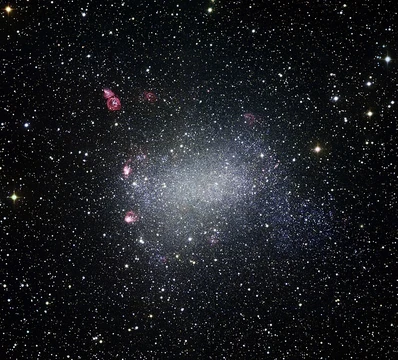
NGC 891
Edge-on spiral galaxy resembling the Milky Way.

NGC 891 is a spiral galaxy seen edge-on, located roughly 30 million light-years away in the constellation Andromeda. It goes by several other names: Caldwell 23, the Silver Sliver Galaxy, and the Outer Limits Galaxy. William Herschel first spotted it on October 6, 1784. This galaxy belongs to the NGC 1023 group, which is part of the Local Supercluster, and it features an H II nucleus.
Through small or moderate telescopes, it appears as a faint, elongated streak of light. Larger apertures reveal a dust lane within it. In 1999, the Hubble Space Telescope captured an infrared image of NGC 891. Its visual appeal and scientific value led to it being chosen as the first light target for the Large Binocular Telescope in 2005, and again for the Lowell Discovery Telescope’s Large Monolithic Imager in 2012. A supernova, SN 1986J, was discovered in this galaxy on August 21, 1986, with an apparent magnitude of 14.
NGC 891 is thought to resemble what the Milky Way would look like if viewed edge-on—some astronomers note the similarity, especially from the Southern Hemisphere. Both galaxies are considered comparable in luminosity and size. Studies of its molecular hydrogen dynamics suggest the likely presence of a central bar. However, recent high-resolution images of its dusty disk reveal unusual filamentary patterns extending into the galaxy’s halo, away from the disk. Scientists suspect supernova explosions may have thrown this interstellar dust outward, or that light pressure from nearby stars could be responsible.
The galaxy is part of a small group often called the NGC 1023 Group, which includes NGCs 925, 949, 959, 1003, 1023, and 1058, as well as UGCs 1807, 1865 (DDO 19), 2014 (DDO 22), 2023 (DDO 25), 2034 (DDO 24), and 2259. Its outer regions contain multiple large, faint, coherent substructures, such as giant streams looping around the parent galaxy up to about 50 kiloparsecs away. The bulge and disk are encased in a flat, thick, cocoon-like stellar structure with vertical and radial distances of up to 15 and 40 kiloparsecs, respectively. This is interpreted as the remnant of a satellite galaxy that was disrupted and is now being absorbed by NGC 891.
Quick Facts
- Epoch
- J2000
- Ra
- 02 · 22 · 33.4
- Dec
- +42 · 20 · 57
- Dist Ly
- 27.3 ±
- Appmag V
- 10.1
- Constellation Name
- Andromeda
Facts from the source article.
Lore & Background
NGC 891 looks as the Milky Way would appear when viewed edge-on, and both galaxies are considered very similar in luminosity and size. Studies of its molecular hydrogen dynamics suggest the likely presence of a central bar. The galaxy is visible in small to moderate telescopes as a faint elongated smear of light, with a dust lane visible in larger apertures.
In 1999, the Hubble Space Telescope imaged NGC 891 in infrared. In 2005, it was selected as the first light image of the Large Binocular Telescope, and in 2012 it was again used as a first light image of the Lowell Discovery Telescope with the Large Monolithic Imager. High-resolution images of its dusty disk reveal unusual filamentary patterns extending into the halo, possibly caused by supernova explosions or light pressure from surrounding stars.
The galaxy is a member of the NGC 1023 Group, which includes NGCs 925, 949, 959, 1003, 1023, and 1058, along with several UGC objects. Its outskirts contain multiple low-surface brightness substructures, including giant streams looping up to about 50 kpc. The bulge and disk are surrounded by a flat, thick cocoon-like stellar structure with vertical and radial distances up to 15 kpc and 40 kpc, interpreted as the remnant of a disrupted satellite galaxy being absorbed.
Reader's Guide
NGC 891 holds significance both scientifically and culturally. Its edge-on orientation provides a rare direct comparison to the Milky Way, allowing astronomers to study the structure and dynamics of a galaxy similar to our own. The detection of a likely central bar through molecular hydrogen studies adds to its importance as a galactic analog. The unusual filamentary dust patterns extending into the halo, possibly from supernova explosions or stellar light pressure, offer insights into galactic feedback processes. The galaxy's role as a first light target for two major telescopes—the Large Binocular Telescope in 2005 and the Lowell Discovery Telescope in 2012—underscores its value as a calibration and demonstration object. Its membership in the NGC 1023 Group and the presence of disrupted satellite remnants contribute to understanding galaxy interactions and evolution. In popular culture, NGC 891 appears in the end credits of the Outer Limits TV series, earning it the nickname Outer Limits Galaxy. It also inspired musical works: a track on the soundtrack of the 1974 film Dark Star by John Carpenter, and a track on Edgar Froese's 1974 solo album Aqua, the latter recorded using the artificial head system.
Did You Know?
- NGC 891 is sometimes called the Outer Limits Galaxy because it appears in the end credits of the Outer Limits TV series.
- Supernova SN 1986J was discovered in NGC 891 on August 21, 1986, at apparent magnitude 14.
- The galaxy was used as the first light image for both the Large Binocular Telescope (2005) and the Lowell Discovery Telescope (2012).
- NGC 891 is a member of the NGC 1023 group of galaxies in the Local Supercluster.
Frequently Asked Questions
What is NGC 891?
NGC 891 is an edge-on unbarred spiral galaxy situated about 30 million light-years away in the constellation Andromeda. It is also catalogued as Caldwell 23 and popularly known as the Silver Sliver or Outer Limits Galaxy.
Who first spotted NGC 891 and when?
William Herschel was the first to observe this galaxy on October 6, 1784. His discovery added it to the growing catalog of deep-sky objects he compiled during his prolific surveying career.
What does NGC 891 look like through a telescope?
In small or moderate-aperture instruments it shows up as a dim, elongated smudge of light. With larger telescopes you can pick out a dark dust lane running through its disc, and Hubble's 1999 infrared imaging revealed additional structural detail in its H II nucleus.
Why do fans call NGC 891 the Silver Sliver Galaxy?
The nickname comes from its striking edge-on profile, which makes the galaxy's thin disc of stars and dust appear as a narrow, glistening ribbon against the dark sky. Its appearance is often compared to looking at the Milky Way from outside, which is what gives it that 'sliver' character.
What group or cluster does NGC 891 belong to?
It is a member of the NGC 1023 group of galaxies, which itself sits within the broader Local Supercluster. This places it in a relatively nearby cosmic neighborhood, making it a useful reference point for studying galaxy interactions in that region.
More in NGC Objects, Part 2 1-24
Spotted an error? Know more?
Reader corrections go straight into our review queue. Suggest an edit · How this site is sourced