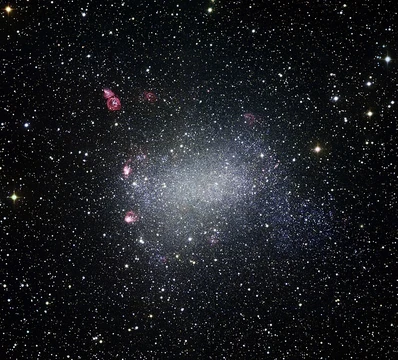
NGC 772
Large unbarred spiral galaxy with a prominent elongated arm.

NGC 772 is a large spiral galaxy without a central bar, located about 106 million light-years from Earth in the constellation Aries. It is sometimes called Arp 78 or the Fiddlehead Galaxy. German-British astronomer William Herschel first spotted it on 29 November 1785.
Spanning roughly 200,000 light-years across, NGC 772 is slightly bigger than the Milky Way. It has several smaller companion galaxies, including the dwarf elliptical NGC 770. The gravitational pull from these satellites likely created a single, unusually long and prominent outer spiral arm, much stronger than the galaxy’s other arms. Halton Arp included it in his Atlas of Peculiar Galaxies as Arp 78, describing it as a spiral galaxy with a small, bright companion.
The galaxy’s nucleus may be an H II region, though it could also be a transitional type. Three supernovae have been observed in NGC 772: SN 2003hl (Type II, magnitude 16.5) on 20 August 2003; SN 2003iq (Type II, magnitude 16.4) on 8 October 2003, which was visible at the same time as the earlier supernova; and SN 2022qze (Type II-P, magnitude 19.89) on 8 August 2022.
Quick Facts
- Epoch
- J2000
- Ra
- 01 · 59 · 19.5443
- Dec
- +19 · 00 · 27.751
- Dist Ly
- 32.42 ± 2.29 Mpc
- Z
- 0.008236
- Appmag V
- 10.3
- Constellation Name
- Aries
Facts from the source article.
Lore & Background
NGC 772 is a large unbarred spiral galaxy approximately 106 million light-years away in Aries. At around 200,000 light-years in diameter, it is somewhat larger than the Milky Way. It was discovered by German-British astronomer William Herschel on 29 November 1785. The galaxy is surrounded by several satellite galaxies, including the dwarf elliptical NGC 770. Tidal forces from these companions have likely caused the emergence of a single elongated outer spiral arm that is much more developed and stronger than the other arms.
Halton Arp includes NGC 772 in his Atlas of Peculiar Galaxies as Arp 78, where it is described as a 'Spiral galaxy with a small high-surface brightness companion'. NGC 772 probably has an H II nucleus, but it may be a transitional object. Three supernovae have been observed in the galaxy: SN 2003hl (Type II, mag. 16.5) discovered on 20 August 2003; SN 2003iq (Type II, mag. 16.4) discovered on 8 October 2003, visible simultaneously with SN 2003hl; and SN 2022qze (Type II-P, mag. 19.89) discovered on 8 August 2022.
Reader's Guide
NGC 772's inclusion in Halton Arp's Atlas of Peculiar Galaxies as Arp 78 highlights its significance as a spiral galaxy with a small high-surface brightness companion, NGC 770. The galaxy's single elongated outer spiral arm, much stronger than the others, is a direct result of tidal interactions with its satellite galaxies, making it a key object for studying galactic dynamics and the effects of gravitational interactions on spiral structure. The observation of three supernovae within NGC 772—SN 2003hl, SN 2003iq, and SN 2022qze—provides valuable data on stellar explosions in a galaxy with an unusual morphology. Its designation as the Fiddlehead Galaxy reflects the distinctive shape of its prominent arm. As a large unbarred spiral somewhat larger than the Milky Way, NGC 772 serves as an important comparative example for understanding the evolution of spiral galaxies and the role of satellite galaxies in shaping their features.
Did You Know?
- NGC 772 is also known as Arp 78 and the Fiddlehead Galaxy.
- It has a single elongated outer spiral arm much stronger than the others, likely due to tidal forces from satellite galaxies.
Frequently Asked Questions
What is NGC 772?
NGC 772 is a large unbarred spiral galaxy located in the constellation Aries, roughly 106 million light-years from Earth. It is also catalogued as Arp 78 and popularly nicknamed the Fiddlehead Galaxy.
What makes NGC 772's spiral structure stand out?
The galaxy possesses one dramatically elongated outer arm that dwarfs its other spiral features, giving it a fiddlehead-like appearance. Astronomers attribute this lopsided arm to gravitational tugs from nearby companion galaxies rather than to any internal bar.
How does NGC 772 compare in size to the Milky Way?
At approximately 200,000 light-years across, NGC 772 is slightly larger in diameter than our own Milky Way galaxy.
Who discovered NGC 772 and when?
The German-British astronomer William Herschel first recorded NGC 772 on 29 November 1785, making it a product of his extensive deep-sky surveys.
What companion galaxies are associated with NGC 772?
Several smaller satellites, most notably the dwarf elliptical NGC 770, orbit in the vicinity of NGC 772. Their gravitational influence is widely believed to be the cause of the galaxy's single, unusually prominent outer arm.
More in NGC Objects, Part 2 1-24
Spotted an error? Know more?
Reader corrections go straight into our review queue. Suggest an edit · How this site is sourced