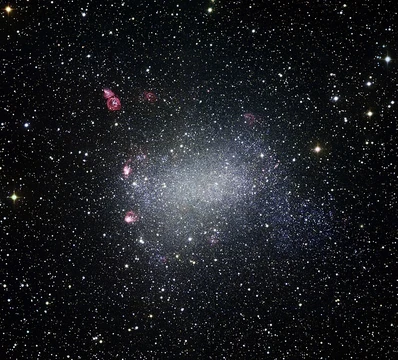
NGC 774
Lenticular galaxy with double stellar ring and a UV ring.

NGC 774 is a lenticular galaxy located in the constellation Aries, approximately 180 million light years from Earth. It was discovered by William Herschel on October 16, 1784, and is notable for its double stellar ring, a faint dust ring, and a ring visible in ultraviolet that may host active star formation.
Quick Facts
- Epoch
- J2000
- Ra
- 01 · 59 · 34.7
- Dec
- +14 · 00 · 30
- Dist Ly
- 179 ± 18 Mly (54.8 ± 5.5 Mpc)
- Z
- 0.015326 ± 0.000008
- H Radial V
- 4,595 ± 2 km/s
- Appmag V
- 13.1
- Constellation Name
- Aries
- Names
- UGC 1469, MCG +02-06-008, CGCG 438-010, PGC 7536
Facts from the source article.
Lore & Background
NGC 774 is a lenticular galaxy whose nucleus emits faint [NII]6584 and H-alpha emission. Ionised gas is distributed asymmetrically around the nucleus, extending up to 20 arcseconds (6 kpc at the galaxy's distance). Stellar kinematics reveal a double stellar ring, and a faint dust ring is also present. A ring visible in ultraviolet is possibly a site of active star formation, as it hosted a core-collapse supernova. One supernova, SN 2006ee, was observed in NGC 774; it was discovered on 18 August 2006 at an apparent magnitude of 17.6 by the Katzman Automatic Imaging Telescope and classified spectrally as a type II supernova. NGC 774 forms a pair with UGC 1468, located 4 arcminutes away, and is a member of a galaxy group that includes UGC 1496, NGC 786, UGC 1512, and NGC 792.
Reader's Guide
NGC 774 contributes to the study of lenticular galaxies with complex ring structures and star formation. Its ultraviolet ring, likely a region of active star formation, and the occurrence of a core-collapse supernova (SN 2006ee) within that ring provide insight into stellar evolution and the dynamics of gas in such galaxies. The double stellar ring and asymmetric ionised gas distribution offer clues to past interactions or mergers. As a member of a small galaxy group and paired with UGC 1468, NGC 774 helps astronomers understand galaxy interactions and group dynamics. The detection of faint [NII]6584 and H-alpha emission from its nucleus indicates ongoing low-level nuclear activity. The galaxy's discovery by William Herschel in 1784 places it within the historical catalog of deep-sky objects, and its continued observation with modern instruments like the Katzman Automatic Imaging Telescope underscores its relevance in contemporary astrophysical research.
Frequently Asked Questions
What is NGC 774?
NGC 774 is a lenticular galaxy sitting in the constellation Aries, roughly 180 million light years from Earth. It is best known for its layered ring structures that set it apart from typical smooth lenticular systems.
Who discovered NGC 774 and when?
William Herschel first recorded the galaxy on October 16, 1784, as part of his extensive deep-sky surveys. It has carried its New General Catalogue number ever since that initial observation.
What makes NGC 774 visually distinctive?
The galaxy displays a double stellar ring together with a faint dust ring, creating a striking layered profile. An additional ring visible in ultraviolet wavelengths hints at ongoing star formation within those ring structures.
How large is NGC 774?
It spans approximately 70,000 light years across, making it a fairly substantial lenticular system. At its 180-million-light-year distance, it appears as a compact but detailed target for deep-sky imaging.
What does its lenticular classification mean?
As a lenticular galaxy, NGC 774 occupies a middle ground between spiral and elliptical types, possessing a smooth disk without well-defined spiral arms. Its prominent ring structures are a characteristic feature often seen in this transitional class of galaxies.
More in NGC Objects, Part 2 1-24
Spotted an error? Know more?
Reader corrections go straight into our review queue. Suggest an edit · How this site is sourced