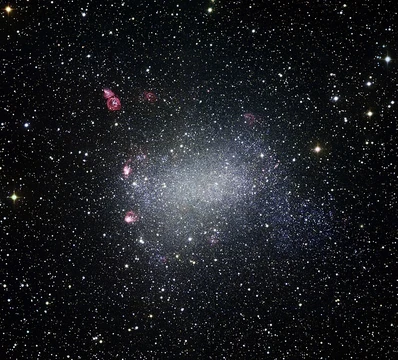
NGC 818
Intermediate spiral galaxy in Andromeda with a possible active nucleus.

NGC 818 is an intermediate spiral galaxy in the constellation Andromeda. It was discovered by William Herschel on 18 October 1786. The galaxy may contain an active galactic nucleus, meaning its center has a compact region emitting significant energy across the electromagnetic spectrum that does not come from stars. Its velocity relative to the cosmic microwave background gives a Hubble distance of about 59.14 ± 4.15 megaparsecs, while 14 other non-redshift measurements yield a closer mean distance of roughly 51.700 ± 2.565 megaparsecs. NGC 818 belongs to the galaxy group [CHM2007] LDC 148, which also includes NGC 834 and several other galaxies. Based on near-infrared K-band luminosity measurements of its bulge, the galaxy hosts a supermassive black hole with a mass of 13 million solar masses. One supernova, SN 1992az (Type II, magnitude 18), was observed in NGC 818 on 27 September 1992 by Christian Pollas.
Quick Facts
- Epoch
- J2000
- Constellation Name
- Andromeda
- Ra
- 02 · 08 · 44.5464ned
- Dec
- +38 · 46 · 37.596ned
- Z
- 0.014156 · 0.0000130ned
- Dist Ly
- 51.700 ± 2.565 Mpcned
- Group Cluster
- [CHM2007] LDC 148
- Appmag V
- 13.20ned
Facts from the source article.
Lore & Background
NGC 818 was discovered by German-British astronomer William Herschel on 18 October 1786. It is a member of the galaxy group [CHM2007] LDC 148, which also includes NGC 834 and several other galaxies. The galaxy's velocity relative to the cosmic microwave background yields a Hubble distance of 59.14 ± 4.15 Mpc, while 14 non-redshift measurements give a closer mean distance of 51.700 ± 2.565 Mpc, indicating some uncertainty in its exact distance.
The galaxy has a possible active galactic nucleus, meaning a compact central region emits significant energy across the electromagnetic spectrum, with characteristics suggesting the luminosity is not produced by stars. Based on near-infrared K-band luminosity measurements of its bulge, NGC 818 hosts a supermassive black hole with a mass of 13 million solar masses. One supernova, SN 1992az (Type II, magnitude 18), was observed in the galaxy, discovered by Christian Pollas on 27 September 1992.
Reader's Guide
NGC 818's significance lies in its dual distance measurements and the presence of a possible active galactic nucleus, which marks it as a galaxy with energetic central activity beyond ordinary stellar processes. The supermassive black hole at its core, with a mass of 13 million solar masses, places it among galaxies where black hole demographics can be studied. The supernova SN 1992az, a Type II event, adds to the record of stellar explosions in this system. As a member of the [CHM2007] LDC 148 group, NGC 818 contributes to understanding galaxy interactions and group dynamics. The discrepancy between its Hubble distance and closer non-redshift measurements highlights the challenges in determining extragalactic distances, making it a useful object for calibrating distance indicators. Its discovery by William Herschel in 1786 connects it to the early cataloging of deep-sky objects, and its continued observation helps refine models of galaxy evolution and black hole growth.
Frequently Asked Questions
What is NGC 818?
NGC 818 is an intermediate spiral galaxy located in the constellation Andromeda, first recorded by William Herschel on 18 October 1786.
Does NGC 818 have a black hole at its center?
Yes—its core is thought to host a supermassive black hole of roughly 13 million solar masses, and the galaxy may also contain an active galactic nucleus radiating energy well beyond what ordinary stars produce.
How far away is NGC 818?
Redshift-based estimates place it at about 59.14 ± 4.15 megaparsecs, while fourteen independent non-redshift measurements converge on a slightly nearer mean of roughly 51.7 ± 2.6 megaparsecs.
Has a supernova ever been observed in NGC 818?
Yes, SN 1992az, a Type II supernova peaking near magnitude 18, was detected in this galaxy.
What galaxy group does NGC 818 belong to?
It is a member of the local galaxy group designated [CHM2007] LDC 148.
More in NGC Objects, Part 2 1-24
Spotted an error? Know more?
Reader corrections go straight into our review queue. Suggest an edit · How this site is sourced