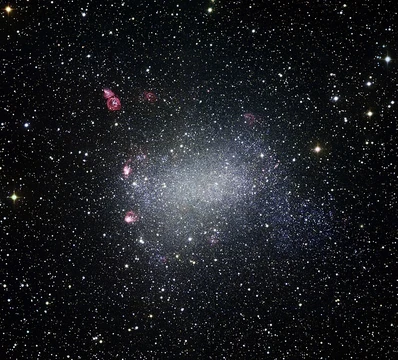
NGC 884
Eastern component of the Double Cluster in Perseus.

NGC 884, also known as χ Persei, is an open cluster of stars located 7,640 light years away in the constellation of Perseus. It forms the eastern component of the Double Cluster with NGC 869, and both clusters are often designated h and χ Persei, respectively. The cluster is about 14 million years old and is part of the Perseus OB1 association.
Quick Facts
- Epoch
- J2000
- Ra
- 02 · 22.0
- Dec
- +57 · 08
- Constellation
- Perseus
- Dist Ly
- 7.6 kly
- Appmag V
- 6.1
- Age
- 14 Myr
- Names
- Caldwell 14, Cr 25, Mel 14, Raab 10, OCl 353, Chi Per Cluster, χ Persei
Facts from the source article.
Lore & Background
The cluster was first recorded by Hipparchus and has been known since antiquity. It is located physically close to NGC 869, only a few hundred light years apart, and both clusters belong to the Perseus OB1 association. The Double Cluster is a favorite of amateur astronomers, visible with the unaided eye between the constellations of Perseus and Cassiopeia as a brighter patch in the winter Milky Way. In small telescopes, NGC 884 appears as a beautiful assemblage of bright stars in a rich star field, dominated by bright blue stars with a few orange stars that add visual interest. Both clusters together offer a spectacular low-magnification view.
Reader's Guide
NGC 884 is notable as part of the Double Cluster, a well-known pair of open clusters that has been observed since antiquity. The cluster's inclusion in the Caldwell catalogue, a catalogue of astronomical objects for amateur observation, underscores its appeal to amateur astronomers. The clusters are easy to find and are often photographed or observed with small telescopes, making them a popular target. The visual contrast between the dominant blue stars and the occasional orange stars enhances the cluster's aesthetic, and the rich star field surrounding it adds to the observing experience. The Double Cluster's visibility to the unaided eye and its location in the winter Milky Way contribute to its significance as a celestial landmark.
Frequently Asked Questions
What is NGC 884?
NGC 884 is an open star cluster in the constellation Perseus, sitting roughly 7,640 light years from Earth. It is also widely catalogued under the Greek-letter name χ Persei.
What role does NGC 884 play in the night sky?
It forms the eastern half of the Double Cluster, the visually striking pair created together with NGC 869 (h Persei). This pairing makes it one of the brightest and most recognizable open-cluster targets in the northern sky.
How old is NGC 884?
The cluster is estimated to be about 14 million years old, placing it firmly in the young-stellar category. It also belongs to the broader Perseus OB1 association of massive, recently formed stars.
Why is NGC 884 important to stargazers and astronomers?
Its tight visual pairing with NGC 869 gives observers the iconic Double Cluster, a favorite both for backyard telescopes and for professional studies of how open clusters evolve and eventually disperse. At 14 million years it also serves as a useful benchmark for stellar-age research.
Where exactly can I find NGC 884 in the sky?
Look in the constellation Perseus, just to the east (right) of its companion NGC 869. The two clusters sit close together, about 7,640 light years out, and are often visible to the naked eye under dark skies.
More in NGC Objects, Part 2 1-24
Spotted an error? Know more?
Reader corrections go straight into our review queue. Suggest an edit · How this site is sourced