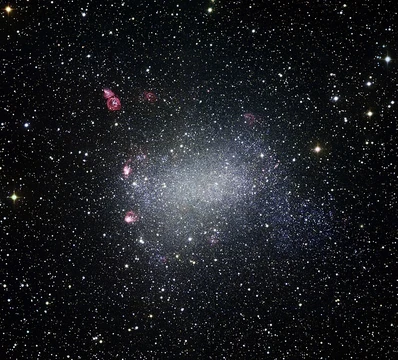
NGC 863
A changing look Seyfert galaxy in Cetus.

NGC 863, also known as Markarian 590, NGC 866, and NGC 885, is an unbarred spiral galaxy in the constellation Cetus. It lies about 300 million light years from Earth and spans roughly 110,000 light years across. The galaxy is notable as a changing look Seyfert galaxy, exhibiting dramatic shifts in its active galactic nucleus spectrum over time.
Quick Facts
- Epoch
- J2000
- Ra
- 02 · 14 · 33.6
- Dec
- -00 · 46 · 00
- Dist Ly
- 297 ± 19 Mly (91.1 ± 5.7 Mpc)
- Z
- 0.026385 ± 0.000040
- H Radial V
- 7,910 ± 10 km/s
- Appmag V
- 13.2
- Constellation Name
- Cetus
- Notes
- Seyfert galaxy
- Names
- NGC 863, NGC 866, NGC 885, UGC 1727, MCG +00-06-056, PGC 8586
Facts from the source article.
Lore & Background
NGC 863 was discovered by William Herschel on 6 January 1785. It was independently discovered by Lewis Swift on 3 October 1886, who also catalogued it again as a different galaxy on 31 October 1886, resulting in three listings in the New General Catalogue. John Louis Emil Dreyer described it as very faint, round, with a brighter middle and stellar appearance.
The galaxy's nucleus is active, powered by an accretion disk around a supermassive black hole. Its active galactic nucleus has been categorised as changing look, meaning its broad emission lines can disappear or reappear, shifting the galaxy between Seyfert types I and II. Originally classified as type I, later observations placed it as type 1.5 and type 1.9-2. The broad line emission strengthened by a factor of tens from the 1970s to the 1990s, then decreased about 100 times in the 2000s in optical, UV, and X-ray wavelengths, with the broad Hβ emission line disappearing completely. Observations by the Suzaku X-ray satellite in 2011 showed the soft X-ray excess emission could no longer be detected, while the X-ray continuum flux had minimal change; the variation is attributed to a change in accretion rate rather than obstruction. Infrared observations revealed a sharp decrease in luminosity between 2000 and 2001, and during the low activity period the circumnuclear dust torus radius decreased to 32 light days. In 2014, the soft excess emission reappeared in Chandra X-ray Observatory observations, along with the broad MgII emission line.
Radio emission is concentrated to a single core source, extending to two components at about 2 arcsec (~1 kpc) and 6 arcsec (~3 kpc) from the core, likely related to ring-like molecular gas structures. The outer gas ring is probably associated with the spiral arms, while the inner ring relates to faint dust lanes. A faint parsec-scale radio jet extending 2.8 mas to the north has been detected via very-long-baseline interferometry. X-ray observations have shown ultra fast outflows indicated by blueshifted absorption lines of O VIII, Ne IX, Si XIV, and Mg XII.
Reader's Guide
NGC 863's significance lies in its status as a changing look Seyfert galaxy, a class that provides direct insight into the variability of active galactic nuclei. The dramatic changes in its broad emission lines and X-ray spectrum over decades—from strengthening in the 1970s–1990s to a hundredfold decrease in the 2000s, followed by reappearance in 2014—demonstrate that such variations are driven by changes in accretion rate rather than obscuration. This makes it a key object for studying the physics of supermassive black hole accretion and the mechanisms behind Seyfert type transitions. The galaxy's multiwavelength behavior, including correlated radio and infrared variability, and the detection of ultra fast outflows in X-rays, further enrich understanding of feedback processes in active galaxies. Its triple listing in the New General Catalogue due to independent discoveries by Herschel and Swift adds historical interest, while the observation of a Type Ia supernova (SN 2018djd) in 2018 contributes to studies of stellar explosions in active environments.
Did You Know?
- NGC 863 is also catalogued as NGC 866 and NGC 885 due to independent discoveries by Lewis Swift.
- It is a changing look Seyfert galaxy, shifting between Seyfert types I and II as its broad emission lines appear or disappear.
- The broad Hβ emission line completely disappeared in the 2000s and later reappeared by 2014.
- One Type Ia supernova, SN 2018djd, was observed in this galaxy in July 2018.
Frequently Asked Questions
What is NGC 863?
NGC 863 is an unbarred spiral galaxy located in the constellation Cetus, roughly 300 million light years from Earth. It spans about 110,000 light years across, making it comparable in scale to the Milky Way.
What makes NGC 863 special or notable?
It is classified as a changing look Seyfert galaxy, meaning its active galactic nucleus undergoes dramatic shifts in its spectral output over time. This kind of variability is rare and gives astronomers a live look at how AGN behavior can evolve.
What other designations does NGC 863 carry?
In addition to NGC 863, the galaxy is listed as Markarian 590, NGC 866, and NGC 885. These duplicate entries stem from independent historical surveys that catalogued the same object under different numbers.
Where in the sky can I find NGC 863?
Look toward the constellation Cetus, the mythological sea monster, to locate this galaxy. At a distance of about 300 million light years, it is far beyond naked-eye visibility and requires a decent telescope to resolve its spiral form.
What type of galaxy is NGC 863?
It is an unbarred spiral, so it displays winding spiral arms without the central bar structure found in barred spirals. Its active, variable Seyfert nucleus adds an energetic core on top of the classic spiral morphology.
More in NGC Objects, Part 2 1-24
Spotted an error? Know more?
Reader corrections go straight into our review queue. Suggest an edit · How this site is sourced