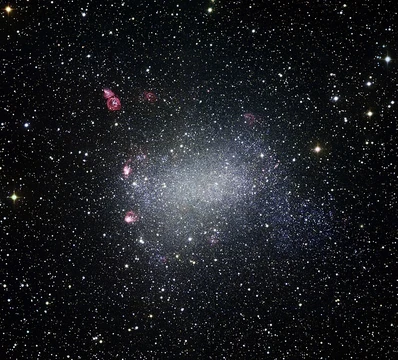
NGC 751
Elliptical galaxy in a close interacting pair with NGC 750.

NGC 751 is an elliptical galaxy located about 225 million light-years away in the constellation Triangulum. It forms a close interacting pair with the galaxy NGC 750, and together they are cataloged as Arp 166 in the Atlas of Peculiar Galaxies, under the category for galaxies with diffuse filaments.
The smaller and fainter of the two, NGC 751 was first resolved on October 11, 1850, by Irish engineer and astronomer Bindon Stoney, using Lord Rosse's 72-inch telescope. William Herschel had discovered a galaxy at this position on September 12, 1784, but he did not separate the pair, recording it as a single object, NGC 750.
The two galaxies have been undergoing strong tidal interactions for at least 100 million years. Their centers are separated by 21 arcseconds, or about 10 kiloparsecs in projection, and both have nearly identical central radial velocities. While NGC 750 shows nearly flat radial velocity curves, NGC 751's curves vary by more than 100 km/s along the slit. A large, diffuse tidal tail extends 20 arcseconds (10 kiloparsecs) to the northeast of the pair.
Quick Facts
- Epoch
- J2000.0
- Constellation Name
- Triangulum
- Ra
- 01 · 57 · 33.00
- Dec
- +33 · 12 · 11.00
- Z
- 0.017185
- H Radial V
- 5152 ± 8 km/s
- Dist Ly
- 225 Mly
- Appmag B
- 13.20
- Appmag V
- 12.20
- Names
- PGC 7370, MCG +05-05-035, UGC 1431, Arp 166
Facts from the source article.
Lore & Background
NGC 751 was first resolved on October 11, 1850, by Irish engineer and astronomer Bindon Stoney, who used Lord Rosse's 72-inch telescope. The galaxy had been observed earlier by William Herschel on September 12, 1784, but he did not resolve the close pair and described it as a single object, NGC 750. NGC 751 is smaller and fainter than its companion.
The pair is characterized by strong tidal interactions and distortions. At least 100 million years have passed since the first strong tidal perturbation between them, and they remain in a state of efficient tidal interaction. The projected distance between their centers is 21 arcseconds, or 10 kiloparsecs. Both galaxies have nearly identical central radial velocities, but while NGC 750 shows nearly flat radial velocity curves, NGC 751 exhibits large variations of more than 100 km/s along the slit. A large, diffuse tidal tail extends 20 arcseconds (10 kpc) to the northeast of the pair.
Reader's Guide
NGC 751 is significant as the fainter component of Arp 166, a classic example of interacting galaxies with diffuse filaments. Its discovery history illustrates the challenge of resolving close galaxy pairs with early telescopes: William Herschel saw only a single object, while Bindon Stoney, using Lord Rosse's larger instrument, separated the two components 66 years later. The pair's ongoing tidal interaction, with a projected separation of 10 kpc and a diffuse tidal tail extending another 10 kpc, provides a clear case study of gravitational perturbation over timescales exceeding 100 million years. The contrasting radial velocity curves—flat in NGC 750 but varying by over 100 km/s in NGC 751—highlight the different internal responses to the same tidal forces. As part of the Atlas of Peculiar Galaxies, NGC 751 and its companion help astronomers understand the structural evolution of galaxies under mutual gravitational influence.
Did You Know?
- NGC 751 was discovered 66 years after NGC 750 was first observed.
- A diffuse tidal tail extends 10 kpc to the northeast of the pair.
Frequently Asked Questions
What kind of object is NGC 751?
NGC 751 is an elliptical galaxy located roughly 225 million light-years from Earth in the constellation Triangulum. It is the smaller and fainter member of a tight interacting pair with the galaxy NGC 750.
Who first identified NGC 751 as a separate galaxy?
Irish astronomer Bindon Stoney resolved the pair on October 11, 1850, using Lord Rosse's 72-inch reflector. William Herschel had noted a galaxy at that sky position back in 1784, but he never distinguished the two objects from one another.
What is NGC 751's Arp catalog number and why?
Together with NGC 750, it is listed as Arp 166 in the Atlas of Peculiar Galaxies. The pair earned that entry because of the diffuse filamentary structures visible between the two galaxies.
How far away is NGC 751 and where should I look?
The galaxy sits about 225 million light-years distant and can be found in the constellation Triangulum. Because it is the fainter of its interacting pair, it demands a moderately sized instrument and dark skies to observe comfortably.
What makes NGC 751 and NGC 750 interesting to observers?
The two galaxies are gravitationally interacting, producing the diffuse filaments that earned them their Arp 166 listing. NGC 751, being the less luminous partner, is the more challenging of the two to resolve visually.
More in NGC Objects, Part 2 1-24
Spotted an error? Know more?
Reader corrections go straight into our review queue. Suggest an edit · How this site is sourced