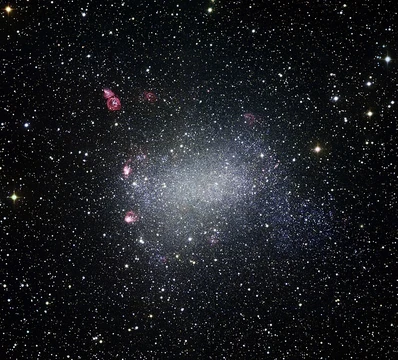
NGC 869
Western component of the Double Cluster in Perseus.

NGC 869, also called h Persei, is an open star cluster roughly 7,460 light-years away in the constellation Perseus. At about 14 million years old, it forms the western half of the Double Cluster, with NGC 884 as its eastern companion. The two clusters lie a few hundred light-years apart within the Perseus OB1 association. Known since antiquity, they were first recorded by the Greek astronomer Hipparchus.
The designations h and χ (chi) Persei for NGC 869 and NGC 884, respectively, have caused some confusion. It is sometimes thought that Bayer did not distinguish the pair as two separate patches of nebulosity, and that χ referred to the whole Double Cluster while h marked a nearby star. Bayer’s chart for Perseus in *Uranometria* does not show them as nebulous, but his chart for Cassiopeia does, and they are described as *Nebulosa Duplex* in Schiller’s *Coelum Stellatum Christianum*, compiled with Bayer’s help.
The Double Cluster is a popular target for small telescopes and astrophotography. Naked-eye observers can spot it as a brighter patch in the winter Milky Way, between Perseus and Cassiopeia. In small telescopes, NGC 869 appears as a group of bright stars set in a rich star field, dominated by blue stars but also containing a few orange ones.
Quick Facts
- Epoch
- J2000
- Constellation
- Perseus
- Ra
- 02 · 19.1
- Dec
- +57 · 09
- Dist Ly
- 7460 ly
- Appmag V
- 5.3
- Names
- Caldwell 14, Cr 24, Mel 13, · h Per, h Persei
Facts from the source article.
Lore & Background
NGC 869 and NGC 884 are often designated h and χ (chi) Persei, respectively. Some confusion surrounds what Bayer intended by these designations. It is sometimes claimed that Bayer did not resolve the pair into two patches of nebulosity, and that χ refers to the Double Cluster and h to a nearby star. Bayer's Uranometria chart for Perseus does not show them as nebulous objects, but his chart for Cassiopeia does, and they are described as 'Nebulosa Duplex' in Schiller's Coelum Stellatum Christianum, which was assembled with Bayer's help. The clusters are both located in the Perseus OB1 association, a few hundred light years apart from each other. The clusters were first recorded by Hipparchus, thus have been known since antiquity.
Reader's Guide
The Double Cluster, including NGC 869, is often photographed and observed with small telescopes. The clusters are visible with the unaided eye between the constellations of Perseus and Cassiopeia as a brighter patch in the winter Milky Way. In small telescopes, the cluster appears as an assemblage of bright stars located in a rich star field. Dominated by bright blue stars, the cluster also hosts a few orange stars. Its long history, dating back to Hipparchus, and its prominent place in the winter sky make it a notable object for both casual observers and astronomers. The uncertainty surrounding Bayer's designations adds a layer of historical interest, reflecting the challenges of early celestial mapping. The cluster's membership in the Perseus OB1 association and its proximity to NGC 884 underscore its role in understanding stellar groupings and the structure of the Milky Way.
Did You Know?
- NGC 869 is the western component of the Double Cluster with NGC 884.
- The cluster is around 14 million years old.
- It was first recorded by Hipparchus and has been known since antiquity.
Frequently Asked Questions
What is NGC 869?
NGC 869, also known as h Persei, is an open star cluster located in the constellation Perseus. It serves as the western member of the famous Double Cluster, paired with NGC 884 to its east.
How far away is NGC 869 from Earth?
The cluster sits roughly 7,460 light-years from our solar system, placing it well within the Milky Way's disk but still far enough to require a telescope to resolve its individual stars.
What is the Double Cluster and how does NGC 869 fit in?
The Double Cluster is a pair of nearby open clusters—NGC 869 and NGC 884—that sit only a few hundred light-years apart within the larger Perseus OB1 association. NGC 869 makes up the western half of this visually striking duo.
How old is NGC 869?
At approximately 14 million years, the cluster is quite young by galactic standards, meaning its stars are still in relatively early stages of their lifecycles.
Who first recorded NGC 869 in the sky?
The cluster was catalogued as far back as the Hellenistic era by the Greek astronomer Hipparchus, making it one of the oldest star groupings known to Western astronomy. Its Bayer designations (h and chi Persei) have since caused some mix-up over whether the ancients saw it as one patch of light or two.
More in NGC Objects, Part 2 1-24
Spotted an error? Know more?
Reader corrections go straight into our review queue. Suggest an edit · How this site is sourced