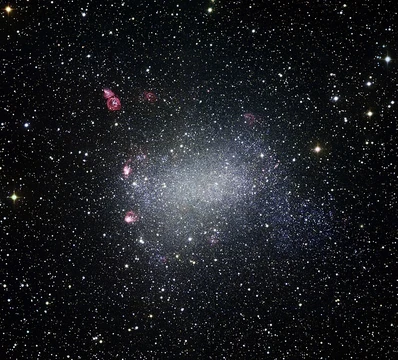
NGC 973
Giant edge-on spiral galaxy with an active nucleus.

NGC 973 is a giant spiral galaxy located in the constellation Triangulum, approximately 200 million light-years from Earth. It is notable for its large size, spanning about 230,000 light-years across, and for being the largest member of the NGC 973 group, one of the largest galaxy groups in the Perseus–Pisces Supercluster.
Quick Facts
- Epoch
- J2000
- Ra
- 02 · 34 · 20.1
- Dec
- +32 · 30 · 20
- Dist Ly
- 195 ± 16 Mly (60.0 ± 4.8 Mpc)
- Z
- 0.016195 ± 0.000027
- H Radial V
- 4,855 ± 8 km/s
- Appmag V
- 12.8
- Constellation Name
- Triangulum
- Notes
- Seyfert galaxy
- Names
- UGC 2048, CGCG 505-014, MCG +05-07-013, PGC 9795
Facts from the source article.
Lore & Background
NGC 973 is seen edge-on, with an inclination of nearly 90°. Its bulge has a boxy or peanut shape, and subtraction of axisymmetric components reveals an X-like morphology, indicating the presence of a bar. A prominent dust lane runs across the galaxy. Kinematic studies show that the northeast side is approaching and the southwest is receding; the disk appears flat without warps. The total hydrogen mass and dust mass have been estimated, with the dust distributed in a clumpy pattern. Faint H-alpha emission from gas outside the galactic plane has been detected, correlated with the disk and halo.
The galaxy's nucleus is active, classified as a Type II Seyfert galaxy, with the energy source believed to be an accretion disk around a supermassive black hole. NGC 973 forms a pair with IC 1815, located 4.6 arcminutes to the south. A small satellite galaxy, discovered in HI imaging near the northeast edge of the disk, has no optical counterpart. One supernova, SN 2025agyg, has been observed in NGC 973.
Reader's Guide
NGC 973 holds significance as a giant spiral galaxy and the dominant member of the NGC 973 group, which contains at least 39 identified galaxies and is one of the largest groups in the Perseus–Pisces Supercluster. Its edge-on orientation and boxy, X-shaped bulge provide a clear example of a barred spiral galaxy viewed at nearly 90° inclination. The prominent dust lane and flat disk offer insights into the structure and kinematics of such galaxies. The detection of faint H-alpha emission outside the plane suggests interactions between the disk and halo. As a Type II Seyfert galaxy, its active nucleus contributes to the study of supermassive black holes and accretion processes. The discovery of a small, optically invisible satellite in HI imaging highlights the presence of dark or gas-rich companions. The recorded supernova adds to the observational history of the galaxy.
Did You Know?
- NGC 973 is about 230,000 light-years across, larger than the Milky Way.
- A small satellite galaxy with no optical counterpart was discovered in HI imaging near its northeast edge.
- One supernova, SN 2025agyg, was observed in NGC 973 on 24 November 2025.
Frequently Asked Questions
What is NGC 973?
NGC 973 is a giant edge-on spiral galaxy with an active nucleus, classifying it as a Type II Seyfert galaxy. It also serves as the dominant member of the NGC 973 group, one of the largest galaxy groups in the Perseus–Pisces Supercluster.
How large is NGC 973?
The galaxy stretches roughly 230,000 light-years across, making it one of the bigger spiral systems known. Its enormous diameter is a key reason it anchors the NGC 973 group as the largest member.
Where is NGC 973 located and how far away is it?
It resides in the constellation Triangulum and sits approximately 200 million light-years from Earth. That means the light reaching your telescope today departed the galaxy around two hundred million years ago.
What makes NGC 973 special among deep-sky targets?
Its Type II Seyfert nucleus gives it an active core that distinguishes it from ordinary spirals, while its sheer size and group-dominant role make it a standout object in the Perseus–Pisces Supercluster. Together these traits make it a favorite for observers chasing large, luminous galaxies.
Who discovered NGC 973 and when?
American astronomer Lewis Swift first recorded the galaxy on October 30, 1885. It has retained its NGC 973 catalogue designation in the New General Catalogue ever since.
More in NGC Objects, Part 2 1-24
Spotted an error? Know more?
Reader corrections go straight into our review queue. Suggest an edit · How this site is sourced