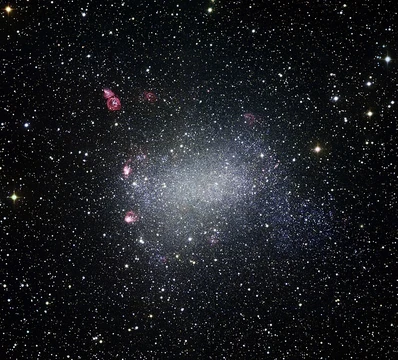
NGC 936
Barred lenticular galaxy nicknamed Darth Vader’s Galaxy.

NGC 936 is a barred lenticular galaxy in the constellation Cetus, approximately 60 million light-years from Earth. It is notable for its high surface brightness nucleus and prominent bar, which together with a ring of stars at the end of the bar give it a shape reminiscent of a TIE fighter from the Star Wars universe, leading to its informal names Darth Vader’s Galaxy or Darth Vader’s Starfighter.
Quick Facts
- Epoch
- J2000
- Ra
- 02 · 27 · 37.4
- Dec
- -01 · 09 · 22
- Dist Ly
- 67.7 ±
- Appmag V
- 10.2
- Constellation Name
- Cetus
- Names
- UGC 1929, PGC 9359
Facts from the source article.
Lore & Background
NGC 936 was discovered by William Herschel on 6 January 1785, who initially classified it as a planetary nebula due to its round shape. The galaxy’s disc was studied by Kormendy in 1986, who measured its radial velocity and found the disc to be stable, explaining its smooth appearance. One supernova, SN 2003gs, has been observed in NGC 936; it was a peculiar Type Ia supernova characterized by fast evolution, peaking at magnitude 14.
The galaxy forms a visual pair with the spiral galaxy NGC 941 at a separation of 12.6 arcminutes, but the two do not interact. NGC 936 is the primary member of the NGC 936 group, which also includes NGC 955, UGC 01945, and IC 225. This group is associated with the Messier 77 group.
Reader's Guide
NGC 936’s significance lies in its distinctive morphology, which has drawn a popular comparison to a TIE fighter from Star Wars, earning it the nicknames Darth Vader’s Galaxy and Darth Vader’s Starfighter. This resemblance arises from the combination of its bright nucleus, prominent bar, and the ring of stars at the bar’s ends. Scientifically, the galaxy is important for studies of disc stability; Kormendy’s 1986 work demonstrated that the disc’s radial velocity profile indicates a stable configuration, accounting for its unusually smooth appearance. The galaxy also contributes to understanding supernova diversity through SN 2003gs, a peculiar Type Ia event with a fast evolution. As the central member of the NGC 936 group, which is linked to the Messier 77 group, it provides context for galaxy group dynamics and large-scale structure. Its discovery by William Herschel, who misidentified it as a planetary nebula, adds historical interest to its observational record.
Did You Know?
- NGC 936 is informally called Darth Vader’s Galaxy due to its resemblance to a TIE fighter.
- It was discovered by William Herschel in 1785, who initially thought it was a planetary nebula.
- The galaxy’s disc was found to be stable in 1986 by Kormendy, explaining its smooth appearance.
- One supernova, SN 2003gs, was observed in NGC 936 and classified as a peculiar Type Ia with fast evolution.
Frequently Asked Questions
What is NGC 936?
NGC 936 is a barred lenticular galaxy located in the constellation Cetus, roughly 60 million light-years from Earth. Its elongated central bar, capped by a ring of stars, gives it a silhouette that fans routinely liken to a Star Wars TIE fighter.
Why is NGC 936 nicknamed 'Darth Vader's Galaxy'?
The informal nickname comes from the galaxy's visual profile: a bright, high-surface-brightness nucleus sits at the center of a prominent bar, and a ring of stars flares out at the bar's tip, together evoking the shape of a TIE starfighter. Long-exposure astrophotographs make the resemblance especially striking, cementing the 'Darth Vader' moniker in the amateur-astronomy community.
Who discovered NGC 936 and when?
William Herschel first recorded the galaxy on 6 January 1785 while conducting his systematic southern-sky surveys. It was subsequently entered into the New General Catalogue under the designation 936.
Has a supernova ever been observed in NGC 936?
Yes—SN 2003gs exploded in the galaxy and reached a peak apparent magnitude of about 14. It was classified as a peculiar Type Ia supernova, meaning its light curve and spectral features deviated noticeably from the standard Type Ia template.
What other galaxies are gravitationally associated with NGC 936?
NGC 936 anchors a small local group that also contains NGC 955, UGC 01945, and IC 225. All four members share a similar distance from Earth and are bound to one another by mutual gravity.
More in NGC Objects, Part 2 1-24
Spotted an error? Know more?
Reader corrections go straight into our review queue. Suggest an edit · How this site is sourced