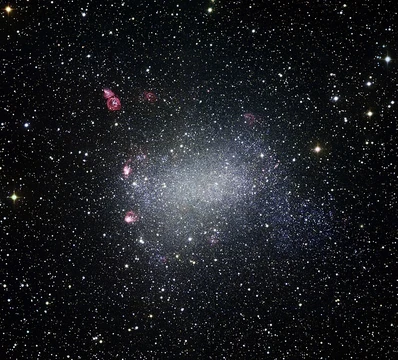
NGC 1511
Barred spiral galaxy in Hydrus, central member of its group.

NGC 1511 is a barred spiral galaxy in the southern constellation Hydrus. Its motion relative to the cosmic microwave background gives a recessional velocity of 1341 ± 5 km/s, which translates to a Hubble distance of roughly 64 million light-years (19.76 ± 1.39 Mpc). British astronomer John Herschel first spotted it on 2 November 1834.
In 2002, astronomers Eskridge, Frogel, and Pogge published a morphological study of 205 closely spaced spiral and lenticular galaxies, using infrared H-band and blue B-band observations. They described NGC 1511 as part of that sample.
The galaxy is the central member of the NGC 1511 group (also designated LGG 107), as defined by A.M. Garcia. Some sources include additional galaxies in this group.
One supernova has been recorded in NGC 1511: SN 1935C (unknown type, magnitude 12.5). Emily Hughes Boyce discovered it on 16 August 1935. Initially thought to be either a supernova or a nova in the Large Magellanic Cloud, it was classified as a nova and cataloged as HV 11970 or Nova Hydri 1935. In September 1988, Sidney van den Bergh and Martha L. Hazen conclusively identified it as a supernova in NGC 1511, and it was redesignated SN 1935C.
Quick Facts
- Constellation Name
- Hydrus
- Epoch
- J2000
- Ra
- 03 · 59 · 36.9554
- Dec
- -67 · 38 · 03.094
- Dist Ly
- 19.76 ± 1.39 Mpc
- Group Cluster
- NGC 1511 Group (LGG 107)garcia
- Z
- 0.004474
- H Radial V
- 1341 ± 5 km/s
- Appmag V
- 11.3
Facts from the source article.
Lore & Background
NGC 1511 was discovered by British astronomer John Herschel on 2 November 1834. Its velocity relative to the cosmic microwave background is 1341 ± 5 km/s, corresponding to a Hubble distance of 19.76 ± 1.39 Mpc (about 64 million light-years). The galaxy is the central member of the NGC 1511 group (LGG 107), which includes several other galaxies; some sources also include an additional galaxy in this group.
In 2002, Eskridge, Frogel, and Pogge published a study of the morphology of 205 closely spaced spiral or lenticular galaxies, observing in the H-band (infrared) and B-band (blue). They described the morphology of NGC 1511 as part of that work.
One supernova has been observed in NGC 1511: SN 1935C. It was discovered by Emily Hughes Boyce on 16 August 1935, with an apparent magnitude of 12.5 and an unknown type. Initially thought to be either a supernova or a nova associated with the Large Magellanic Cloud, it was classified as a nova and known as HV 11970 or Nova Hydri 1935. In September 1988, Sidney Van den Bergh and Martha L. Hazen concluded definitively that the object was a supernova in NGC 1511, and it was given the designation SN 1935C.
Reader's Guide
NGC 1511 holds significance as the central member of its eponymous group (LGG 107), a small galaxy cluster in the southern constellation Hydrus. Its barred spiral structure was characterized in a 2002 morphological survey of over 200 galaxies, contributing to the understanding of such galaxies in the infrared and blue bands. The galaxy's most notable legacy involves the supernova SN 1935C, which underwent a decades-long identity crisis. Discovered in 1935 by Emily Hughes Boyce, it was initially mistaken for a nova in the Large Magellanic Cloud and cataloged as HV 11970 or Nova Hydri 1935. It was not until 1988 that Sidney Van den Bergh and Martha L. Hazen reclassified it definitively as a supernova within NGC 1511, resolving the confusion. This case illustrates the challenges of early extragalactic astronomy and the importance of careful re-examination. The galaxy's Hubble distance of about 64 million light-years places it within a relatively nearby volume, making it a useful target for studies of galaxy groups and supernova demographics.
Did You Know?
- NGC 1511 was discovered by John Herschel on 2 November 1834.
- The supernova SN 1935C was initially classified as a nova and called Nova Hydri 1935.
- Sidney Van den Bergh and Martha L. Hazen reclassified SN 1935C as a supernova in September 1988.
More in NGC Objects, Part 2 1-24
Spotted an error? Know more?
Reader corrections go straight into our review queue. Suggest an edit · How this site is sourced