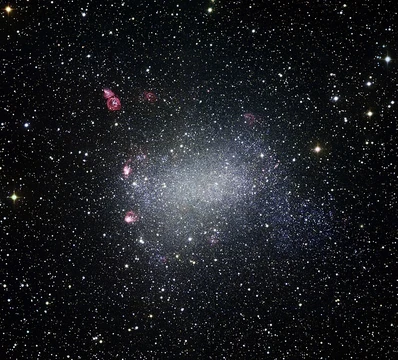
NGC 1502
A young open cluster of about 60 stars in Camelopardalis.

NGC 1502, also known as the Golden Harp Cluster, is a young open cluster of approximately 60 stars in the constellation Camelopardalis. It has a visual magnitude of 6.0 and is dimly visible to the naked eye, located at the outer edge of the Cam OB1 association of co-moving stars, likely part of the Orion Arm.
Quick Facts
- Epoch
- J2000
- Constellation
- Camelopardalis
- Ra
- 04 · 07 · 48.96
- Dec
- +62 · 19 · 55.2
- Appmag V
- 6.0
- Radius Ly
- 1.7 pc
- Age
- 5 Myr
- Names
- NGC 1502, Cr 45
Facts from the source article.
Lore & Background
Discovered by William Herschel on November 3, 1787, NGC 1502 is a young open cluster with a Trumpler class of II3p, indicating a poorly populated cluster with a wide brightness range. Its main sequence turnoff point is not well-defined, leading to age estimates ranging from five to fifteen million years. The cluster is heavily reddened due to interstellar dust. The asterism known as Kemble's Cascade appears to flow into NGC 1502, but this is a chance alignment of stars. One of the brightest candidate members is the eclipsing binary SZ Cam, which is a component of the visual double star ADS 2984. The cluster contains eleven variable stars and four candidate variables, including a β Cep, two periodic B-type variables, 2–3 eclipsing variables, and an RR Lyrae star. Five members are chemically peculiar.
Reader's Guide
NGC 1502 is notable as a young open cluster at the outer edge of the Cam OB1 association, likely part of the Orion Arm. Its age uncertainty, between five and fifteen million years, reflects a poorly defined main sequence turnoff. The cluster's heavy reddening from interstellar dust affects its observed properties. The presence of multiple variable star types—including β Cep, B-type periodic variables, eclipsing variables, and an RR Lyrae star—makes it a valuable target for stellar variability studies. The chemically peculiar members add further interest. The visual double star ADS 2984, containing the eclipsing binary SZ Cam, is among its brightest candidate members. The chance alignment with Kemble's Cascade enhances its visual appeal. The runaway star Alpha Camelopardalis may have been ejected from this cluster, linking it to broader stellar dynamics. Despite its modest population of about 60 stars, NGC 1502 offers insights into early stellar evolution and cluster dynamics.
Did You Know?
- NGC 1502 is also known as the Golden Harp Cluster.
- The asterism Kemble's Cascade appears to flow into NGC 1502 but is a chance alignment.
- Alpha Camelopardalis is a runaway star possibly ejected from this cluster.
More in NGC Objects, Part 2 1-24
Spotted an error? Know more?
Reader corrections go straight into our review queue. Suggest an edit · How this site is sourced