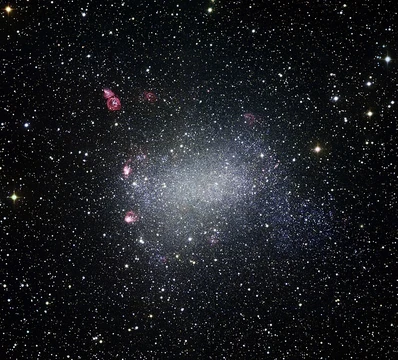
NGC 1493
Barred spiral Seyfert II galaxy in Horologium, discovered by James Dunlop.

NGC 1493 is a barred spiral galaxy in the constellation Horologium, discovered by Scottish astronomer James Dunlop on 2 September 1826. Its velocity relative to the cosmic microwave background is 1004 ± 4 km/s, placing it at a Hubble distance of 14.81 ± 1.04 Mpc, though six non-redshift measurements yield a closer average distance of 10.848 ± 0.525 Mpc. The SIMBAD database classifies it as a Seyfert II Galaxy, meaning its nucleus is quasar-like—very bright, with strong, highly ionised emission lines—yet the surrounding host galaxy remains clearly visible.
In 2002, Eskridge, Frogel, and Pogge studied the morphology of 205 closely spaced spiral or lenticular galaxies in the infrared H-band and blue B-band, describing NGC 1493 in that work. The galaxy is the namesake of the NGC 1493 group (also known as LGG 106), which, according to A.M. Garcia, contains six galaxies including NGC 1483, PGC 13979, and PGC 14125. One supernova has been observed in NGC 1493: SN 2024abfo, a Type II event with a magnitude of 16.793, discovered by ATLAS on 15 November 2024.
Quick Facts
- Constellation Name
- Horologium
- Epoch
- J2000
- Ra
- 03 · 57 · 27.4555
- Dec
- -46 · 12 · 38.554
- Dist Ly
- 14.81 ± 1.04 Mpc
- Group Cluster
- NGC 1493 Group (LGG 106)
- Z
- 0.003512
- H Radial V
- 1053 ± 1 km/s
- Appmag V
- 11.3
Facts from the source article.
Lore & Background
NGC 1493 was discovered by Scottish astronomer James Dunlop on 2 September 1826. The SIMBAD database classifies it as a Seyfert II Galaxy, characterized by a bright, quasar-like nucleus with high-ionisation emission lines, yet the host galaxy is clearly visible. Its velocity relative to the cosmic microwave background is 1004 ± 4 km/s, yielding a Hubble distance of 14.81 ± 1.04 Mpc, though six non-redshift measurements indicate a closer distance of 10.848 ± 0.525 Mpc, preserving a discrepancy between the two distance estimates.
In terms of morphology, a 2002 study by Eskridge, Frogel, and Pogge examined NGC 1493 in the H-band (infrared) and B-band (blue) as part of a survey of 205 closely spaced spiral or lenticular galaxies. The galaxy is the namesake of the NGC 1493 group (also known as LGG 106), which includes six galaxies: NGC 1483, PGC 13979, and PGC 14125, among others.
One supernova has been observed in NGC 1493: SN 2024abfo, a Type II supernova with magnitude 16.793, discovered by ATLAS on 15 November 2024.
Reader's Guide
NGC 1493 holds significance as a barred spiral galaxy with a Seyfert II nucleus, bridging the characteristics of active galactic nuclei and normal galaxies. Its classification as a Seyfert II Galaxy places it in a category where the central engine is powerful but the host galaxy remains observable, offering insights into the interplay between supermassive black holes and their galactic environments. The galaxy's membership in the NGC 1493 group (LGG 106) situates it within a small cluster of six galaxies, providing a context for studying group dynamics and interactions. The distance discrepancy between Hubble-based and non-redshift measurements—14.81 ± 1.04 Mpc versus 10.848 ± 0.525 Mpc—highlights ongoing uncertainties in extragalactic distance scales. The detection of a Type II supernova, SN 2024abfo, adds to its legacy as a site of stellar death and nucleosynthesis, observed by the ATLAS survey in 2024. The morphological study by Eskridge, Frogel, and Pogge in 2002 further contributes to the understanding of spiral galaxy structure across infrared and blue wavelengths, making NGC 1493 a useful object for comparative galaxy morphology.
Did You Know?
- It is classified as a Seyfert II Galaxy, with a bright nucleus but a clearly detectable host galaxy.
- One supernova, SN 2024abfo (Type II, mag. 16.793), was observed in NGC 1493 on 15 November 2024.
More in NGC Objects, Part 2 1-24
Spotted an error? Know more?
Reader corrections go straight into our review queue. Suggest an edit · How this site is sourced