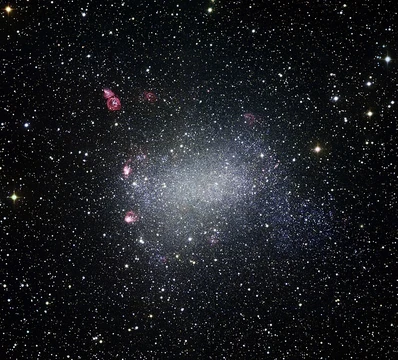
NGC 1432
Reflection nebula surrounding Maia in the Pleiades cluster.

NGC 1432 is a reflection nebula that surrounds the star Maia, also known as 20 Tauri, within the Pleiades open star cluster (Messier 45). This nebula is one of the brighter patches of nebulosity in the cluster and is sometimes referred to as the Maia Nebula. It holds the distinction of being the only object in the New General Catalogue that was discovered using photographic methods.
- Designation
- NGC 1432
- Also known as
- Maia Nebula
- Associated star
- Maia (20 Tauri)
- Location
- Pleiades open star cluster (Messier 45)
- Discovery method
- Photographic
Lore & Background
NGC 1432 is a reflection nebula that surrounds the star Maia, a blue giant of spectral type B8 III and a chemically peculiar star. Maia is the fourth-brightest star in the Pleiades cluster, after Alcyone, Atlas and Electra. The nebula is one of the brighter patches of nebulosity within the Pleiades star cluster.
The distance to Maia has been measured by the Gaia spacecraft using the annual parallax method. Gaia Data Release 2 gives a parallax corresponding to a certain distance, while the 2007 new Hipparcos reduction gives a statistically more accurate parallax indicating a different distance. Analysis of Gaia parallaxes for the whole Pleiades cluster gives an average distance, and VLBI measurements of multiple members give another distance.
Maia's visual magnitude is 3.87. Its bolometric luminosity is 501 times that of the Sun, mostly in the ultraviolet, suggesting a radius of 3.6 times that of the Sun and a mass of 3.8 solar masses. Interferometric measurements give an angular diameter suggesting a radius assuming a distance, and allow the effective temperature to be estimated. Maia is a chemically peculiar star, classified as a helium-weak star, but also shows an excess of some elements including manganese.
Reader's Guide
NGC 1432 holds significance as a reflection nebula within the well-known Pleiades star cluster, a prominent feature of the winter night sky. Its association with Maia, one of the seven sisters of Greek mythology, ties it to a rich mythological tradition. The nebula is notable for being the only New General Catalogue object discovered photographically, marking a milestone in astronomical observation methods.
The nebula's brightness and location within the Pleiades make it a target for astrophotography, as seen in high-resolution images and APOD features. The surrounding star Maia has been studied for its variability, with observations from Kepler/K2 showing low-amplitude variability with a period of 10.3 days, attributed to the rotation of a starspot. Maia was once thought to be a variable star of a proposed class called Maia variables, but it is now thought to be a rotating variable rather than a pulsating one.
The legacy of NGC 1432 includes its role in the study of reflection nebulae and chemically peculiar stars. The nebula's discovery photographically represents an early use of that technique in cataloging celestial objects. Its place in the Pleiades cluster, whose distance has been measured by multiple methods including Gaia and VLBI, contributes to ongoing research in stellar distances and cluster dynamics.
Did You Know?
- NGC 1432 is the only member of the New General Catalogue discovered photographically.
- The nebula surrounds Maia, the fourth-brightest star in the Pleiades cluster.
- Maia was once proposed as a prototype for a class of variable stars called Maia variables, but is now thought to be a rotating variable.
More in NGC Objects, Part 2 1-24
Spotted an error? Know more?
Reader corrections go straight into our review queue. Suggest an edit · How this site is sourced