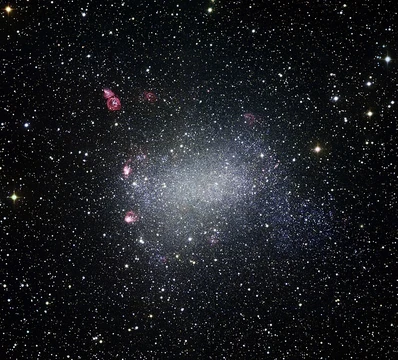
NGC 1376
A face-on spiral galaxy with active star-forming regions.

NGC 1376 is a spiral galaxy about 180 million light-years from Earth, located in the constellation Eridanus. It was first spotted in 1785 by William Herschel and measures roughly 79,000 light-years in diameter. The galaxy does not appear to have an active galactic nucleus, but it is rich in star-forming regions.
Bright blue knots of gas, concentrated along the spiral arms, mark where new stars are actively forming. These areas shine strongly in ultraviolet light because they contain hot, young stars. In contrast, the redder, dimmer regions near the galaxy’s center and between the arms are made up mostly of older stars. Dark reddish dust lanes trace cooler, denser clouds where interstellar material is collapsing to create new stars. Behind the spiral arms, a scattering of reddish background galaxies can be seen.
NGC 1376 is a type of spiral galaxy that appears nearly face-on from our perspective. This orientation gives astronomers a relatively clear, unobstructed view of its details and features.
Three supernovae have been observed in NGC 1376. SN 1999go, a Type II supernova with a magnitude of 15.5, was discovered by the Lick Observatory Supernova Search on 23 December 1999. For several weeks, its brightness matched that of the entire galactic nucleus as seen from ground-based telescopes. SN 2003lo, a Type IIn supernova with a magnitude of 17.2, was found by Tim Puckett and B. Kerns on 31 December 2003. SN 2011dx, a Type Ia supernova with a magnitude of 16.5, was discovered on 27 June 2011.
Quick Facts
- Epoch
- J2000
- Constellation Name
- Eridanus
- Ra
- 03 · 37 · 05.80
- Dec
- -05 · 02 · 36
- Z
- 0.013873±0.00003
- Dist Ly
- 180 Mly (55.1 Mpc)
- Appmag V
- 12.1
- Names
- IRAS 03346-0512, MCG-01-10-011, PGC 13352, GSC 04722-00875
- Notes
- Older stars near core
Facts from the source article.
Lore & Background
NGC 1376 is a spiral galaxy seen nearly face on from Earth, a perspective that allows astronomers to study its features with relatively little obstruction. Its spiral arms are marked by bright blue knots of gas, which are areas of active star formation. These regions emit strongly in ultraviolet light due to the presence of hot, newborn stars. In contrast, the galaxy's core and the areas between its arms appear redder, consisting mainly of older stars. Dark reddish dust lanes trace cooler, denser regions where interstellar clouds collapse to form new stars. Behind the galaxy, a sprinkling of reddish background galaxies is visible.
Reader's Guide
NGC 1376 is significant for its nearly face-on orientation, which offers a clear view of its spiral structure and star-forming activity. The galaxy does not host an active galactic nucleus, but it contains numerous star-forming regions concentrated along its spiral arms. These regions, visible as bright blue knots, highlight areas where hot, young stars emit ultraviolet light. The contrast between these blue knots and the redder older stars in the core and between the arms helps astronomers understand the distribution of stellar populations. Three supernovae have been observed in NGC 1376: SN 1999go (Type II, magnitude 15.5), discovered in December 1999, which briefly rivaled the brightness of the entire galactic nucleus; SN 2003lo (Type IIn, magnitude 17.2), discovered in December 2003; and SN 2011dx (Type Ia, magnitude 16.5), discovered in June 2011. These events provide insights into stellar evolution and the galaxy's history of massive star formation.
Did You Know?
- NGC 1376 was discovered in 1785 by William Herschel.
- It is located about 180 million light-years away in the constellation Eridanus.
- The galaxy is seen nearly face on, offering an unobscured view of its spiral arms.
More in NGC Objects, Part 2 1-24
Spotted an error? Know more?
Reader corrections go straight into our review queue. Suggest an edit · How this site is sourced