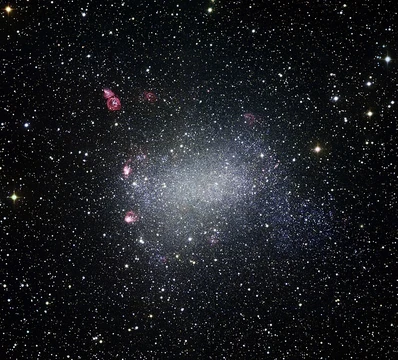
NGC 1375
A barred lenticular galaxy with uncertain cluster membership.

NGC 1375 is a barred lenticular galaxy in the constellation Fornax. It is notable for its low recession velocity, which has led to uncertainties about its membership in the Fornax Cluster and whether it forms a pair with the nearby galaxy NGC 1374.
Quick Facts
- Epoch
- J2000
- Ra
- 03 · 35.16
- Dec
- -35 · 13
- Dist Ly
- 8.5 Mpc
- Z
- 643 km/s
- Appmag V
- 12.2
- Constellation Name
- Fornax
- Notes
- Boxy-shaped bulge
Facts from the source article.
Lore & Background
NGC 1375 was discovered by John Herschel on November 29, 1837. It is an early-type galaxy with a Hubble classification of SB0 pec, indicating it is a barred lenticular galaxy. Early-type galaxies are much older than spiral galaxies and consist mostly of old, red-colored stars, with very little star formation occurring in them. The lack of star formation in such galaxies appears to start at the center and slowly propagate outward.
This galaxy contains a boxy bulge, making it one of the few lenticular galaxies known to have such a feature; another example is NGC 1175. Boxy bulges have been found mostly in edge-on galaxies, though recent studies show they are possible in galaxies with an inclination of less than 70°, of types S0 and Sb, such as NGC 1532 in the Fornax Cluster. Other examples with much less inclination include the barred spiral galaxies NGC 3049 and IC 676.
NGC 1375 is a member of the NGC 1386 Group, which also includes NGC 1386, NGC 1389, and NGC 1396, galaxies with similar distance uncertainties. Its position in the night sky is near the center of the Fornax Cluster and the central galaxy NGC 1399. The closest galaxy after NGC 1374 is NGC 1373.
Reader's Guide
NGC 1375 holds significance as a barred lenticular galaxy with a boxy bulge, a feature rare among lenticular galaxies. Its low recession velocity of about 643 km/s, the lowest in the entire Fornax Cluster, has raised uncertainties about its membership in the cluster. It may be a foreground galaxy unrelated to the Fornax Cluster, and it is uncertain whether it forms a physical pair with NGC 1374. These ambiguities affect the understanding of the NGC 1386 Group, of which it is a member, as other galaxies in that group have similar distance uncertainties. The galaxy's diameter of 23,000 light-years, derived from its apparent size of 2.3 x 0.9 arcminutes and its estimated distance of 28 million light-years, places it among the smaller members of the cluster region. Its boxy bulge contributes to studies of galactic structure, as such bulges are not limited to edge-on galaxies but can appear in galaxies with lower inclinations, as seen in other Fornax Cluster members like NGC 1532. The legacy of NGC 1375 lies in its role as a case study for the complexities of cluster membership and the diversity of bulge morphologies in early-type galaxies.
Did You Know?
- NGC 1375 has the lowest recession velocity in the entire Fornax Cluster, about 643 km/s.
- It is one of the few lenticular galaxies known to contain a boxy bulge.
- The galaxy's diameter is estimated at 23,000 light-years.
More in NGC Objects, Part 2 1-24
Spotted an error? Know more?
Reader corrections go straight into our review queue. Suggest an edit · How this site is sourced