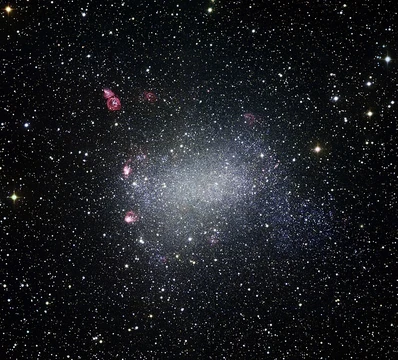
NGC 1358
A Seyfert 2 galaxy with a heavily veiled active nucleus.

NGC 1358 sits in the constellation Eridanus, roughly 190 million light-years away. This barred lenticular galaxy, marked by ring-like structures, is a Seyfert 2 type. Its core hosts an active galactic nucleus powered by a supermassive black hole, producing strong X-ray and infrared radiation.
The galaxy is heavily obscured by gas and dust, a condition known as Compton-thick obscuration, where column densities exceed 10²⁴ atoms per square centimeter. Observations from telescopes like NuSTAR and XMM-Newton, taken over multiple epochs, show changes in its X-ray absorption linked to the black hole’s feeding and feedback processes.
NGC 1358 is often pictured together with the nearby galaxy NGC 1355. High-resolution images from the Hubble Space Telescope, taken as recently as 2024, have allowed detailed study of the narrow-line region and its motion. Research has mapped the extent, shape, and kinematics of this region in Seyfert galaxies, revealing signs of outflows driven by the active nucleus. Data from the OASIS spectrograph, along with follow-up work by Chandra and NuSTAR, have clarified the nuclear activity and obscuration. Studies of the galaxy’s environment, including possible interactions with NGC 1355, help explain its evolution. Analysis of its globular cluster system and outer ring structures points to a complex formation history.
Quick Facts
- Epoch
- J2000
- Ra
- 03 · 33 · 39.7
- Dec
- -05 · 05 · 22
- Dist Ly
- 190 Mly
- Z
- 0.0134
- Appmag B
- 13.20
- Appmag V
- 12.78
- Constellation Name
- Eridanus
- Names
- LEDA 13182, 2MASX J03333970-0505224, IRAS F03311-0515
- H Radial V
- 4,002 km/s
Facts from the source article.
Lore & Background
NGC 1358 was discovered by astronomer John Herschel on 1 December 1837 during his observations from the Cape of Good Hope. The galaxy is characterized by Compton-thick obscuration, where its central core is heavily veiled by gas and dust with column densities exceeding 10^24 atoms/cm². Multi-epoch monitoring with telescopes such as NuSTAR and XMM-Newton has revealed variability in its X-ray absorption, linked to AGN feeding and feedback processes.
The galaxy is often imaged alongside NGC 1355. Recent observations using the Hubble Space Telescope have provided high-resolution O III and continuum images, enabling detailed studies of the narrow-line region and its kinematics. Research has explored the extents, geometries, and kinematics of the NLR in Seyfert galaxies like NGC 1358, identifying signatures of AGN-driven outflows. High ionization line images from the OASIS spectrograph and follow-up observations with Chandra and NuSTAR have further characterized the nuclear activity and obscuration. Analysis of its globular cluster system and outer ring structures suggests a complex formation history.
Reader's Guide
NGC 1358 holds significance as a Compton-thick Seyfert 2 galaxy, offering a laboratory for studying active galactic nuclei under extreme obscuration. Its variability in X-ray absorption, observed across multiple epochs with NuSTAR and XMM-Newton, provides insight into the dynamic processes of AGN feeding and feedback. High-resolution Hubble Space Telescope imaging of the narrow-line region has advanced understanding of AGN-driven outflows and their kinematics. The galaxy's environment, including potential interactions with nearby NGC 1355, has been studied to understand its evolutionary context. The presence of globular cluster systems and outer ring structures points to a complex formation history, making NGC 1358 a valuable target for research into galaxy evolution and nuclear activity.
Did You Know?
- NGC 1358 is a barred lenticular galaxy with ring features located in Eridanus.
- It is classified as a Seyfert 2 galaxy with a Compton-thick obscured nucleus.
- The galaxy was discovered by John Herschel on 1 December 1837 from the Cape of Good Hope.
- Multi-epoch monitoring with NuSTAR and XMM-Newton has shown variability in its X-ray absorption.
More in NGC Objects, Part 2 1-24
Spotted an error? Know more?
Reader corrections go straight into our review queue. Suggest an edit · How this site is sourced