NGC 1350
A spiral galaxy with two rings resembling a cosmic eye.

NGC 1350 is a spiral galaxy about 87 million light-years from Earth, located in the southern constellation Fornax (the Furnace). Scottish astronomer James Dunlop first spotted it on 24 November 1826.
Spanning roughly 130,000 light-years across, NGC 1350 is slightly larger than the Milky Way. Its classification is Sa(r), meaning it is a spiral galaxy with arms wound tightly enough to form a prominent central ring. A faint outer pseudo-ring is sometimes noted in the classification as "R'1." The galaxy lies on the outskirts of the Fornax Cluster, but whether it truly belongs to the cluster is uncertain due to its distance.
One supernova has been observed in NGC 1350: SN 1959A, discovered by Howard S. Gates on 6 January 1959. Its type is unknown, and it reached magnitude 16.
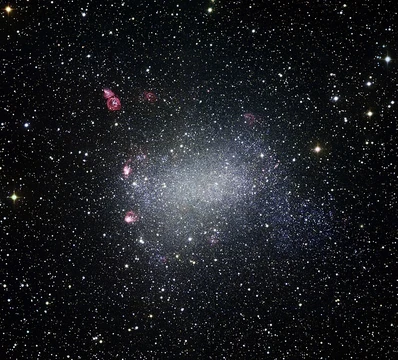
An almost-true color composite image of NGC 1350 was taken with the VLT's 8.2-meter Kueyen telescope on 26 January 2000, at the European Southern Observatory site at Cerro Paranal, Chile. The observations used four filters: B (blue) for 6 minutes, V (green) for 4 minutes, R (orange) for 3 minutes, and I (red) for 3 minutes. The image covers 8.0 by 5.0 arcminutes of sky, with north to the left and east down.
The galaxy’s viewing angle and two rings give it the look of a cosmic eye. Its outer arms are tenuous, allowing many background galaxies to be seen through them. The blue tint in the outer region signals ongoing star formation.
NGC 1350 is a member of the NGC 1316 group (also known as LGG 94), which contains at least 20 galaxies, including IC 335, NGC 1310, NGC 1316, NGC 1317, NGC 1326A, NGC 1341, NGC 1365, NGC 1380, NGC 1381, NGC 1382, NGC 1404, and NGC 1427A.
Quick Facts
- Epoch
- J2000
- Ra
- 03 · 31 · 08.074
- Dec
- -33 · 37 · 41.959
- Z
- 0.006354
- Dist Ly
- 87.4 Mly (26.8 Mpc)
- Group Cluster
- NGC 1316 group (LGG 94)
- Appmag V
- 11.46
- Constellation Name
- Fornax
- Notes
- pronounced ring structure
Facts from the source article.
Lore & Background
NGC 1350 was discovered by Scottish astronomer James Dunlop on 24 November 1826. It is classified as an Sa(r) galaxy, meaning its spiral arms are wound tightly enough to form a prominent central ring. A faint outer ring, called a pseudo-ring, is sometimes designated with the prefix "R'1." The galaxy measures roughly 130,000 light years across, slightly larger than the Milky Way.
NGC 1350 lies on the outskirts of the Fornax Cluster of galaxies, but its membership in the cluster is uncertain due to distance. It is a member of the NGC 1316 group (also known as LGG 94), which includes at least 20 galaxies such as IC 335, NGC 1310, NGC 1316, NGC 1317, NGC 1326A, NGC 1341, NGC 1365, NGC 1380, NGC 1381, NGC 1382, NGC 1404, and NGC 1427A.
One supernova has been observed in NGC 1350: SN 1959A (type unknown, magnitude 16), discovered by Howard S. Gates on 6 January 1959. An almost-true color composite image of the galaxy was made with the VLT's 8.2 meter Kueyen telescope on 26 January 2000 at the European Southern Observatory site at Cerro Paranal, Chile. The image covers 8.0 x 5.0 arcminutes, with north to the left and east down. The outer region's blue tint indicates star formation, and a number of background galaxies are visible through the tenuous outer arms.
Reader's Guide
NGC 1350's significance lies in its distinctive structure: a tightly wound inner ring and a faint outer pseudo-ring that together create an eye-like appearance. This morphology makes it a valuable example of an Sa(r) galaxy, illustrating how spiral arms can form rings. Its location on the outskirts of the Fornax Cluster raises questions about its membership, highlighting the challenges of determining galaxy group affiliations at distances of 87 million light years. The galaxy's membership in the NGC 1316 group (LGG 94) places it within a well-studied collection of at least 20 galaxies, providing context for understanding galaxy interactions and evolution in a group environment. The observation of SN 1959A, though of unknown type, adds to the historical record of supernovae in this galaxy. The high-quality VLT image from 2000, with its multi-wavelength exposures, has allowed astronomers to study the galaxy's star-forming regions (indicated by blue tints in the outer arms) and the background galaxies visible through its tenuous outer structure. NGC 1350 thus serves as both an aesthetic object and a scientific case study in ringed spiral galaxies and group dynamics.
Did You Know?
- NGC 1350 is slightly larger than the Milky Way, measuring about 130,000 light years across.
- The galaxy's outer ring is called a pseudo-ring and is sometimes designated 'R'1.'
- Only one supernova, SN 1959A, has been observed in NGC 1350, discovered by Howard S. Gates.
More in NGC Objects, Part 2 1-24
Spotted an error? Know more?
Reader corrections go straight into our review queue. Suggest an edit · How this site is sourced