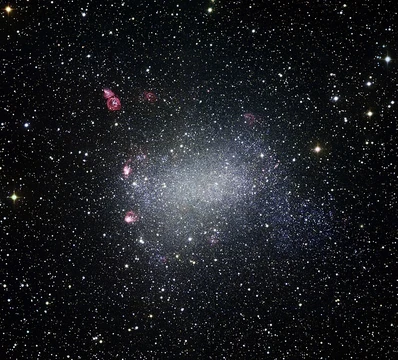
NGC 1343
A barred spiral galaxy with intense starburst activity and a faint dwarf companion.

NGC 1343 is a barred spiral galaxy with unusual features, found in Cassiopeia and overlapping slightly into Camelopardalis. Its most prominent trait is a bright blue inner ring, where intense starburst activity occurs, encircling a small, dense core. A faint bar links the core to this ring, and from the ring, subtle spiral arms extend outward, dotted with visible star clusters. The galaxy has a low surface brightness and is further dimmed by dust from the Milky Way, making it appear faint from Earth.
A faint dwarf companion galaxy, cataloged as HFLLZOA G134.74+13.65, lies to the northeast of NGC 1343’s core. A possible faint star stream or bridge hints at gravitational interaction between the two, though the main galaxy’s disk shows little distortion. The inner ring itself is nearly circular, with a slight gap, and likely formed through resonance effects common in barred galaxies.
One supernova has been recorded in NGC 1343. SN 2008dv, a Type Ic event reaching magnitude 18.2, was spotted by Japanese astronomer Kōichi Itagaki on July 1, 2008. The galaxy was first discovered by German-British astronomer William Herschel on October 17, 1786.
Quick Facts
- Epoch
- J2000
- Ra
- 03 · 37 · 50
- Dec
- 72 · 34 · 16
- Dist Ly
- 4,2 ± 0,8 Mpc
- Z
- +0,007348 ± 0,000067
- Appmag B
- 13.67
- Appmag V
- 12.37
- Constellation Name
- Cassiopeia
- Names
- UGC 2792, PGC 13384
- H Radial V
- 2214 km/s
Facts from the source article.
Lore & Background
NGC 1343 was discovered by the German-British astronomer William Herschel on October 17, 1786. The galaxy features a nearly circular inner ring, likely formed by resonance effects typical in barred galaxies, which shows a slight gap and is connected to the core by a faint bar. Subtle spiral arms with visible star clusters extend outward from the ring. A faint dwarf companion, designated HFLLZOA G134.74+13.65, lies northeast of the core, and a possible faint star stream or bridge suggests gravitational interaction, though the disk of NGC 1343 shows minimal distortion. Due to its low surface brightness and position behind the Milky Way’s dust, the galaxy is relatively faint when observed from Earth.
Reader's Guide
NGC 1343 is significant as a nearby example of a starburst galaxy with a well-defined inner ring and bar structure, offering insights into resonance-driven star formation in barred spirals. Its intense starburst activity within the blue inner ring indicates a recent or ongoing burst of star formation, while the faint bar and subtle spiral arms provide clues to the dynamics of gas inflow and star cluster formation. The presence of a dwarf companion and a possible star stream suggests a mild gravitational interaction that may have triggered the starburst, yet the minimal distortion of the main disk implies a relatively gentle encounter. The recorded supernova SN 2008dv, a Type Ic event, adds to the galaxy's value as a site for studying massive star evolution and core-collapse supernovae. Its faintness due to foreground Milky Way dust makes it a challenging target for amateur observers but an interesting object for professional studies of obscured galaxies.
Did You Know?
- NGC 1343 was discovered by William Herschel on October 17, 1786.
- It has a bright blue inner ring surrounding a compact core, indicating intense starburst activity.
- Supernova SN 2008dv (Type Ic, mag. 18.2) was observed in NGC 1343 on 1 July 2008.
More in NGC Objects, Part 2 1-24
Spotted an error? Know more?
Reader corrections go straight into our review queue. Suggest an edit · How this site is sourced