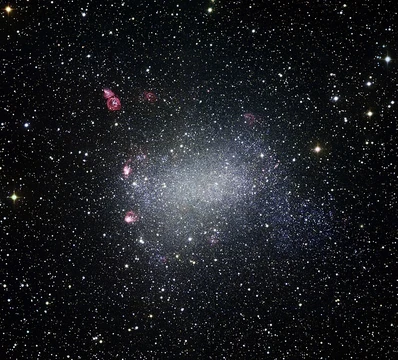
NGC 1320
Spiral Seyfert 2 galaxy in Eridanus with a supermassive black hole.

NGC 1320 is a spiral galaxy in the constellation Eridanus, classified as a Seyfert 2 active galaxy with a luminous class I core that emits ultraviolet light. It appears in the Markarian catalog as Mrk 607. Discovered by William Herschel in 1784, its speed relative to the cosmic microwave background is 2,620 ± 15 km/s, yielding a Hubble distance of about 38.6 ± 2.7 Mpc (roughly 126 million light-years). A non-redshift-based measurement gives a distance of approximately 37,700 Mpc (about 123 million light-years), consistent with the Hubble value. The central supermassive black hole has been estimated at 1.51 × 10⁷ solar masses (2002 study), 15 × 10⁶ solar masses (2007 study of 90 Seyfert 2 galaxies), and 19.5 million solar masses (2012 study based on velocity dispersion in the central region). One supernova, SN1994aa (type Ia, magnitude 17), was observed on 11 September 1994 by Robert H. McNaught.
Quick Facts
- Constellation Name
- Eridanus
- Epoch
- J2000
- Ra
- 03h 24m 48s
- Dec
- -03° 02 31
- Appmag V
- 14
- Sbrightness
- 23.01 mag/arcsec2
- Z
- 0.009283
- H Radial V
- 2,783 km/s
- Dist Ly
- 126 Mly (38.6 Mpc)
- Names
- Mrk 607, PGC 12756, KUG 0322-032, IRAS 03222-0313, MCG -01-09-036
Facts from the source article.
Lore & Background
NGC 1320 was discovered by the German-British astronomer William Herschel in 1784. It is a spiral galaxy with luminosity class I and is classified as an active Seyfert 2 galaxy, meaning its nucleus emits strongly in the ultraviolet. The galaxy is also cataloged as Mrk 607 in the Markarian catalog.
Multiple studies have estimated the mass of its central supermassive black hole. A 2002 paper gave a mass of 1.51 × 10⁷ M☉, while a 2007 study of 90 Seyfert 2 galaxies using velocity dispersion estimated 15 × 10⁶ M☉. A 2012 study based on velocity dispersion of the central region of NGC 3982 (likely a misattribution in the notes) gave 19.5 million M☉.
One supernova has been observed in NGC 1320: SN1994aa, a Type Ia supernova of magnitude 17, discovered by Scottish-Australian astronomer Robert H. McNaught on 11 September 1994.
Reader's Guide
NGC 1320 holds significance as a Seyfert 2 galaxy, a class of active galactic nuclei that are important for understanding the physics of supermassive black holes and their interaction with host galaxies. Its inclusion in the Markarian catalog highlights its ultraviolet-bright core, a key feature for studying the energetic processes near the central black hole. The multiple estimates of its black hole mass—ranging from 1.51 × 10⁷ M☉ to 19.5 million M☉—reflect the ongoing refinement of measurement techniques, such as velocity dispersion studies, and underscore the challenges in determining black hole masses in active galaxies. The detection of a Type Ia supernova, SN1994aa, adds to its value as a site for studying stellar explosions and their use as standard candles. The galaxy's distance, measured both via Hubble flow and a non-redshift method, shows consistency within uncertainties, reinforcing its role as a benchmark object in extragalactic astronomy. Its legacy lies in contributing to the broader understanding of Seyfert galaxies, black hole demographics, and supernova physics.
Did You Know?
- NGC 1320 is listed in the Markarian catalog as Mrk 607.
- Its central supermassive black hole mass has been estimated at 1.51 × 10⁷ M☉ (2002) and 15 × 10⁶ M☉ (2007).
- One supernova, SN1994aa (Type Ia, mag 17), was discovered in NGC 1320 on 11 September 1994.
- The galaxy's core shines in the ultraviolet region.
More in NGC Objects, Part 2 1-24
Spotted an error? Know more?
Reader corrections go straight into our review queue. Suggest an edit · How this site is sourced