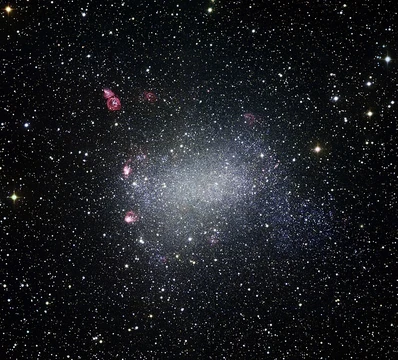
NGC 1313
An irregular field galaxy with a ragged appearance and strong starburst activity.

NGC 1313, also known as the Topsy Turvy Galaxy, is an irregular field galaxy discovered by Scottish astronomer James Dunlop on 27 September 1826. It lies within the Virgo Supercluster and has a diameter of about 50,000 light-years, roughly half the size of the Milky Way. The galaxy is notable for its strikingly uneven shape, strong starburst activity, and the presence of a rare WO star.
Quick Facts
- Epoch
- J2000.0
- Constellation Name
- Reticulum
- Ra
- 03 · 18 · 15.4
- Dec
- -66 · 29 · 50
- Z
- 0.001568
- Dist Ly
- 12.886 Mly
- Names
- Topsy Turvy Galaxy, PGC 12286, ESO 082- G 011
Facts from the source article.
Lore & Background
NGC 1313 was discovered by James Dunlop on 27 September 1826. Its uneven shape and axis of rotation offset from its center, combined with scattered patches of intense star formation, give the galaxy a ragged appearance. These features, along with strong starburst activity and associated supershells, suggest a past galactic collision, yet the galaxy appears isolated with no direct neighbors, leaving it unclear whether it has swallowed a small companion. Young, blue stars are scattered across the galaxy, evidence of infant mortality in which young open clusters quickly became gravitationally unglued, scattering their resident stars. The galaxy bears some resemblance to the Magellanic Clouds and hosts two ultraluminous X-ray sources, NGC 1313 X-1 and X-2, the former being a rare intermediate-mass black hole. In 2007, a rare WO star, designated [HC2007] 31 and of spectral type WO3, was discovered in NGC 1313; its derived absolute magnitude of about -5 is very high for a single WO star, suggesting it is likely part of a binary or small stellar association. Two supernovae have been observed: SN 1962M (Type II, mag. 11.7) discovered by José Sérsic on 26 November 1962, and SN 1978K (Type IIn, mag. 16) discovered by Stuart Ryder in January 1990, originally reported as a nova but later identified from archival photographs as an outburst on 31 July 1978, indicating a very unusual Type II supernova.
Reader's Guide
NGC 1313's significance lies in its role as a nearby laboratory for studying starburst activity and the aftermath of possible galactic mergers. Its ragged appearance and uneven shape, coupled with strong star formation and supershells, provide insight into the dynamics of isolated galaxies that may have cannibalized smaller companions. The discovery of the rare WO3 star [HC2007] 31, with an unusually high absolute magnitude, offers a unique opportunity to study the evolution of massive stars in binary systems or small associations. The two observed supernovae, particularly the unusual Type IIn SN 1978K, contribute to understanding supernova diversity. The presence of ultraluminous X-ray sources, including an intermediate-mass black hole candidate, makes NGC 1313 a key target for studying black hole accretion and the connection between star formation and high-energy phenomena. Its resemblance to the Magellanic Clouds also aids comparative studies of irregular galaxies.
Did You Know?
- NGC 1313 is also called the Topsy Turvy Galaxy.
- A rare WO3 star, [HC2007] 31, was discovered in NGC 1313 in 2007 with an absolute magnitude of about -5.
- Two supernovae have been observed in NGC 1313: SN 1962M and SN 1978K.
More in NGC Objects, Part 2 1-24
Spotted an error? Know more?
Reader corrections go straight into our review queue. Suggest an edit · How this site is sourced