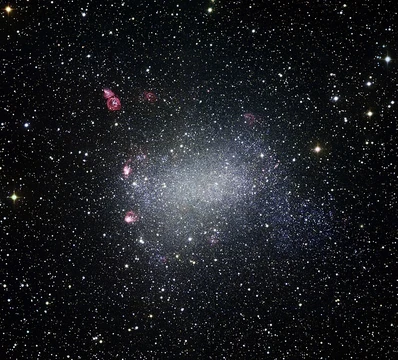
NGC 1291
A ring galaxy with an inner bar and outer ring.

NGC 1291, also cataloged as NGC 1269, is a ring galaxy located about 33 million light-years away in the constellation Eridanus. It is notable for its unusual inner bar and outer ring structure, and was cited as an example of a 'transitional galaxy' by NASA's Galaxy Evolution Explorer team in 2007.
Quick Facts
- Epoch
- J2000
- Ra
- 03 · 15 · 29.6
- Dec
- -41 · 17 · 25.6
- Dist Ly
- 33 Mly
- Z
- 0.002799 (839 ± 2 km/s)
- Appmag V
- 9.39
- Absmag V
- −21.05
- Constellation Name
- Eridanus
- Notes
- inner bar and outer ring structure
- Names
- PGC 012209
Facts from the source article.
Lore & Background
NGC 1291 was discovered by James Dunlop in 1826 and later entered into the New General Catalogue as NGC 1291 by Johan Ludvig Emil Dreyer. John Herschel observed the same object in 1836 and entered it as NGC 1269, unaware it was a duplicate. The galaxy faces the Solar System nearly face-on, with a prominent bulge and a disk that forms stars slowly, characteristic of a lenticular galaxy. It hosts a population of old globular clusters, about 65% of which are 'blue' and metal-poor, while the rest are 'red' and more metal-rich. The concentric inner and outer disk structures visible in DECam imagery are thought to result from a past merger with a gas-rich galaxy, with the inner disk further shaped by density waves radiating from the galactic center. Data for that image came from the Dark Energy Survey archive (2013–2019), obtained with the Dark Energy Camera on the Víctor M. Blanco Telescope at Cerro Tololo Inter-American Observatory.
Reader's Guide
NGC 1291 holds significance as a transitional galaxy, a classification highlighted by NASA's Galaxy Evolution Explorer team in 2007. Its dual catalog entries (NGC 1291 and NGC 1269) reflect a historical observational duplication by John Herschel, who recorded it independently in 1836. The galaxy's structure—a prominent bulge, a slowly star-forming disk, and concentric inner and outer rings—provides evidence of a past merger with a gas-rich galaxy, with density waves from the center shaping the inner disk. Its globular cluster population, split into metal-poor blue and metal-rich red groups, offers insights into early-type galaxy evolution. The DECam image, sourced from the Dark Energy Survey archive, visually captures these features, contributing to studies of galaxy formation and morphology. The galaxy's nearly face-on orientation makes it a valuable target for understanding ring and bar dynamics.
More in NGC Objects, Part 2 1-24
Spotted an error? Know more?
Reader corrections go straight into our review queue. Suggest an edit · How this site is sourced