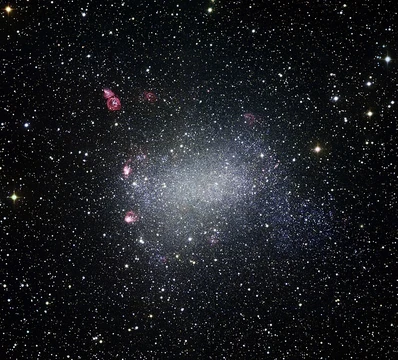
NGC 1277
A relic galaxy with ancient stars and little dark matter.

NGC 1277 is a lenticular galaxy in the constellation Perseus, a member of the Perseus Cluster. It is located approximately 73 Mpc (240 million light-years) from the Milky Way and has an apparent magnitude of about 14.7. Discovered on December 4, 1875, by Lawrence Parsons, 4th Earl of Rosse, it has been called a 'relic of the early universe' due to its stars forming during a 100 million year interval about 12 billion years ago, at a rate 1000 times that of the Milky Way's formation rate. It was the first galaxy confirmed as a relic galaxy — a nearby, passively evolved counterpart of the compact 'red nugget' galaxies observed at redshift z ≈ 2 — and has since served as the archetype of this class.
Quick Facts
- Epoch
- J2000
- Constellation Name
- Perseus
- Ra
- 03 · 19 · 51.5
- Dec
- 41 · 34 · 25
- Z
- 0.016898
- H Radial V
- 5066 km/s
- Gal V
- 5168 km/s
- Dist Ly
- 73 Mpc
- Group Cluster
- Perseus Cluster
- Appmag V
- 14.66
- Names
- PGC 12434, LGG 088
Facts from the source article.
Lore & Background
NGC 1277's stars were formed in a brief, intense burst about 12 billion years ago, lasting only 100 million years, at a rate 1000 times that of the Milky Way's formation. After this process ended, the galaxy was left with metal-rich stars about 7 billion years older than the Sun. Observations with the Hubble Space Telescope indicate that NGC 1277 lacks metal-poor globular clusters, suggesting it has accreted little mass over its lifetime, supporting the relic galaxy hypothesis.
The galaxy has a very unusual rotation curve that suggests it contains very little dark matter. Initial observations using the Hobby–Eberly Telescope suggested a supermassive black hole with a mass of about 17 billion solar masses, equivalent to 14% of the total stellar mass. However, a follow-up study based on the same data estimated the black hole between 2 and 5 billion solar masses, less than a third of the initial estimate. Models with no black hole were also found to provide reasonably good fits to the data.
Subsequent investigations using adaptive optics produced differing results. One group using the Gemini Near Infrared Integral Field Spectrometer estimated a mass similar to the 2–5 billion solar mass range. Another group using the Keck Telescope calculated a black hole mass of about 5 billion solar masses. Subsequent independent dynamical models, including Jeans models and models incorporating dark matter, have supported the higher value of approximately 5 billion solar masses, which still places NGC 1277 well above standard black hole–galaxy scaling relations.
Reader's Guide
NGC 1277 holds significant importance as the first confirmed relic galaxy, serving as the archetype for this class of objects. Its status as a nearby, passively evolved counterpart of the compact 'red nugget' galaxies observed at high redshift provides a unique laboratory for studying early galaxy formation processes. The galaxy's stellar population, formed in a brief, intense burst 12 billion years ago with a star formation rate 1000 times that of the Milky Way, offers direct evidence of the rapid assembly and quenching that characterized massive galaxies in the early universe. The lack of metal-poor globular clusters, as observed by the Hubble Space Telescope, supports the idea that NGC 1277 has accreted little mass over its lifetime, preserving its relic state. The galaxy's unusual rotation curve, suggesting very little dark matter, challenges standard models of galaxy formation and dark matter distribution. The supermassive black hole at its center has been a subject of significant debate, with mass estimates ranging from 2 to 5 billion solar masses, and even models with no black hole fitting the data. Despite the uncertainty, the black hole's mass relative to the galaxy's stellar mass places it well above standard scaling relations, making NGC 1277 a key object for studying black hole–galaxy coevolution.
Did You Know?
- NGC 1277 was the first galaxy confirmed as a relic galaxy, a nearby counterpart of compact 'red nugget' galaxies seen at high redshift.
- The galaxy has a very unusual rotation curve suggesting it contains very little dark matter.
- The mass of its supermassive black hole has been disputed, with estimates ranging from 2 to 5 billion solar masses.
More in NGC Objects, Part 2 1-24
Spotted an error? Know more?
Reader corrections go straight into our review queue. Suggest an edit · How this site is sourced