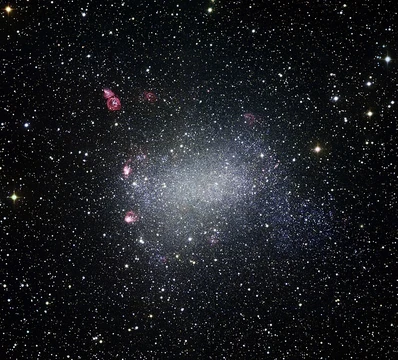
NGC 1266
First intermediate-mass galaxy with AGN-driven star formation suppression.

NGC 1266 is a lenticular galaxy located in the constellation Eridanus. It is not currently undergoing a starburst, but it experienced an intense period of star formation that ended roughly 500 million years ago. The galaxy also hosts an obscured active galactic nucleus (AGN).
A massive molecular outflow, containing about 2.4 × 10⁷ solar masses of hydrogen, streams from the galaxy’s nucleus at a rate of 110 solar masses per year. However, less than 2% of this gas—around 2 solar masses per year—actually escapes the galaxy. The outflow is likely driven by momentum coupling to the AGN’s jet.
The current star-formation rate is about 0.87 solar masses per year, which is 50 to 150 times lower than expected for a galaxy with its properties. The leading explanation is that the AGN-driven outflow injects turbulence into the nuclear region, preventing gravitational collapse of molecular clouds. NGC 1266 is the first intermediate-mass galaxy known to show star formation suppression driven by an AGN.
Two competing hypotheses account for the galaxy’s nuclear activity and excess far-infrared emission: either a heavily obscured ultracompact starburst exists in the nucleus, or a powerful buried AGN is present beyond what other observations suggest. Both scenarios have difficulties. The central black hole is likely growing in line with the M–sigma relation, and the outflow will eventually remove most of the gas from the nucleus.
Quick Facts
- Epoch
- J2000
- Ra
- 03 · 16 · 00.7
- Dec
- -02 · 25 · 38
- Dist Ly
- 29.9 Mpc
- Z
- 0.007238 ± 0.000017
- Half Light Radius Arcminsec
- 20.4"
- Half Light Radius Pc
- 2.96 kpc
- H Radial V
- 2170 ± 5 km s / −1
- Constellation Name
- Eridanus
- Notes
- AGN, molecular outflow, suppressed SFR
- Names
- PGC 12131
Facts from the source article.
Lore & Background
NGC 1266 has undergone a period of intense star formation that ceased approximately 500 million years ago, though it is not currently starbursting. The galaxy hosts an obscured active galactic nucleus, from which a massive molecular outflow of 2.4 × 10⁷ solar masses of hydrogen is present, moving at a rate of 110 solar masses per year. Less than 2% of this gas—about 2 solar masses per year—is escaping the galaxy, with momentum coupling to the AGN's jet likely driving the outflow.
The current observed star-formation rate of roughly 0.87 solar masses per year is significantly lower than expected for a galaxy of its properties, suppressed by a factor of 50 to 150. The most likely explanation is that the AGN-driven molecular outflow injects turbulence into the nuclear regions, preventing gravitational collapse of molecular clouds. Two hypotheses exist to explain the galaxy's nuclear activity and excessive far-infrared emission: either a heavily obscured ultracompact starburst is present in the nuclear regions, or a powerful buried AGN exists beyond what has been inferred from other observations. Neither scenario is without problems.
Reader's Guide
NGC 1266 holds significance as the first known intermediate-mass galaxy to show AGN-driven suppression of star formation, demonstrating that feedback from an active galactic nucleus can quench star formation in galaxies of modest mass. The massive molecular outflow, carrying 2.4 × 10⁷ solar masses of hydrogen at a rate of 110 solar masses per year, is driven by momentum coupling to the AGN's jet, yet less than 2% of this gas escapes the galaxy. This suggests that most of the outflowing material remains bound, primarily injecting turbulence into the nuclear regions rather than being expelled. The current star-formation rate of about 0.87 solar masses per year is suppressed by a factor of 50 to 150 relative to expectations, a dramatic reduction attributed to the outflow's disruptive effect on molecular cloud collapse. The galaxy's obscured AGN and excessive far-infrared emission remain debated, with two competing hypotheses—an ultracompact starburst or a more powerful buried AGN—neither fully satisfactory. The central black hole is likely growing in accordance with the M–sigma relation, and the outflow is expected to eventually remove most of the gas from the nucleus, marking a key stage in the galaxy's evolution.
Did You Know?
- Its molecular outflow contains 2.4 × 10⁷ solar masses of hydrogen, but less than 2% of the gas escapes the galaxy.
- The current star-formation rate is suppressed by a factor of 50 to 150 compared to expectations.
- Two competing hypotheses explain its nuclear activity: an ultracompact starburst or a powerful buried AGN.
More in NGC Objects, Part 2 1-24
Spotted an error? Know more?
Reader corrections go straight into our review queue. Suggest an edit · How this site is sourced