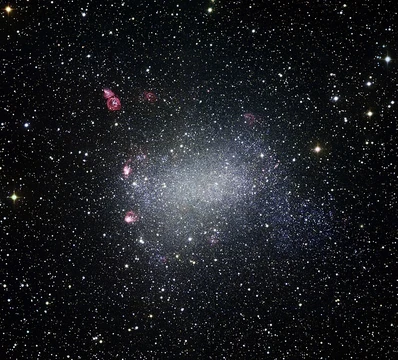
NGC 1253
A barred spiral galaxy with Whirlpool-like arms interacting with a companion.

NGC 1253 is a barred spiral galaxy located in the constellation Eridanus, approximately 70 million light years from Earth. It is notable for its two spiral arms, which resemble those of the Whirlpool Galaxy, and for its interaction with the companion galaxy NGC 1253A.
Quick Facts
- Epoch
- J2000
- Ra
- 03 · 14 · 09.1
- Dec
- -02 · 49 · 23
- Dist Ly
- 69 ± 15.8 Mly (21.2 ± 4.85 Mpc)
- Z
- 0.005713 ± 0.000002
- H Radial V
- 1,713 ± 1 km/s
- Appmag V
- 11.7
- Constellation Name
- Eridanus
- Notes
- Interacting galaxy
- Names
- UGCA 62, Arp 279, MCG -01-09-018, IRAS 03116-0300, PGC 12041
Facts from the source article.
Lore & Background
NGC 1253 was discovered by William Herschel on September 20, 1784. It is classified as a barred spiral galaxy, but its spiral arms are similar to those of the Whirlpool Galaxy. The galaxy has two spiral arms, likely shaped by interaction with its satellite galaxy NGC 1253A. The spiral arms terminate in a ring of hydrogen gas, while the inner region of the galaxy appears hydrogen-poor. The velocity pattern indicates that this ring lies at the outer Lindblad resonance. The highest hydrogen density is found in the northwest part of the ring, and the largest HII regions of the galaxy lie along that ring. At the center of NGC 1253 is a supermassive black hole with an estimated mass of 106.99 ± 0.53 (3–33 million solar masses).
Reader's Guide
NGC 1253 forms an interacting pair with NGC 1253A, a Magellanic spiral galaxy located 3.7 arcminutes away, corresponding to a projected separation of 25 kiloparsecs. The two galaxies share a common hydrogen envelope, which has an extension on its eastern side to the north that may be a tidal tail. This interaction is likely responsible for the galaxy's two prominent spiral arms and the ring of hydrogen gas at their ends. The ring's location at the outer Lindblad resonance and the concentration of HII regions along it indicate ongoing star formation driven by the interaction. Both galaxies belong to the same galaxy cloud as Messier 77 and its group. The presence of a supermassive black hole at the center, with a mass in the range of 3 to 33 million solar masses, adds to the galaxy's significance as a subject for studying galactic dynamics and black hole demographics.
Did You Know?
- NGC 1253 has two spiral arms similar to those of the Whirlpool Galaxy.
- The galaxy's spiral arms end in a ring of hydrogen gas, with the highest density in the northwest part.
- NGC 1253 shares a common hydrogen envelope with its companion NGC 1253A.
More in NGC Objects, Part 2 1-24
Spotted an error? Know more?
Reader corrections go straight into our review queue. Suggest an edit · How this site is sourced