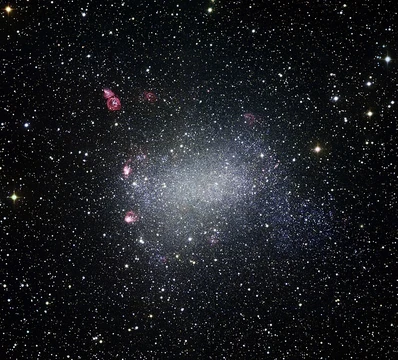
NGC 1218
Lenticular galaxy in Cetus hosting radio source 3C 78.

NGC 1218 is a lenticular galaxy in the constellation Cetus, notable as the host of the radio source 3C 78. Discovered in 1886 by American astronomer Lewis A. Swift, it is a radio galaxy with a synchrotron jet and a radio halo comparable in size to its optical extent.
Quick Facts
- Epoch
- J2000.0
- Constellation Name
- Cetus
- Ra
- 03 · 08 · 26.2
- Dec
- +04 · 06 · 39.3
- Z
- 0.0288
- Dist Ly
- 116.08 Mpc
- Group Cluster
- [CHM 2007] LDC 223
- Appmag V
- 8.460
- Appmag B
- 12.84
- Absmag V
- -2.70
Facts from the source article.
Lore & Background
NGC 1218 was discovered by Lewis Swift on September 6, 1886, and was included in the original New General Catalogue. The radio source 3C 78 was later identified and cataloged in the Third Cambridge Catalogue of Radio Sources. In 1982, a radio jet was detected from the galaxy's nucleus, and a 1986 study confirmed the jet and found evidence of a possible weak counter-jet. The Hubble Space Telescope observed NGC 1218 on August 17, 1994, revealing an optical synchrotron jet similar to that of Messier 87. A type Ia supernova was detected in the galaxy on September 6, 2000, and a 2002 study attributed it to the radio jet. In 2023, the proper motion of 3C 78 was measured using Very Large Array and Atacama Large Millimeter/submillimeter Array observations.
Reader's Guide
NGC 1218 is significant as a lenticular radio galaxy whose optical and radio jets have been studied across multiple wavelengths. The detection of a synchrotron jet by the Hubble Space Telescope in 1994 provided a direct optical counterpart to the radio jet, analogous to the well-known jet in Messier 87. The radio source 3C 78 exhibits complex structure, including a jet with three bright knots, one of which showed apparent superluminal motion. Discrepancies in the measured rotation measure and intrinsic position angle of 3C 78 between studies (Tabara and Inoue 1980 vs. Simard-Normandin, Kronberg, and Button 1981) highlight ongoing uncertainties in its magnetic field properties. The 2023 proper motion measurement using VLA and ALMA data adds to the understanding of jet dynamics. The supernova of 2000, linked to the jet, underscores the role of active galactic nuclei in stellar explosions.
Did You Know?
- NGC 1218 hosts the radio source 3C 78.
- An optical synchrotron jet was discovered in NGC 1218 by the Hubble Space Telescope in 1994.
- A type Ia supernova detected in 2000 was attributed to the radio jet.
- The radio jet of 3C 78 has three bright knots, with the second and third being the most prominent.
More in NGC Objects, Part 2 1-24
Spotted an error? Know more?
Reader corrections go straight into our review queue. Suggest an edit · How this site is sourced