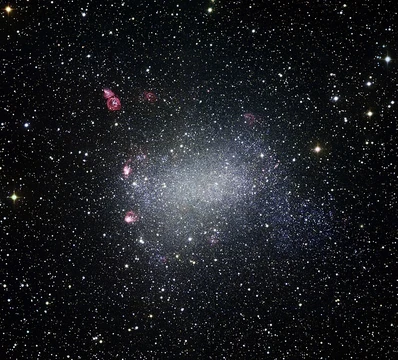
NGC 1217
A spiral galaxy with an active nucleus in Fornax.

NGC 1217 is a spiral galaxy situated in the constellation Fornax. It was first observed by British astronomer John Herschel on 23 October 1835. The galaxy contains an active galactic nucleus, meaning its central region emits substantial energy across the electromagnetic spectrum in a way that cannot be attributed to stars. It is classified as both a Seyfert II galaxy and a LINER galaxy. Seyfert II galaxies have bright, quasar-like nuclei with strong, highly ionized emission lines, while the host galaxy remains clearly visible. LINER galaxies, in contrast, show emission spectra dominated by broad lines from weakly ionized atoms. The galaxy's velocity relative to the cosmic microwave background corresponds to a Hubble distance of about 92.66 ± 6.49 Mpc, though one non-redshift measurement gives a closer distance estimate of 61.300 Mpc. One supernova has been observed in NGC 1217: SN 2025ygq, a Type Ia event with a magnitude of 18.483, discovered by ATLAS on 22 September 2025.
Quick Facts
- Epoch
- J2000
- Constellation Name
- Fornax
- Ra
- 03 · 06 · 06.0421ned
- Dec
- -39 · 02 · 10.833ned
- Z
- 0.021358 · 0.0000400ned
- Dist Ly
- 61.300 Mpcned
- Appmag V
- 13.64ned
Facts from the source article.
Lore & Background
NGC 1217 was discovered by British astronomer John Herschel on 23 October 1835. Its velocity relative to the cosmic microwave background yields a Hubble distance of 92.66 ± 6.49 Mpc, though a non-redshift measurement suggests a much closer distance of 61.300 Mpc. The galaxy possesses an active galactic nucleus, a compact central region emitting substantial energy across the electromagnetic spectrum, with characteristics indicating the luminosity does not originate from stars. It is classified as a Seyfert II galaxy, featuring a quasar-like nucleus with very high surface brightness and strong, high-ionisation emission lines, while the host galaxy remains clearly detectable. Additionally, NGC 1217 is a LINER galaxy, meaning its nucleus displays an emission spectrum with broad lines of weakly ionized atoms. One supernova, SN 2025ygq, a Type Ia event with magnitude 18.483, was discovered by ATLAS on 22 September 2025.
Reader's Guide
NGC 1217 holds significance as a galaxy that exhibits multiple active nucleus classifications—Seyfert II and LINER—indicating a transitional or complex nuclear environment. Its dual distance estimates, one from Hubble flow and another from a non-redshift method, introduce uncertainty about its true distance, which affects understanding of its physical properties. The detection of a Type Ia supernova in 2025 adds to its observational record, providing a potential standard candle for distance calibration. The galaxy's active galactic nucleus and high-ionisation emission lines make it a valuable target for studying the interplay between supermassive black holes and their host galaxies. Its discovery by John Herschel in the 19th century places it within the historical catalog of deep-sky objects, while modern observations continue to refine its characteristics. The coexistence of Seyfert and LINER features suggests a nucleus that may be powered by both accretion and low-ionization processes, offering insights into the diversity of galactic nuclei. The supernova event further enriches its legacy as a site of transient astrophysical phenomena.
Did You Know?
- NGC 1217 is a spiral galaxy in the constellation Fornax.
- It was discovered by John Herschel on 23 October 1835.
- One supernova, SN 2025ygq (Type Ia, mag. 18.483), was observed in NGC 1217.
- The galaxy is both a Seyfert II and a LINER galaxy.
More in NGC Objects, Part 2 1-24
Spotted an error? Know more?
Reader corrections go straight into our review queue. Suggest an edit · How this site is sourced