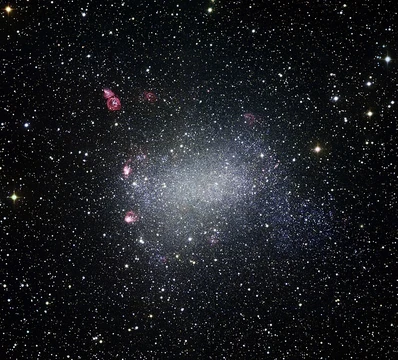
NGC 1167
A massive lenticular galaxy with a giant HI disk.

NGC 1167 is a lenticular, nonbarred galaxy of the late type, situated in the constellation Perseus. William Herschel first observed and recorded it in 1784. The galaxy is exceptionally large, featuring a vast neutral hydrogen (HI) disk with a diameter of 160 kiloparsecs—more than five times the Milky Way’s roughly 30.6 kpc span. Astronomers believe NGC 1167 is still growing its disk by pulling in gas from smaller neighboring galaxies through recent mergers. Although it holds a substantial amount of gas, that material is spread over such a wide area that its surface density is low, below 2 solar masses per parsec.
The galaxy contains thin, smooth ring-like arcs where new stars are forming. These arcs are unusually uniform, lacking the typical irregularities seen in star-forming regions of other galaxies. Researchers suspect this smoothness may result from an absence of massive O-type stars in those arcs. The exact reason for this phenomenon remains unclear.
In 2022, a study reported a radio jet, designated B2 0258+35, emanating from NGC 1167. Based on the X-ray emission from the jet and its resemblance to the extended emission of an active galactic nucleus, scientists concluded that the galaxy is currently a LINER (low-ionization nuclear emission-line region) but hosted an active galactic nucleus in the past.
Quick Facts
- Epoch
- J2000
- Ra
- 03 · 01 · 42.3
- Dec
- +35 · 12 · 21
- Dist Ly
- ~241.3 Mly · (74.50 ± 5.22 Mpc)
- Z
- 0.01653 ± 0.00002
- Appmag V
- 12.4
- Appmag B
- 13.4
- Sbrightness
- 14.5 mag/arcmin / 2
- Names
- UGC 2487, MCG +06-07-033, CGCG 524-045, / PGC 11425
- H Radial V
- 4954.97 ± 5.09 km/s
Facts from the source article.
Lore & Background
NGC 1167 is a massive galaxy that contains a giant HI disk with a diameter of 160 kpc, significantly larger than the Milky Way's 30.6 kpc. Astronomers suggest the galaxy is accumulating gas through satellite accretion, incorporating neighboring galaxies via fairly recent mergers, which expands its disk. Although the galaxy contains a significant amount of gas, the matter is distributed over a very large area, resulting in a relatively low surface density of less than 2 M⊙/pc.
The galaxy exhibits ring-like arcs where star formation is occurring. These arcs are uncommonly thin and smooth, lacking the expected irregularities typically observed in star-forming regions of a galaxy's arms. Astronomers suggest this might be due to the absence of O stars within the structure, though the nature of the phenomenon is not yet fully understood.
In a research paper released in 2022, astronomers reported the detection of a radio jet named B2 0258+35 on NGC 1167. Based on the properties of the detected X-ray emission from the jet and its similarity to an extended emission from an active galactic nucleus, researchers concluded the galaxy is presently a LINER but had an AGN in the past.
Reader's Guide
NGC 1167 holds significance as a massive lenticular galaxy with an exceptionally large HI disk, offering insights into galaxy growth through satellite accretion and mergers. Its giant disk, spanning 160 kpc, provides a laboratory for studying how galaxies accumulate gas and expand over time. The galaxy's unusual star-forming arcs—thin, smooth, and lacking typical irregularities—pose an unresolved puzzle about the role of O stars in shaping such structures. The detection of the radio jet B2 0258+35 in 2022 adds to its importance, revealing that NGC 1167 is currently a LINER but once hosted an active galactic nucleus. This dual nature helps astronomers understand the evolutionary transitions between active and quiescent galactic phases. The galaxy's legacy lies in its contribution to the study of low-surface-density gas disks, the mechanics of star formation in unusual environments, and the history of nuclear activity in lenticular galaxies. It is listed alongside other LINER galaxies such as the Sombrero Galaxy, NGC 5195, and Messier 94.
Did You Know?
- NGC 1167 has a giant HI disk with a diameter of 160 kpc, over five times larger than the Milky Way's disk.
- The galaxy's star-forming arcs are unusually thin and smooth, possibly due to a lack of O stars.
- A radio jet named B2 0258+35 was detected on NGC 1167 in a 2022 research paper.
- NGC 1167 is currently classified as a LINER but is believed to have hosted an active galactic nucleus in the past.
More in NGC Objects, Part 2 1-24
Spotted an error? Know more?
Reader corrections go straight into our review queue. Suggest an edit · How this site is sourced