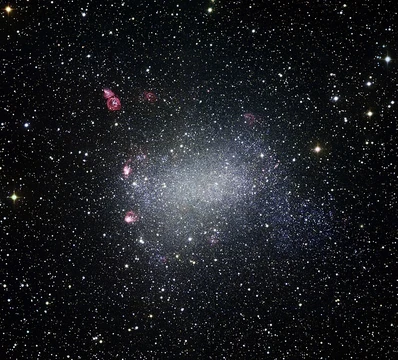
NGC 1060
Brightest member of LGG 72 with a disturbed intergalactic medium.

NGC 1060 is a lenticular galaxy located around 256 million light-years away in the constellation Triangulum. It was first observed by William Herschel on September 12, 1784. This galaxy is the brightest member of the LGG 72 group, which includes roughly 15 galaxies.
The intergalactic medium within this system is highly disturbed. Two distinct X-ray peaks are centered on the two main galaxies of the group—NGC 1060 and NGC 1066—and a hot gas arc about 250 kiloparsecs long connects them. The system appears to be undergoing a merger, which may have triggered nuclear activity in NGC 1060. The galaxy hosts a confirmed active galactic nucleus (AGN). In 2013, a small-scale jet source spanning 20 arcseconds (7.4 kiloparsecs) was detected, indicating a remnant of an old, low-power outburst; radio emission from this jet was also observed.
A supernova, designated SN 2004fd, was discovered in NGC 1060 on October 22, 2004, by Tom Boles using a 0.35-meter Schmidt-Cassegrain telescope as part of the UK Nova/Supernova Patrol. It was a type Ia supernova with a magnitude of 15.70, located very close to the galaxy's nucleus at J2000 coordinates RA 02h 43m 15.20s, Dec +32° 25′ 26.00″.
Quick Facts
- Epoch
- J2000.0
- Constellation Name
- Triangulum
- Ra
- 02 · 43 · 15.05
- Dec
- +32 · 25 · 29.90
- Z
- 0.017312
- H Radial V
- 5190 ± 22 km/s
- Dist Ly
- 256 Mly
- Appmag B
- 13.00
- Appmag V
- 12.00
- Names
- PGC 10302, MCG 5-7-35, UGC 2191
Facts from the source article.
Lore & Background
NGC 1060 was discovered by William Herschel on September 12, 1784. It is a lenticular galaxy and the brightest member of the galaxy group LGG 72, which contains approximately 15 galaxies. The intergalactic medium (IGM) in this system is highly disturbed, with separate X-ray peaks centered on the two main galaxies of the group, NGC 1060 and NGC 1066. A roughly 250 kpc arc of hot gas links these two galaxies, and the system appears to be undergoing a merger, which may have triggered the nuclear activity in NGC 1060. In 2013, a small-scale (20 arcseconds / 7.4 kpc) jet source was detected in NGC 1060, indicating a remnant of an old, low-power outburst; the radio emission arising from this jet was also detected. The galaxy hosts a confirmed active galactic nucleus (AGN).
Reader's Guide
NGC 1060 holds significance as the dominant member of LGG 72, a galaxy group of about 15 members, and as an active galaxy whose nuclear activity may have been triggered by an ongoing merger with NGC 1066. The highly disturbed intergalactic medium, marked by separate X-ray peaks and a 250 kpc arc of hot gas linking the two main galaxies, provides evidence of a dynamic interaction. The detection in 2013 of a small-scale jet source and associated radio emission reveals a remnant of an old, low-power outburst, adding to the understanding of past AGN activity. The supernova SN 2004fd, a type Ia event discovered by Tom Boles in 2004, further highlights the galaxy as a site of stellar explosions. Together, these features make NGC 1060 a key object for studying galaxy group dynamics, merger-induced AGN activity, and the evolution of radio jets in lenticular galaxies.
Did You Know?
- A ~250 kpc arc of hot gas links NGC 1060 and NGC 1066, indicating an ongoing merger.
- In 2013, a small-scale jet source (20 arcseconds / 7.4 kpc) was detected, suggesting a remnant of an old, low-power outburst.
- Supernova SN 2004fd, a type Ia event of magnitude 15.70, was discovered in NGC 1060 on October 22, 2004.
More in NGC Objects, Part 2 1-24
Spotted an error? Know more?
Reader corrections go straight into our review queue. Suggest an edit · How this site is sourced